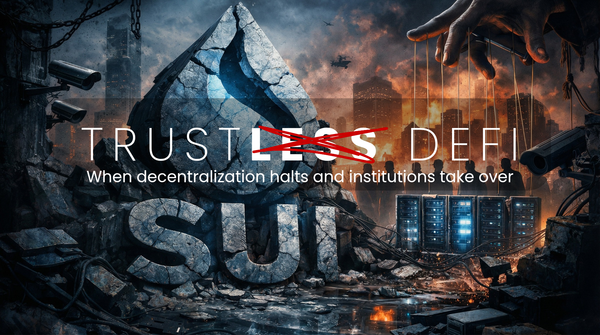
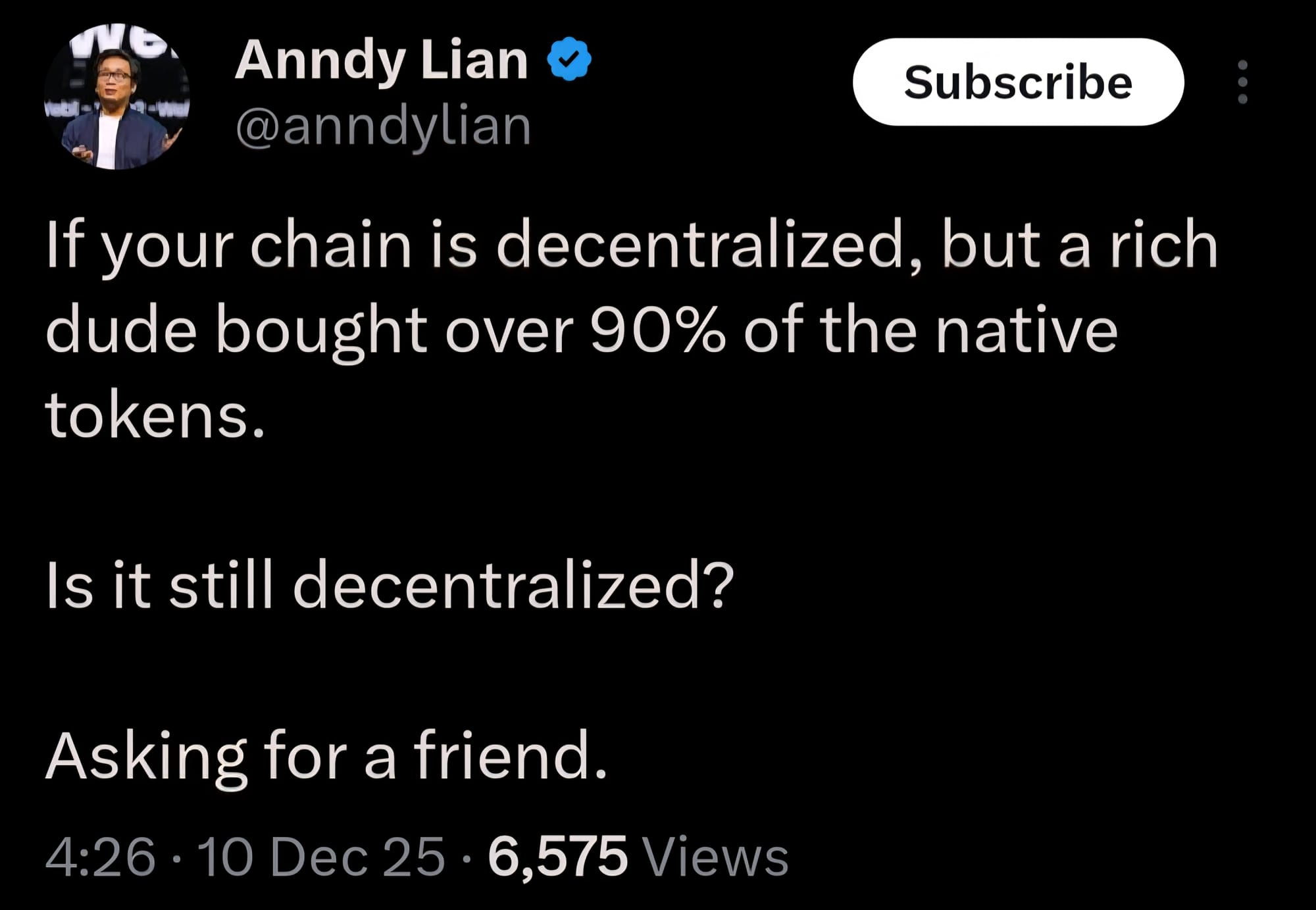
If your chain is decentralized, but a rich dude bought over 90% of the native tokens. Is it still decentralized?
Anndy Lian posted a question on X 👆🏻today. I can only assume it was aimed at PulseChain, so I’ll answer it in my own way.

People get nervous when they see one entity holding a large early supply, but they never stop to ask who they would actually prefer to see holding it. A pack of venture capitalists waiting to extract every drop of value, or the man who built the system in the first place. I know my answer before the question is even finished. And anyone who understands PulseChain already knows why.
With that in mind, let us walk through the question properly.
If a chain is decentralized but one entity holds most of the supply, the real question is not the wallet snapshot but the architecture beneath it and the mind shaping the early phase of the system. Bitcoin showed this clearly. Satoshi did not pre mine and he did not seize anything. He simply mined when no one else was there because nobody cared. As a result he naturally held most of the early supply, yet Bitcoin was still decentralized because control lived in the code, in the consensus rules and in the open invitation for anyone to participate. His holdings protected the network while it was fragile. He never sold. He did not distort the market. The supply acted as a stabilizer while the system was young. People only forget this because they were not present at the beginning.
PulseChain is passing through the same birth stage now. Outsiders look at early concentration and immediately assume risk because they do not understand the pattern. But those who actually watched Richard over the years know exactly what they were seeing. We saw the mind. We saw the discipline. We saw the obsession with sovereignty and the determination to build something that the wrong people could not hijack at the start. And the funniest part is how many people took the bait. Richard was flashing watches like a cartoon villain, twerking on stream, walking out of Louis Vuitton with ten bags looking like the universe’s most expensive clown. And the industry judged him exactly the way he wanted them to. They saw the costume and not the architect. They tripped at the first hurdle and never got back up. It is beautiful. Anyone with depth stayed. Anyone with shallowness failed the test immediately.
That is what the antics were all along. Not ego. Not chaos. A filter. A psychological tripwire that kept VC parasites, opportunists, corporate extractors and self appointed crypto elites miles away from the foundation of this ecosystem. He did not want the early supply in their hands. He wanted them repelled so thoroughly that they would never even look in this direction. And it worked. The people who dismissed him walked away. The people who listened stayed long enough to understand what was actually being built.
And here is the part critics always miss. Holding supply is not the same thing as controlling a network. Look at chains like Sui. Becoming a validator there costs millions. The barrier to entry ensures that only a tiny circle of privileged operators control the ledger. They can coordinate, freeze activity and override users because the architecture is built around a closed validator cartel. That is not decentralization. It is an illusion wrapped in marketing.
PulseChain is the opposite. Becoming a validator costs a few thousand dollars and requires simple equipment. Anyone can do it. There is no corporate barrier. No engineered elitism. This is why PulseChain already has tens of thousands of validators and why it will eventually have hundreds of thousands or even millions. When the entry cost is low, decentralization becomes organic. Anyone can step in. Anyone can verify. Anyone can secure the chain. That is how real decentralization grows.
So yes, some supply is concentrated early, just as it was in Bitcoin, but the network is not. Control is not. Consensus is not. The heartbeat of PulseChain lives in the validator set and the permissionless nature of participation. And anyone who understands this architecture knows that the early supply is not a threat. It is structural. It is protective. It allows the system to grow without being captured by the wrong hands. People close to PulseChain are not worried about dumps because we understand what that supply is ultimately for. It will support the system, not distort it. It will be deployed when the moment is right and for a purpose that insiders can already feel in their bones.
Everyone deep in this ecosystem already understands the unspoken truth. We know that supply will not sit idle forever. We know what it is likely to empower when PulseChain steps fully into real, uncompromised DeFi. And we know why that moment has not yet arrived. Wink wink.
Richard did not build this so that the new world would begin in the same hands that destroyed the old one. He built it so that power flows to the people who participate, who validate and who understand the mission. And when the architecture finally reveals what it has been preparing for all along, the pattern will be obvious even to those who mocked him.
Veritya Thalassa
PulseChain Nexus membership.
$20 monthly or $180 yearly. Includes full access and entry to the Guardians private Telegram.
Join here:
https://www.pulsechain.nexus/#/portal/signup