Liberland: Where Freedom Stops Being an Idea
The most disruptive thing about Liberland is not what it builds, but what it quietly proves. That sovereignty does not begin with permission, and never did.

What actually defines a country in your mind?
Is it land, or is it recognition? Is it a flag, or is it the agreement of other systems that it exists? And if recognition is just a shared belief between governments, then what happens when something begins to function without waiting for that belief to be granted?
At what point does an idea stop being theoretical and start becoming real?
Is it when people arrive? When structures are built? When governance is no longer spoken about, but executed? Or is it when you realise that participation itself is optional, and always has been, but you were never encouraged to see it that way?
And if that is true, then what exactly have you been participating in up until now?
Liberland does not answer these questions directly. It simply exists in a way that makes them harder to ignore. What began as a legal anomaly on the banks of the Danube has moved beyond theory and into something far more tangible, a functioning experiment in sovereignty that is no longer asking for permission to exist.
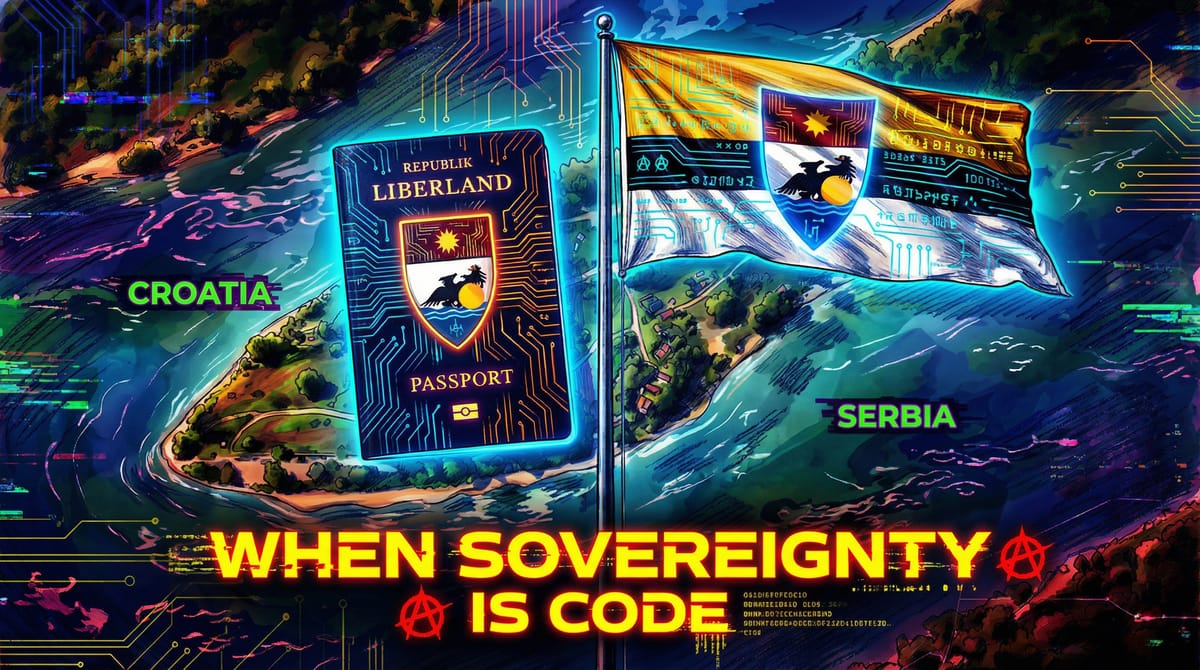
For years it was easy to dismiss Liberland as a curiosity, a fringe idea that captured attention precisely because it seemed improbable. A micronation founded on unclaimed land between Croatia and Serbia, built on voluntary principles, speaking openly about minimal government and individual sovereignty. It sounded like philosophy more than reality. That distinction is now becoming harder to maintain. The developments taking place are not abstract, they are logistical, physical, and increasingly structured in ways that mirror and in some areas challenge the frameworks of established nations.
People are not just talking about Liberland, they are going there. Monthly gatherings are drawing hundreds of participants onto the territory itself, and with each event the infrastructure expands in a way that feels deliberate rather than rushed. There are now treehouses, a beach bar, water sports on the Danube, camping facilities, showers, and spaces that allow people to stay, not just visit. These are not symbolic gestures, they are the early mechanics of habitation. Families are beginning to look at what it means to spend time there, and with the opening of a school at ARC II built on voluntary principles rather than state-imposed curriculum, the concept of settlement is quietly transitioning into something more permanent.
Citizenship, once a digital or philosophical alignment, is also taking on a more grounded form. There is a structured application process, a citizenship package, and a passport that has begun to see limited recognition in certain jurisdictions. That detail alone changes the tone of the conversation. A passport, even in partial recognition, represents an interface with the existing world, a bridge between an emerging system and the legacy structures it exists alongside. It signals intent, but more importantly, it signals continuity.
The governance model itself is where Liberland begins to separate from almost every traditional nation-state. Elections are run quarterly and take place on-chain, designed to be transparent, auditable, and merit-based. Participation is not framed as a default condition of birth, but as something earned through contribution. The introduction of Liberland Merit and the transition of governance onto Ethereum reflects a deliberate move toward systems that reduce reliance on intermediaries. It is not positioned as a technological novelty, but as a structural decision about how trust is handled. Alongside this, the Liberland Dollar remains in use for transactions and exchange access, creating a dual-layer system where governance and economic activity are separated but still interlinked.
What makes the current phase particularly interesting is not just what is being built on the ground, but how Liberland is positioning itself within the wider global context. Its presence at events such as Davos in 2026, alongside attendance at high-level political moments including the inauguration of Donald Trump, places it in conversations that extend beyond the typical boundaries of a micronation. Figures such as Javier Milei aligning themselves with Liberland, even symbolically through citizenship, further reinforces the sense that this is not being treated purely as an experiment on the fringes. It is engaging, however selectively, with the structures it originally set out to exist outside of.
At the same time, there is a €30 million development plan underway, permanent structures are already standing on Liberty Island, and people are living there now. These are not projections or speculative roadmaps, they are developments in motion. Elections for Congress are approaching, with eligibility tied to merit accumulation, and public debates are being hosted openly. The cadence of activity suggests a system that is not waiting for validation before it acts, but instead is building first and allowing recognition to follow where it may.
When you step back from the specifics, what begins to emerge is a different framing of sovereignty. Not as something imposed through geography or history, but as something constructed through participation, contribution, and alignment. Liberland does not remove the complexity of governance, it redistributes it. Responsibility shifts toward the individual, and in doing so it exposes something that many people rarely confront directly, which is the extent to which they rely on the systems they critique.
This is where the connection to crypto becomes unavoidable, not as a superficial comparison, but as a shared trajectory. The movement toward on-chain governance, transparent systems, and voluntary participation mirrors the original intent behind decentralised networks. The idea that code can replace trust, that systems can operate without central points of control, and that individuals can opt in rather than be assigned, sits at the core of both. What Liberland is attempting is to extend those principles beyond finance and into the realm of nationhood itself.
For those already operating within ecosystems like PulseChain, the parallels are clear. The emphasis on immutable systems, the rejection of unnecessary intermediaries, and the focus on long-term structural integrity over short-term perception are not isolated ideas. They are part of a broader shift toward sovereignty at both the individual and collective level. Liberland does not replace these systems, but it reflects them in physical form, creating a bridge between digital sovereignty and territorial presence.
None of this guarantees success in the traditional sense. Recognition from other nations, expansion, and population growth are all variables that will play out over time. What matters more is that the framework now exists in a way that can be observed, interacted with, and, for those willing, participated in. It is no longer a hypothetical.
What sits underneath all of this is a quieter question, one that is less about Liberland itself and more about the individual reading this. Not whether Liberland will succeed, but whether the idea it represents is something you are prepared to engage with beyond observation. Because sovereignty, whether digital or physical, is not something that arrives passively. It requires a shift in how responsibility is perceived and accepted.
Liberland, in its current form, is an invitation. Not a demand, not a promise, but a visible alternative that continues to develop regardless of how many people choose to step toward it. And that alone makes it one of the more interesting movements to watch as the world continues to fragment and reconfigure itself around new models of coordination, value, and control.
v.