OnlyFans, Breastfeeding, and the Collapse of Something Sacred

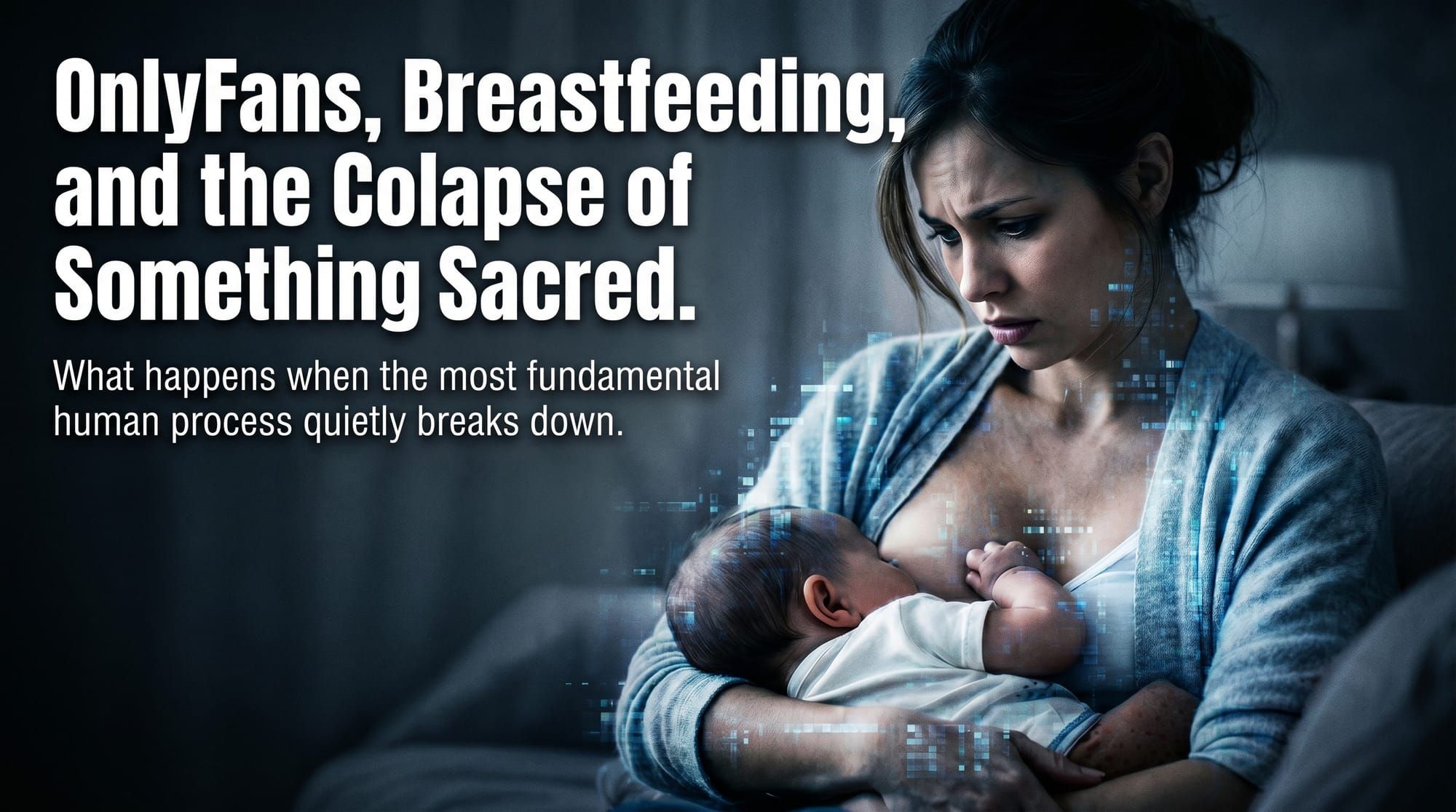
What happens when the most fundamental human process quietly breaks down
You don’t feel it at first.
It’s not obvious. It doesn’t arrive as some loud, dramatic collapse. It shows up quietly, almost invisibly, in the small places where things used to be held together and now aren’t. A slight disconnection here, a missing piece there, something that should have been passed down but wasn’t. And most people carry on, adjusting, adapting, telling themselves everything is fine because it looks fine on the surface.
But is it?
What happens to a civilisation when it loses its roots? When the things that were once instinctive, embodied, and guided by lived experience become uncertain, fragmented, or replaced altogether? Carl Jung called it deracination, a kind of uprooting from what grounds us. Not just culturally, but biologically, emotionally, instinctively. A slow drift away from what we are.
You can see it everywhere if you know where to look. In the way communities have thinned out. In the way knowledge that was once held by elders has disappeared into systems that don’t quite carry the same weight. In the way people are left to figure out the most important parts of life on their own, often in the most vulnerable states they will ever experience.
And nowhere is this more exposed than in the very beginning of life itself.
A woman gives birth and steps into a moment that is as old as humanity. Nothing about it is new. Everything about it is profound. Her body is primed for one thing above all else, to nourish the life she has just brought into the world. Not just with calories, but with connection, hormones, regulation, signalling. The kind of exchange that shapes a human being from the inside out. And yet, somehow, this is where things begin to unravel.
Not because the body fails, but because the environment around it no longer supports what the body is trying to do.
If the latch is not right, and the mother is not guided through this process by someone who understands it, things begin to drift almost immediately. The baby will suck and suck, but very little milk is actually drawn. The breasts don’t receive the signal they need, and supply begins to fall. The baby feeds more, but settles less, falling asleep from exhaustion rather than being full, only to wake again unsettled, still needing more. And the mother finds herself feeding constantly, doing everything she believes she should be doing, yet the struggle only deepens. Because breastfeeding is not passive. It is a feedback loop. It works on demand. If milk is not being properly drawn, the body interprets that as a lack of need and begins to reduce supply.
And while this is happening, the advice starts coming in, shaped by other people’s experiences of it, not always from a place of clarity, but from what they went through themselves and came to accept as the way it is.
“Maybe you are not producing enough.”
This is the most repeated lie, at the exact moment it does the most damage.
"The baby has had the best bit anyway."
This is repeated so often it almost sounds like wisdom. As if there is a defined window where everything important has already been given, and beyond that point it does not really matter.
But it does matter.
It matters more than most people are willing to sit with.
Because what is happening in that moment is not just feeding. It is regulation. It is hormonal exchange. It is skin to skin communication. It is the calibration of a nervous system that will carry through into how that human being experiences the world.
And when that process begins to break down, the consequences are not isolated, they ripple. Eventually, the breaking point arrives. Not as a failure of effort, but as a consequence of exhaustion. She has been trying. Properly trying. Not once, not twice, but over days and weeks, pushing through something that should have felt natural but hasn’t settled into place. The father is exhausted as well. The environment is strained. The pressure does what pressure always does when there is no support to hold it.
A decision is made.
Formula is introduced.
And something shifts immediately.
The baby feeds and settles in a way it hasn’t before. The crying stops. The house becomes quiet. There is relief, real relief, and for a moment it feels like the problem has been solved. But beneath that relief, something lands that very few people speak about honestly. After everything she has just put her body through, after every attempt to make this work, the thing that resolves it comes from outside of her. Not from her body, not from the connection she was trying to establish, but from something external. It registers as a quiet, internal conclusion that her body did not do what it was meant to do, that she was not enough in that moment, and at a deep human, biological level, that feeling is not abstract but something that takes root and begins to alter the landscape of her being.
You can rationalise it. You can say it does not matter. You can point to all the modern explanations that make it easier to move on from. But at a human level, that feeling exists. And once it exists, it changes things. It changes how she sees herself. It changes how she responds the next time something is difficult. It changes the subtle dynamics between her, the baby, and the father. Feeding is no longer solely hers. The bond adjusts.
And because this is how human systems work, the next time another mother struggles, the same advice is passed on. The baby has had the best bit. Maybe you are not producing enough. Just give a bottle, becomes the path of least resistance. And the original problem, the latch, the lack of support, the absence of guidance, remains unaddressed. This is where the deeper fracture sits. There are no elders in the room anymore. No consistent, experienced presence watching closely, adjusting the latch, correcting the angle, noticing the subtle cues that make all the difference. Families are scattered. Communities are thin. The most important interaction between mother and child is left to chance, often in the most exhausted state a person can be in.
So when it fails, it is attributed to the body.
Not the system around it.
Not the missing support.
Not the quiet erosion of the old knowing that once made this instinctive.
And this is where the conversation needs to widen, this is not just about one mother or one baby. This is about trajectory. When something as fundamental as early nurturing is disrupted at scale, the effects do not stay contained. They show up later in life. In behaviour, in attachment, in what people seek out. In how they regulate themselves and in how relate to others. When you place that understanding next to what dominates attention today, the contrast becomes difficult to ignore.
Because at the same time that this foundational process is quietly breaking down, the surface expression of it is being amplified everywhere. Bodies, stripped of their original context, presented for consumption, for transaction, for attention. The same biology, but removed from its role in nurturing and placed into a completely different framework.
The same biology.
Two completely different meanings.
And if that trajectory continues unchecked, it does not simply stop here. It moves further away from the body, further away from biology, further away from the need for human processes altogether. Conversations around artificial alternatives, synthetic environments, detaching reproduction from the body itself, they are no longer fringe. They are being explored, developed, normalised.
It is not about whether that future fully arrives. It is about recognising the direction. And more importantly, recognising that there is always a counter movement. Humanity does not just drift endlessly in one direction. There is always a point where people begin to feel the disconnection and start looking back toward what was lost. A re grounding. A return to what actually matters.
Which is where responsibility comes in. Because seeing the pattern is one thing. Doing something about it is another. So rather than just pointing at what’s been lost, the response is to rebuild it, deliberately, in a form that actually works in the world as it is now.
Support.
Real, consistent, informed support in the exact window where it makes the difference between something working and something unravelling. A structure where experienced mothers are available in real time to guide others through it, and where that support is recognised and rewarded properly.
This is where Fed By Love fits in.
Because at the centre of all of this, there is a simple truth that does not change.
The beginning matters.
More than most people realise.
And if that beginning is not held properly, everything that comes after carries the imprint of that loss.
Veritya Thalassa
 FedByLove
Research Notes
This article touches on an area where biology, psychology, and culture overlap. Not everything is cleanly proven, but there are strong lines of evidence pointing in a consistent direction. The notes below separate what is well supported from what is emerging or interpretive.
What is well supported
Early feeding and skin to skin contact are part of a regulatory system, not just a nutritional one. Breastfeeding involves hormonal signalling, particularly oxytocin, which supports bonding, stress reduction, and co regulation between mother and infant.
Breastfeeding works on a demand feedback loop. When milk is not effectively drawn, supply reduces. This is a biological response, not a failure of the body.
Skin to skin contact and early breastfeeding are associated with improved physiological stability in infants, including temperature regulation, heart rate stability, and reduced stress markers.
Maternal wellbeing is also affected. Breastfeeding and close physical contact are linked to lower stress levels and can support maternal bonding and emotional regulation during the postpartum period.
What is strongly suggested
Breastfeeding and early bonding are associated with more secure attachment patterns, although this is influenced by many factors including maternal sensitivity, mental health, and environment.
Some long term studies suggest links between early feeding and behavioural outcomes, including lower rates of aggression, attention issues, and social difficulties. These findings are mixed, but the trend appears repeatedly across different cohorts.
Disruptions in early bonding, whether through feeding difficulties or lack of support, can affect maternal confidence, identity, and emotional state, which in turn influences the mother child relationship.
Animal studies show that early maternal deprivation or disrupted nurturing can alter stress responses, social behaviour, and later caregiving patterns. These effects can persist and, in some cases, carry across generations.
What remains open but important to consider
Early nurturing is not just a physical process. It is part of how a human being learns regulation, safety, and connection. When that process is disrupted, it may contribute to later patterns in attachment, intimacy, and emotional regulation.
There is growing interest in how early undernurturing may relate to later behaviour, including reward seeking, emotional detachment, and difficulties with connection. These links are not proven in a direct causal way, but they are consistent with broader attachment theory and developmental psychology.
The concept often described as the “mother wound” reflects this idea that early disruption in maternal bonding can leave long term imprints on how individuals relate to themselves and others.
The key takeaway
The beginning is not just a phase. It is a foundation.
When early nurturing, bonding, and regulation are supported, they stabilise the system from the start. When they are disrupted, the effects do not stay contained. They move outward, shaping patterns that can carry through the individual, the family, and, over time, the culture itself.


Discussion