Who Gave Them The Right To Stand At The Gate?
The official story is simple enough to travel quickly. A 17 year old British researcher exposes a Russian crypto laundering network. Moscow retaliates by placing him on a sanctions or stop list. Western media frames it as the schoolboy who embarrassed the Kremlin.

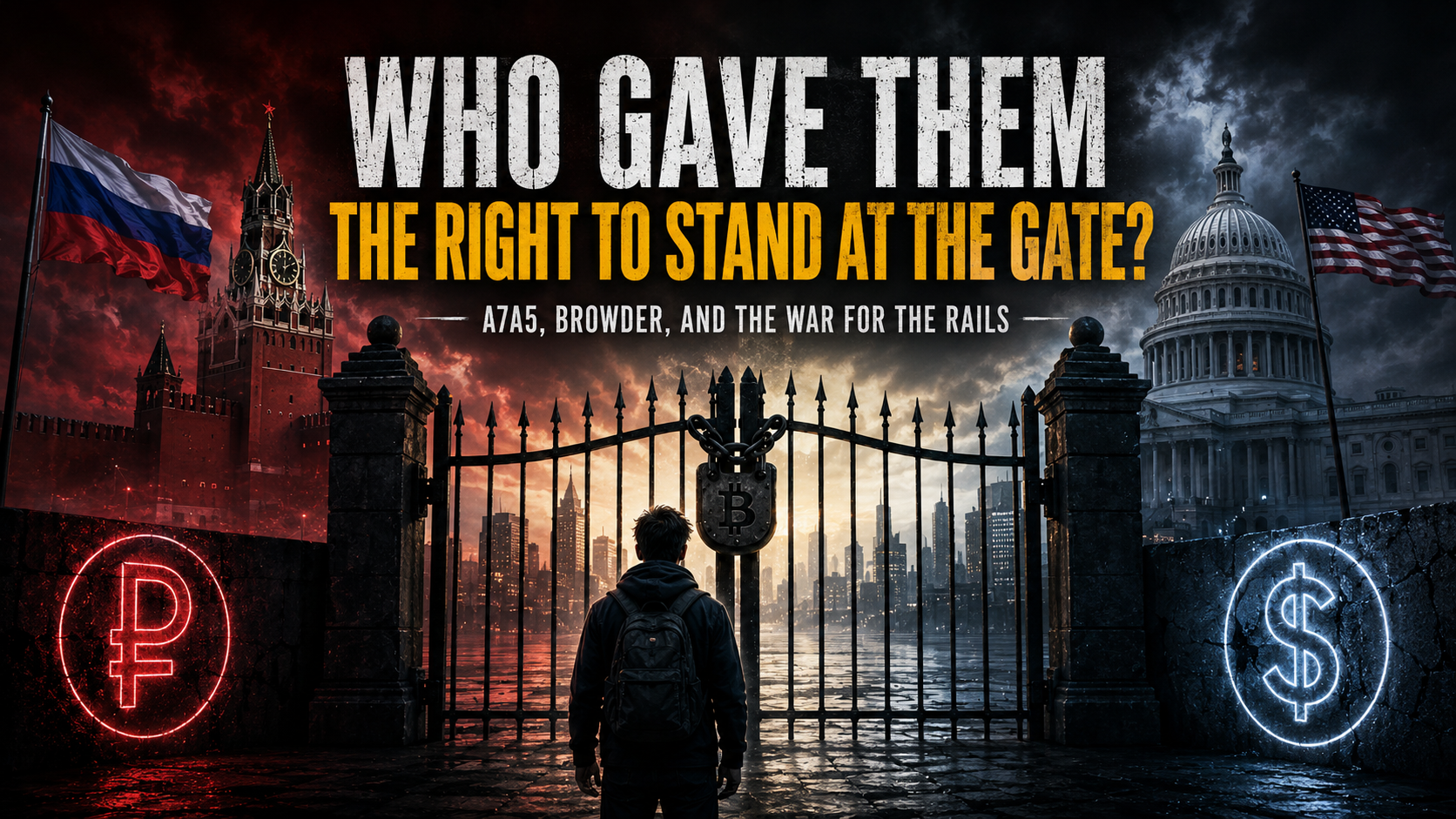
The official story is simple enough to travel quickly. A 17 year old British researcher exposes a Russian crypto laundering network. Moscow retaliates by placing him on a sanctions or stop list. Western media frames it as the schoolboy who embarrassed the Kremlin. The reader is handed a clean moral structure before the deeper machinery has even been examined. Brave researcher. Corrupt Russia. Dangerous crypto. Necessary enforcement. It is neat, emotionally satisfying, and perfectly suited to the modern information environment, where the first version of a story often becomes the only version most people ever absorb.
But A7A5 is not simply a Russian stablecoin story. It is a fracture line running through the modern financial order. The token is the visible object, but the object is not the system. The real system is the relationship between sanctioned banks, friendly jurisdictions, exchanges, stablecoin liquidity, payment processors, blockchain intelligence firms, regulators, state power and narrative control. What has been presented as a narrow case of Russian evasion is actually a glimpse into the next phase of monetary warfare, where public blockchains become the contested terrain between states trying to escape financial pressure and states trying to preserve the power to apply it.
The question is not whether Russia is using crypto to bypass sanctions. It almost certainly is. The better question is why the West gets to call its own financial coercion law, while calling every escape route from that coercion crime. That is where the bias sits. Not necessarily in the raw facts, because many of those facts may be true, but in the framing that surrounds them. The mainstream story begins from the assumption that the Western dominated financial order is legitimate by default. It treats dollar clearing, euro access, correspondent banking, SWIFT connectivity, exchange compliance and sanctions enforcement as the natural structure of the world. Money that moves through approved channels is lawful. Money that moves around those channels is suspicious. The gatekeeper retains moral authority simply because it already owns the gate.
A7A5 appears to be a ruble aligned settlement rail built around that reality. The allegation is that rubles enter the structure, a ruble pegged digital instrument moves across public chains, and holders then attempt to convert that value into other crypto assets, other stablecoins or fiat through exchanges and liquidity providers. The technical design can be analysed in detail, but the political principle is obvious enough. A sanctioned financial system is attempting to reconnect to global liquidity through crypto. It is not decentralisation in the true sense. It is not trustless finance. It is not peer to peer freedom. It is state aligned financial routing through blockchain rails.
That distinction should not be softened. A7A5 does not appear to represent crypto as liberation. It appears to represent crypto as a bypass. But the existence of the bypass reveals something the official story avoids. Russia did not wake up one morning and decide to build alternative settlement routes in a vacuum. It is responding to a world where the banking system has already been turned into a geopolitical weapon. Banks can be cut off. Reserves can be frozen. Payment systems can be blocked. Correspondent relationships can be severed. Dollar and euro access can be restricted. Entire nations can be pushed toward financial isolation through institutions that still present themselves as neutral, rules based and global.
When the West does that, it is called sanctions. When the target builds around it, it is called evasion. That is the asymmetry. It does not make Russia innocent, and it does not make every Russian financial route legitimate. It simply exposes the language game. Their control is corruption. Our control is compliance. Their censorship is authoritarian. Our censorship is safety. Their financial weapon is criminal. Our financial weapon is national security. Their propaganda is manipulation. Our propaganda is public interest journalism. The public is trained to accept one set of actions as moral because they come wrapped in institutional language, while the same underlying mechanics are condemned when used by an adversary.
This is why the Browder story is so useful to the Western frame. Alexander Browder may have done serious work. The research may be important. The links around A7A5 may be relevant. But the way the story is packaged is not neutral. He is presented as a young researcher standing against the Kremlin, a digital native exposing hidden money flows, and the son of Bill Browder, the man most closely associated with the Magnitsky sanctions movement. That personal history gives the story emotional force. The father helped build a sanctions architecture that turned corruption and human rights abuses into international financial penalties. The son is now mapping crypto rails allegedly used to bypass that same sanctions architecture. For Moscow, that will not look like random teenage curiosity. It will look like the next generation of the same conflict.
Russia’s response is therefore symbolic as much as practical. A state does not need to place a British teenager on a stop list because of a school project. It does so because the act of mapping hidden financial routes now carries political weight. Russia is telling researchers, journalists, compliance analysts and blockchain investigators that open source financial intelligence is not neutral if it interferes with the financial survival of the state. In Moscow’s eyes, the map itself becomes hostile. But the West is also saying something through this moment. It is saying that independent blockchain intelligence can be absorbed into the sanctions machine, used as evidence, amplified through think tanks, passed through parliamentary channels, converted into enforcement pressure and used to justify deeper control over crypto gateways.
That is the part most of the public will never be encouraged to see. Blockchain analysis is no longer just research. Once it enters the machinery of sanctions, it becomes targeting infrastructure. Wallets are mapped. Flows are labelled. Exchanges are pressured. Entities are designated. Stablecoin issuers are pushed to freeze. Regulators demand compliance. Governments claim security. The map becomes a weapon, and every major power wants to either own it, suppress it or use it.
The off ramp is where this entire battle becomes visible. The West cannot stop every public blockchain from existing. It cannot prevent every token from being deployed. It cannot freeze every wallet on every chain without destroying the parts of the crypto economy it now wants to regulate, tax, institutionalise and absorb. So the fight moves to chokepoints. Exchanges. Stablecoin issuers. Hosted wallets. Brokers. OTC desks. Bridges. Payment processors. Compliance software. App stores. Front ends. Banking partners. Jurisdictions that want access to Western capital markets. A token like A7A5 only becomes geopolitically powerful if it can touch broader liquidity. If it can be swapped into USDT, Bitcoin, Ether, dollars, euros or regional fiat corridors, then it becomes a functioning escape route. If those doors close, it becomes trapped inside its own political enclosure.
This is how crypto gets captured without banning the chain. Control the doors, and the chain can remain public while the economy around it becomes permissioned. A user may hold assets in a private wallet, but the moment that value needs to become useful in the wider world, the gate returns. The wallet can move. The token can transfer. The block can settle. But the exchange, issuer, bridge, front end or banking partner can still decide whether the value is allowed to connect to the rest of the economy. That is why stories like A7A5 are so valuable to governments. A real abuse of crypto becomes the justification for expanding control over all crypto.
The public will be told this is about Russia. In one sense, it is. But the infrastructure built in response will not only apply to Russia. More wallet screening, more exchange surveillance, more blacklist infrastructure, more stablecoin freezing, more compliance automation, more jurisdictional pressure and more approved gateway models will affect the entire digital asset space. The state does not build a control system for one enemy and then forget it exists. Once the machinery is built, it seeks more uses.
Stablecoins sit at the centre of this new terrain. Most people still think of stablecoins as trading tools, but they are becoming instruments of statecraft. Dollar stablecoins already extend dollar power into the crypto economy. They export synthetic dollars around the world, create demand for dollar denominated assets, and give users in unstable economies access to something more liquid than their local currency. They also give issuers and regulators the ability to freeze, blacklist and monitor activity at scale. A7A5 appears to be a different version of the same deeper principle. Not a projection of Western dollar power, but a route around it. A ruble aligned instrument reportedly tied to sanctioned Russian financial structures, issued through a friendly jurisdiction and used to reconnect restricted value to global crypto liquidity.
The West does not object only because A7A5 may be used for illicit finance. It objects because A7A5 reveals that stablecoin architecture can be used by any sufficiently motivated power with banking support, jurisdictional shelter and exchange access. The West wants compliant stablecoins. Russia wants bypass stablecoins. China will favour state controlled rails. Other powers will experiment with commodity backed settlement assets, regional trade tokens, bank issued digital money and shadow liquidity corridors. The future will not be a simple argument between crypto and central bank digital currencies. It will be a layered financial conflict between regulated stablecoins, state aligned stablecoins, blacklisted stablecoins, politically protected exchanges, surveillance rails, privacy tools and true peer to peer systems trying to remain outside the machinery altogether.
Most of what calls itself crypto will not survive that test ideologically, because most of it already depends on trusted parties. Issuers. Custodians. Banks. Admin keys. Wrapped assets. Bridges. Validators. Foundations. Market makers. Exchanges. Legal wrappers. Front ends. Venture capital. Compliance teams. Political access. The brand says decentralised, but the architecture tells a different story. A7A5 exposes that from one direction. Western stablecoin control exposes it from another. If money depends on permissioned gateways, then the only question is whose permission matters.
That is why the mainstream frame is too small. It wants to show Russia as the manipulator and the West as the enforcer, but the West is not merely enforcing rules. It is defending a financial order it dominates. Russia is not merely breaking rules. It is building routes around a system that has already been weaponised against it. Both things can be true at the same time. Russia may be using A7A5 to bypass sanctions. The West may be using that fact to justify broader control over crypto. Browder may have produced serious research. The research may also be absorbed into state power. The token may be used for illicit finance. The crackdown may still become a template for controlling ordinary users.
This is not a case for defending Russia. It is a case for refusing to be hypnotised by the Western frame. The most dangerous form of propaganda is not always the obvious lie. It is the selective truth arranged in a way that protects the power behind it. A7A5 can be real. The sanctions evasion can be real. The Russian retaliation can be real. The research can be real. And still, the story can be used to train the public into accepting a future where every crypto gateway becomes an enforcement checkpoint.
The deeper war is over settlement. Who clears value. Who freezes value. Who maps value. Who grants access. Who defines crime. Who controls liquidity. Who owns the gateway between digital money and the real world. A7A5 is one answer to that question. Dollar stablecoins are another. CBDCs will be another. True peer to peer crypto is another. Only one of those answers has any real relationship to financial freedom.
Russia did not place Alexander Browder on a sanctions or stop list only because he embarrassed them. It responded to the act of mapping a hidden financial rail. The West did not amplify the story only because it cares about transparency. It amplified the story because the map is useful. Compliance firms do not track these flows only for justice. They track them because the map has value. Exchanges do not comply only because of morality. They comply because access to the old financial system still decides who survives.
Everyone wants the map. Russia wants to protect its routes. The West wants to close them. The compliance industry wants to sell them. The media wants to simplify them. Crypto users need to understand them before the next wave of regulation arrives dressed as protection.
The official version says a brave teenager exposed Russian crypto laundering. The deeper version says a sanctioned state built a digital escape route, a Western researcher mapped it, Western institutions absorbed that map, Russia retaliated, and the whole event became another step in the battle to control crypto’s gateways. The West wants to make Russia look corrupt. Russia wants to make the West look hypocritical. Both are correct enough to be dangerous. Neither side wants the public asking the question that cuts through the performance.
If money needs permission to move, who gave them the right to stand at the gate?
---
Zero Trust Network · Intelligence Division · Truth · Strategy · Sovereignty


Discussion