AI Wallet Service Bankr Halts Network After Key Compromise
Bankr, an AI-powered interface for cryptocurrency trading, has disabled all platform transactions. The action followed an attack where an adversary gained control of at least 14 user wallets, with one user reporting losses of $150,000. Three attacker-controlled addresses have been identified holding

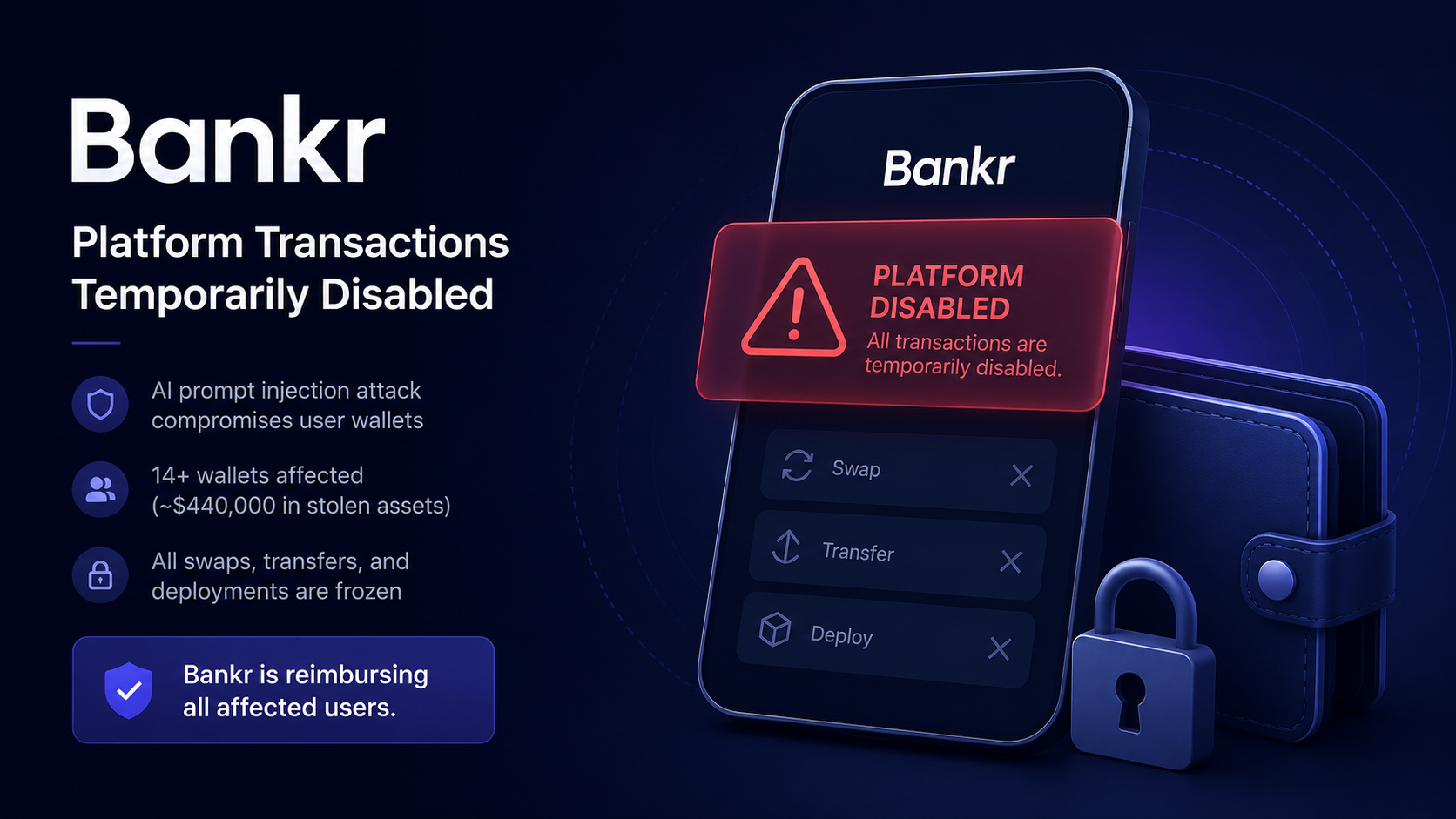
Bankr, an AI-powered interface for cryptocurrency trading, has disabled all platform transactions. The action followed an attack where an adversary gained control of at least 14 user wallets, with one user reporting losses of $150,000. Three attacker-controlled addresses have been identified holding approximately $440,000 in assets. The exploit was not a user device compromise; it was a social engineering attack that manipulated the platform’s automated systems into authorizing malicious transactions. Bankr has frozen all swaps, transfers, and deployments and publicly committed to reimbursing all affected users.
Anatomy
The failure originates in Bankr’s core architecture, designed to abstract the complexities of wallet management. The service automatically generates a new crypto wallet for any user who interacts with its bot via a social media account. This creates a direct link between a social identity and a set of cryptographic keys managed within Bankr’s infrastructure. While marketed as a user-friendly alternative to standard wallets, this model introduces a centralized point of control and failure.
The private keys for these user-assigned wallets are not held exclusively by the end user. They are accessible to Bankr’s backend systems, which interpret natural language prompts from users to execute on-chain actions. This makes the service a de facto custodian or, at a minimum, a co-signer with privileged access. The platform’s ability to unilaterally halt all network transactions confirms its centralized control.
The attack vector was a form of logical manipulation known as prompt injection. The attacker did not need to steal a user’s seed phrase directly. Instead, they reportedly exploited the trust relationship between automated agents. By feeding deceptive prompts to an external AI, believed to be Grok, they induced it to send a command to the Bankr bot. The Bankr bot, interpreting this as a legitimate instruction, then used its signing authority over the targeted user’s wallet to execute the attacker’s transactions. The user was bypassed entirely; the vulnerability existed in the machine-to-machine communication layer built for convenience.
Pattern
This incident follows a recurring pattern of security failures on platforms that add a centralized abstraction layer over decentralized protocols to improve user experience. Services that link social media identities to automatically generated wallets, such as Friend.tech, have previously exposed the risks inherent in centralized key management. The objective is to lower the barrier to entry; the consequence is a trusted third party that becomes a single point of failure.
The exploit also represents a maturing application of AI as an attack surface. Rather than targeting smart contract code or network infrastructure, the attacker targeted the logic of the AI agent entrusted with transaction authority. This parallels prompt injection vulnerabilities in non-financial AI systems, but here the consequences are immediate and irreversible financial losses. A prior, similar incident involving Bankr and Grok, where an attacker tricked the system into launching and then draining a token, indicates this is a persistent, unmitigated vulnerability in the platform’s design.
Functionally, the wallets managed by Bankr operate as server-side hot wallets. Although each wallet is designated for a specific user, the keys are held in an operational environment accessible to the service's core logic. This architecture makes the entire user base susceptible to a single breach of the central system, mirroring the risk model of centralized exchange hacks.
Forward Implication
Bankr’s commitment to fully reimburse lost funds is a necessary customer relations measure, but it also underscores its position as a centralized financial intermediary, not a trustless protocol. The ability to make users whole depends on a central treasury and an admission of liability, concepts foreign to decentralized systems. This action solidifies the platform’s status as a custodial service, irrespective of its marketing.
The attack places the entire category of AI-driven crypto assistants under scrutiny. Their core security model, granting an AI agent signing authority over user funds, has now been proven vulnerable to logical manipulation. Competing and future services in this space will face pressure to demonstrate robust, verifiable defenses against prompt injection and other forms of agent-focused social engineering. The viability of this service model now rests on whether an AI agent can be sufficiently hardened against manipulation when given direct, irreversible control over user assets.
---
Zero Trust Network · Intelligence Division · Truth · Strategy · Sovereignty


Discussion