Analysis: On-Chain Mapping Exposes Iranian Central Bank's USDT Network
The Central Bank of Iran now has a public transaction history. Two of its wallets on the Tron network, holding some $344 million, were not only frozen but also permanently tagged for the world to see. The public doxing came from the analytics firm Arkham Intelligence on May 11, following a US Treasu

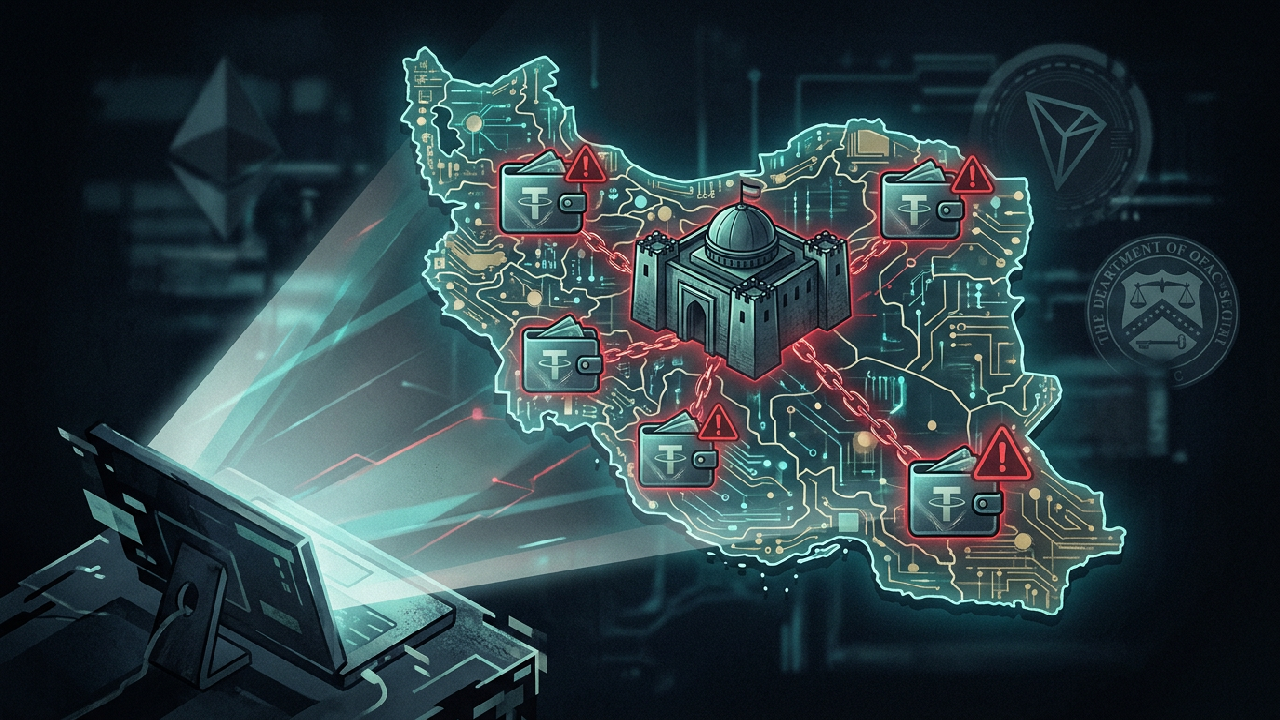
The Central Bank of Iran now has a public transaction history. Two of its wallets on the Tron network, holding some $344 million, were not only frozen but also permanently tagged for the world to see. The public doxing came from the analytics firm Arkham Intelligence on May 11, following a US Treasury designation weeks earlier that linked the addresses to financing for the Islamic Revolutionary Guard Corps and Hezbollah. At the request of US authorities, Tether simply switched the money off.
The failure was not in the network, but in the asset. Iran chose to operate on Tron, a public blockchain that will process a transaction for anyone. But it chose to transact in USDT, a stablecoin issued and controlled by a central company. This is where the plan fell apart. The USDT smart contract contains an administrative kill switch, a function allowing Tether to freeze the balance of any address it chooses. A token that can be frozen by its issuer is just a database entry with better marketing.
Enforcement was a simple sequence. First, the US Treasury’s Office of Foreign Assets Control (OFAC) added the two Tron addresses to its sanctions list. This provided the legal directive. Tether, a company beholden to regulators, received its orders and complied. It invoked its administrative privilege, the transaction was recorded on the Tron ledger, and the funds were immobilized. The final step was surveillance. Arkham Intelligence linked the sanctioned addresses to the name "Central Bank of Iran" on its public dashboard. Raw data became actionable intelligence. The entire transaction graph, every counterparty, was retroactively exposed.
This model is now institutionalized. A collaboration between Tron, Tether, and the analytics firm TRM Labs, called the T3 Financial Crime Unit, provides a formal channel for law enforcement to make these requests. The architecture of control is no longer subtle.
This is simply the largest state-level example of a well-established pattern. It is a bank freeze executed on a blockchain. We saw the same mechanism in 2022 when Circle, issuer of the USDC stablecoin, proactively froze funds in wallets that had touched the Tornado Cash mixer. Tether itself has frozen hundreds of millions in USDT tied to illicit activity, mostly on the Tron network. Using a dollar-pegged stablecoin to evade US sanctions is a special kind of operational error.
A quiet coalition of state agencies, asset issuers, and private surveillance firms now polices these networks. They have built a powerful enforcement framework that operates directly on-chain, replicating the chokepoint function of the traditional banking system they were meant to bypass. For states like Iran, North Korea, and Russia, the playbook of converting revenues to stablecoins and routing them through mixers is now obsolete. The counter-strategy has matured faster.
The public mapping of Iran’s wallets is the real escalation here. The freeze is an inconvenience; the permanent, public exposure of a state’s financial network is a strategic blow. Every exchange, protocol, or individual that ever touched those funds is now flagged, inheriting the risk. The ledger is a permanent record of their association.
This forces an evolution. State actors looking to evade sanctions can no longer treat centralized stablecoins as reliable instruments. The logical pivot is towards assets that lack a central issuer with a kill switch, like Bitcoin or Ethereum. But this is not a solution, it is a trade. They are swapping asset-level censorship for raw market volatility and the persistent problem of on-chain traceability. The game just moves to a different part of the board.
---
Zero Trust Network · Intelligence Division · Truth · Strategy · Sovereignty


Discussion