Another Week, Another “Trustless” Failure: $76M Echo Protocol Exploit Hits Monad
The industry keeps calling this progress.

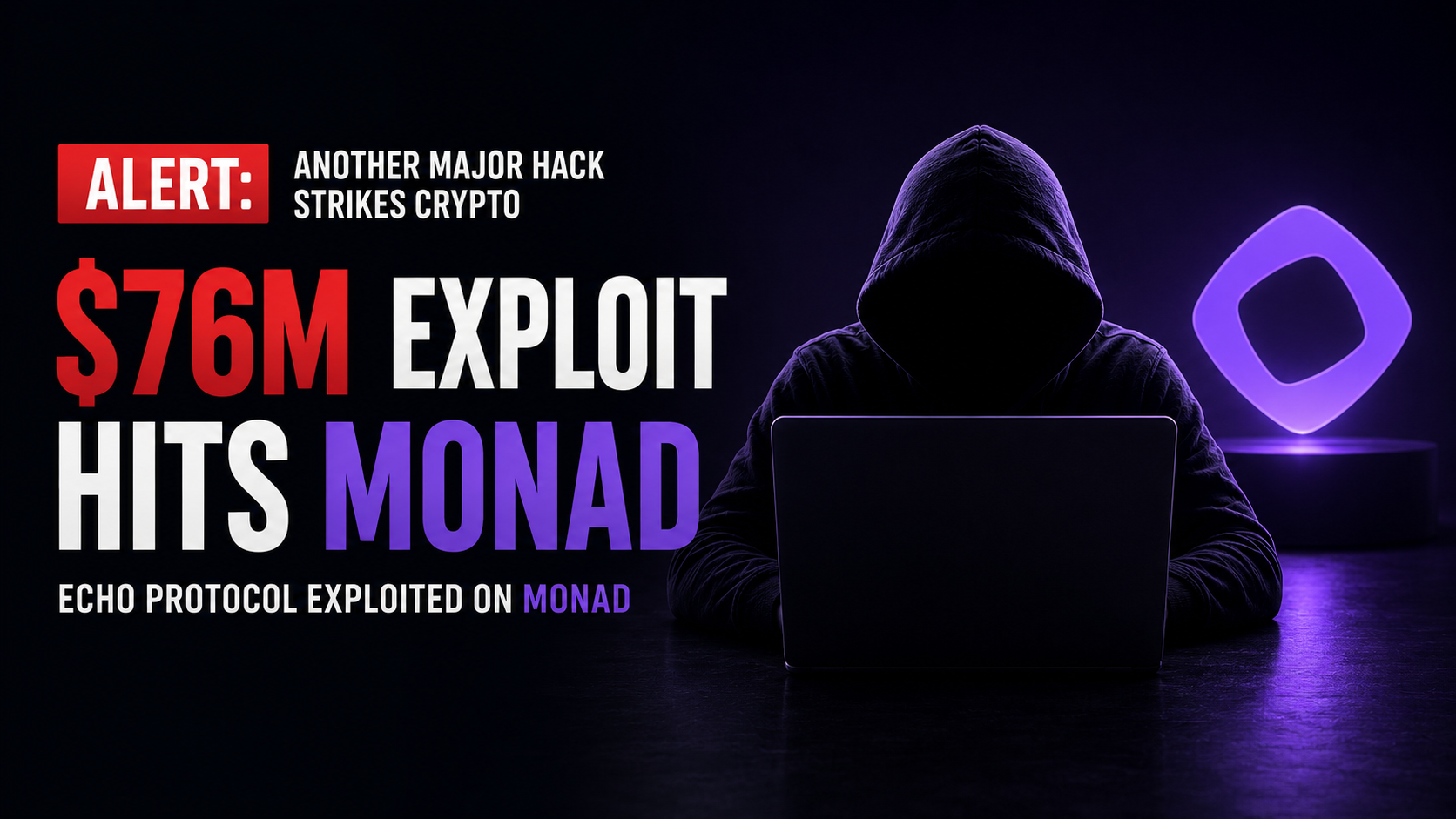
The industry keeps calling this progress.
Another protocol. Another exploit. Another emergency thread. Another pile of user funds moved through bridges, collateral systems, mixers, and wrapped assets until the trail becomes a blur of smart contracts pretending to be infrastructure.
This time it is Echo Protocol on Monad.
According to blockchain investigators, an attacker allegedly minted 1,000 eBTC worth approximately $76.6 million before using the freshly created assets as collateral inside the wider DeFi stack. The attacker reportedly borrowed WBTC through Curvance, bridged assets across chains, swapped them into ETH, and routed around 385 ETH through Tornado Cash.
At the time of writing, the attacker is still believed to control roughly 955 eBTC worth more than $73 million.
And this is now the third major exploit in just four days.
The modern crypto industry keeps trying to convince users that complexity equals innovation. In reality, most of these systems resemble stacked leverage built on top of synthetic representations of synthetic representations. Wrapped assets secured by multisigs. Cross chain messaging systems dependent on committees. Upgradeable contracts. Emergency admin controls. Bridges sitting between ecosystems like giant honeypots waiting to be drained.
Then when something inevitably breaks, everyone suddenly remembers why Bitcoin was revolutionary in the first place.
Simple systems survive.
The deeper problem is not merely “hacks.” It is architectural fragility. Entire ecosystems are now being built around interconnected assumptions where one weak point can ripple through multiple protocols simultaneously. Collateral systems depend on bridges. Bridges depend on validator honesty. Wrapped assets depend on custodians. Governance systems depend on insiders. Stablecoins depend on blacklists and freeze permissions.
The result is an industry increasingly recreating the exact trust dependencies crypto was originally designed to eliminate.
Monad has positioned itself as a high performance chain built for scalable applications, but scalability means very little if the surrounding infrastructure inherits the same systemic weaknesses that continue to plague the wider industry. Fast block times do not remove counterparty risk. Throughput does not magically create trustlessness.
Every major exploit is another reminder that “DeFi” and genuine decentralization are no longer interchangeable terms.
The attacker’s reported movement of funds through Tornado Cash will inevitably reignite the usual political narratives around privacy tools, despite the fact that the real issue once again appears to stem from weaknesses inside protocol design itself. Privacy layers become the headline. Structural fragility becomes the footnote.
Users should begin asking harder questions about the systems they are trusting with their capital.
Can the contracts be upgraded?
Can assets be frozen?
Can validators coordinate reversals?
Can bridges halt withdrawals?
Can insiders pause the protocol?
Can synthetic assets be minted incorrectly?
Because if the answer to those questions is yes, then the system is not operating on immutable certainty. It is operating on trust.
And trust has always been the thing crypto was supposed to remove.
---
Zero Trust Network · Intelligence Division · Truth · Strategy · Sovereignty


Discussion