Bitcoin Has No Government. So Who Fired Luke Dashjr?
Luke Dashjr could not force BIP 110 onto Bitcoin, but other developers could remove him from its proposal archive. The greater threat may not be capture of the code, but the growing concentration of mining, custody and the software everyone defaults to.

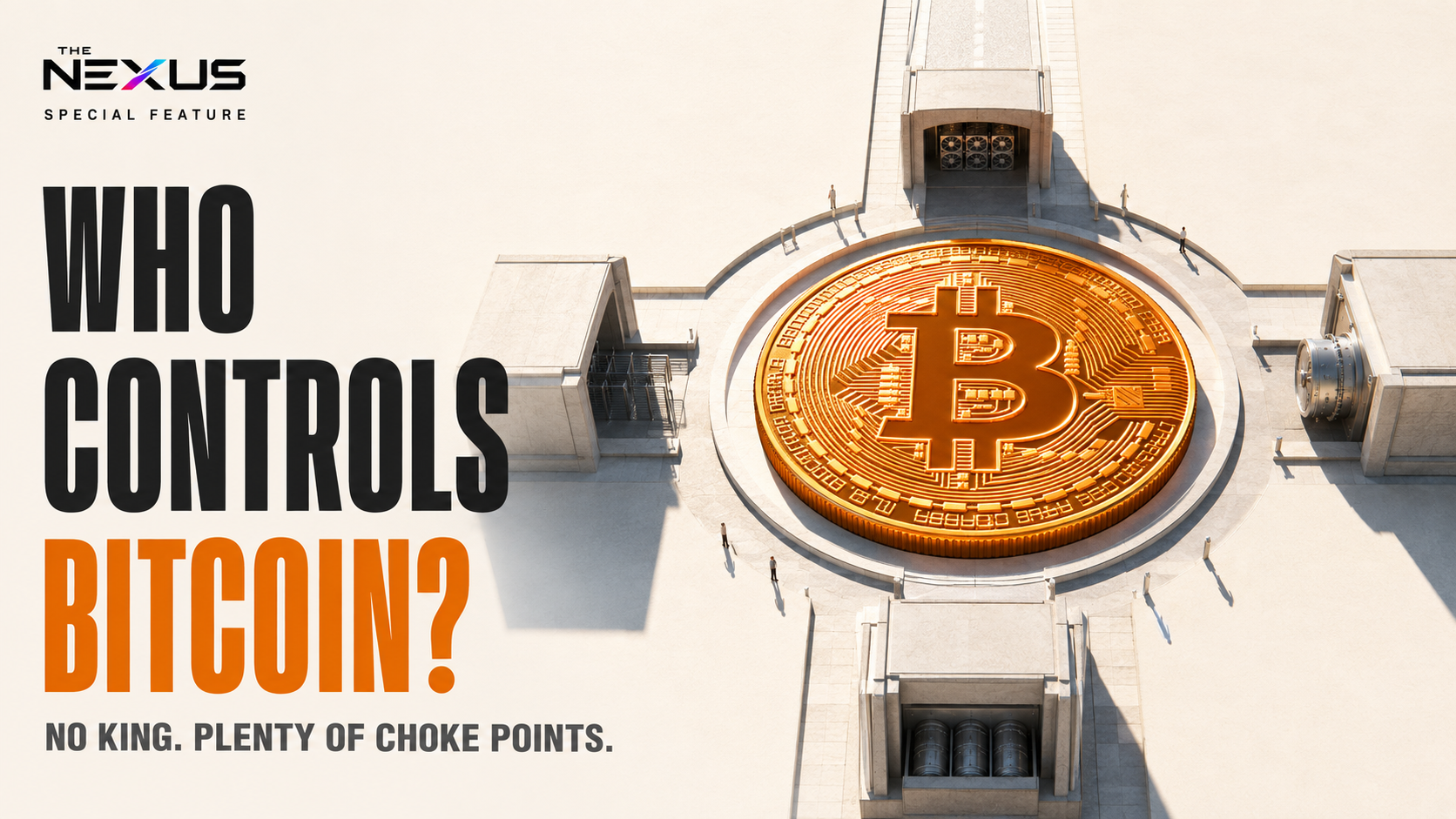
BIP 110 failed to change Bitcoin. Then its most prominent supporter was removed as a BIP editor. The episode reveals where power really sits, and where it could concentrate next.
Bitcoin did not fire Luke Dashjr.
A GitHub repository did.
On 10 August, Bitcoin developer Jon Atack merged a pull request opened by Mark “Murch” Erhardt removing Dashjr from the list of Bitcoin Improvement Proposal editors. The change itself was almost comically small: one name deleted from one file.
The allegations behind it were more serious. Erhardt accused Dashjr of using his editorial privileges to favour BIP 110, a proposal he had championed to restrict arbitrary data and Ordinals-style inscriptions on Bitcoin. According to the removal request, Dashjr tried to assign the proposal a BIP number before proper mailing-list discussion and later merged an update unusually quickly.
Dashjr denies that the removal was legitimate. He has described it as an abuse of power and argued that Bitcoin Core developers have no authority to revoke his position.
One correction matters immediately: this was not a Bitcoin Core consensus decision. It did not alter Bitcoin Core, remove Dashjr from Bitcoin development or change a single rule enforced by the network. Dashjr still maintains Bitcoin Knots, an alternative Bitcoin node implementation.
Yet pretending the removal means nothing would be equally dishonest.
The BIP repository is where serious proposals receive numbers, documentation and visibility. It is less like Parliament than an airport departure board. The editor does not fly the aircraft, build the engine or decide whether passengers board. But controlling what appears on the board is still a form of power.
Code Is Law, After Humans Choose the Code
Bitcoin people like saying that code is law.
That is true only after someone has written the code, reviewed it, merged it, packaged it, recommended it and persuaded other people to run it.
Before execution, code is an argument.
Developers propose changes. Maintainers decide which contributions enter widely used software. Companies decide which versions they support. Miners decide what software and templates they use. Node operators decide which rules they enforce. Exchanges and custodians decide what asset they recognise as BTC when competing chains exist.
The official Bitcoin explanation is that developers cannot force protocol changes because users remain free to choose their software. That is correct. Bitcoin Core’s own documentation also says consensus changes require enforcement by miners, full nodes or both.
But freedom to choose does not mean every choice has equal influence.
Anyone can write a web browser. Most people still use a handful of browsers. Anyone can publish a map. Most drivers still follow the route selected by the same sat-nav.
Bitcoin’s road can remain open while traffic concentrates around a few defaults.
BIP 110 Put Developer Power to the Test
BIP 110 proposed a temporary soft fork restricting several methods used to embed large amounts of arbitrary data in Bitcoin transactions. Supporters argued that inscriptions burden node operators and push Bitcoin away from its monetary purpose. Critics argued that paying users should be free to buy block space without developers deciding which transactions are respectable.
The proposal required 55 per cent miner signalling for an early lock-in. It never came close.
Its fallback mechanism instructed participating nodes to begin rejecting non-signalling blocks from height 961,632. That produced a minority chain split. The branch mined briefly and then stalled. BIP 110 is now marked Closed, with its own changelog recording a chain split and stalled mining.
This is the strongest argument against claiming that Bitcoin is controlled by developers.
Dashjr helped develop, promote and distribute software enforcing the proposal. He had status, experience and access to the BIP repository. The broader network still declined to follow him.
If developers controlled Bitcoin, BIP 110 would now be Bitcoin.
It is not.
The episode demonstrated the limit of developer power. Dashjr could offer new rules, but he could not supply the economic weight needed to make those rules authoritative.
Then the removal demonstrated a different kind of power. Dashjr could not force a consensus change, but people controlling an important coordination repository could remove his administrative access.
Those are not the same power. Both are real.
Bitcoin Has No King. It Has Choke Points
Decentralisation is often discussed as if it were a light switch. A system is either decentralised or it is captured.
Real systems are messier.
Bitcoin distributes authority across software, nodes, miners, pools, exchanges, wallets and holders. That makes complete capture difficult because there is no single lever marked “CONTROL BITCOIN”.
It also creates smaller choke points.
A dominant software implementation can shape the default rules presented to users. A repository can determine which proposals receive official-looking identifiers. Wallet companies can decide which features ordinary users can access. Exchanges can decide which fork keeps the BTC ticker. Custodians can decide what chain millions of indirect holders are exposed to.
None of these actors can rewrite Bitcoin alone.
The danger appears when several of them begin moving together, whether through commercial incentives, regulation, shared infrastructure or simple convenience.
No conspiracy is required. Power usually concentrates because concentration is cheaper.
Five Dispatchers, Most of the Trucks
Bitcoin mining remains technically permissionless. Anyone can connect hardware and attempt to mine a block.
Commercially, it has become brutal.
Specialised machines, industrial power agreements, cooling infrastructure and thin margins reward scale. Smaller miners commonly join pools to receive predictable payouts rather than waiting years for a solo block.
Pools are not necessarily the owners of the machines connected to them. They are closer to dispatch centres coordinating independent lorries. The drivers can leave and switch dispatchers.
Still, the dispatcher often decides where the lorries are going.
At the time of writing, Hashrate Index’s pool data puts roughly 57 per cent of reported hash rate behind the three largest pools and about 76 per cent behind the five largest. Those percentages fluctuate, and they should not be mistaken for ownership of all underlying hardware.
They do show coordination concentrating around a small number of pool operators.
Under the older Stratum V1 model, pools generally construct the block templates miners work on. This gives pool operators practical influence over transaction selection even when the physical machines belong to other people.
Stratum V2 is being developed partly to address this. Its Job Declaration system allows individual miners to construct their own templates instead of accepting work unilaterally selected by a pool. In May 2026, ANTPOOL, F2Pool, Foundry, SpiderPool and other major entities joined the Stratum V2 Working Group.
That is encouraging. Joining a working group, however, is not the same as completing network-wide deployment.
The fact that this technology is needed tells us something important: decentralisation at the hardware layer does not automatically prevent centralisation at the coordination layer.
The ETF Version of Bitcoin Has a Front Desk
Bitcoin’s institutional adoption creates another concentration point: custody.
A self-custody holder owns private keys and can choose which Bitcoin software and chain to recognise. An ETF investor owns shares in a financial product. The sponsor and custodian control the underlying coins.
Coinbase disclosed in its third-quarter 2025 shareholder materials that it was the primary custodian for more than 80 per cent of US Bitcoin and Ethereum ETF assets.
This does not mean Coinbase owns those assets. Nor does it mean ETFs are secretly changing Bitcoin. ETFs have made price exposure easier for pensions, funds and ordinary investors.
The trade-off is operational concentration.
Think of an ETF share as a warehouse receipt. Ownership of the receipts can be spread across millions of people while the goods remain inside a small number of warehouses.
That distinction could become important during a future contentious fork.
An ETF holder cannot install another node client, move hash rate or independently recognise a competing chain. The sponsor, custodian, exchange and index provider would determine what the product continues to call Bitcoin.
That would not give them control over Bitcoin’s consensus rules. It could give them enormous influence over the economic default followed by people who own Bitcoin exposure but not bitcoin keys.
How Bitcoin Could Centralise Without Being Taken Over
The realistic centralisation scenario is not a secret committee changing the 21 million supply limit.
It is more boring than that.
Most users hold Bitcoin through banks, ETFs and exchanges. Most mining power connects through a few pools. Most institutions run the same approved software. Wallet providers hide technical choices because customers prefer convenience. Regulators focus pressure on custodians, exchanges, public mining companies and infrastructure providers because those organisations have addresses, executives and licences.
Bitcoin continues producing blocks throughout.
The base protocol remains decentralised, but every popular entrance becomes institutional.
A government does not need to rewrite the internet to make a website difficult to reach. It can pressure hosting companies, app stores, payment processors and domain providers. The network still exists. The ordinary route to it becomes narrower.
Bitcoin could face the same pattern.
Authorities may never gain the ability to manufacture bitcoin or rewrite old transactions. They could still gain leverage over how most citizens buy it, store it, mine it, spend it and interpret disputed upgrades.
That is not capture of the protocol.
For the average person, it may feel close enough.
Exit Is Bitcoin’s Real Constitution
Bitcoin’s strongest protection is not the purity of its developers or the goodwill of mining companies.
It is the ability to exit.
A node operator can reject an upgrade. A miner can change pools. A holder can withdraw to self-custody. Developers can fork software. Users can preserve an older rule set. Competing implementations can expose decisions that one dominant client might otherwise bury.
BIP 110 showed that this exit mechanism still works. The proposal’s supporters chose different rules. Almost nobody followed them. The larger network continued.
But exit only protects Bitcoin while it remains practical.
If mining becomes available only to industrial operators, self-custody becomes unusual, alternative clients disappear and most coins sit behind regulated wrappers, the theoretical right to exit may survive while the number of people capable of exercising it collapses.
The Dashjr affair is not proof that Bitcoin Core controls Bitcoin. It is proof that even systems built to resist authority eventually grow administrators, defaults and professional classes.
Bitcoin remains difficult to control because no single institution commands every layer.
The future risk is that convenience, regulation and economies of scale gradually bundle those layers together.
No coup. No smoke-filled room. Just fewer dispatchers, fewer vaults, fewer software defaults and fewer people holding their own keys.
Trust nothing. Verify everything.
Especially the parts of Bitcoin that claim they require no trust.
Veritya Thalassa
Zero Trust Network · Intelligence Division · Truth · Strategy · Sovereignty





Discussion