DeFi United: The White-Hat Coup That Saved the Rewards
A shared rewards contract cracked open, and DeFi’s insiders moved first. Funds were saved, but the rescue exposed the quiet power sitting behind supposedly trustless systems.

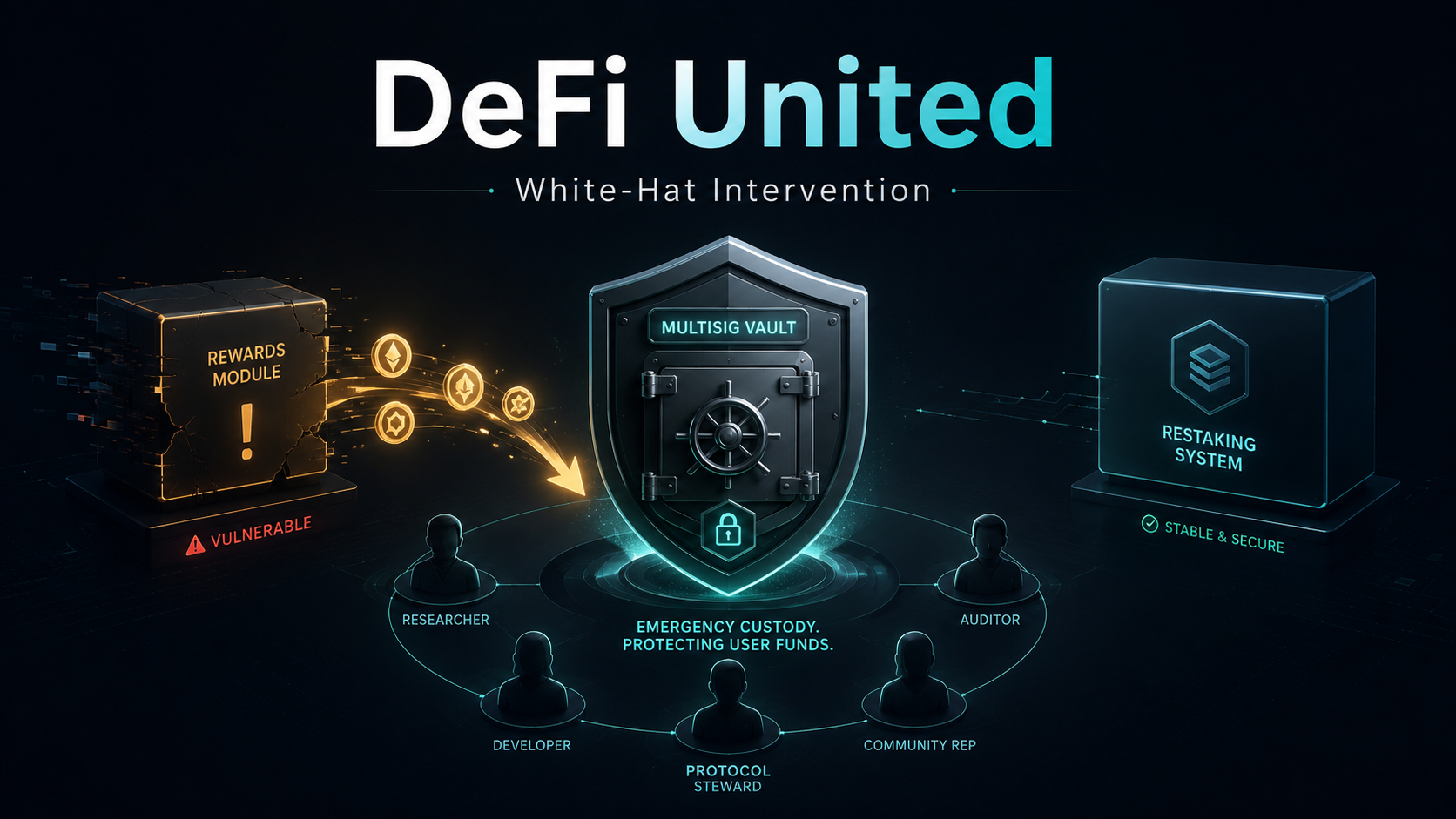
A coordinated, centralised intervention by an ad-hoc group of developers and protocol leads, operating under the name “DeFi United”, pre-empted a widespread exploit targeting the rewards distribution mechanisms of several Liquid Restaking Token (LRT) protocols. The group, which included leadership from Ether.fi and Kelp DAO, executed a “white hat” attack to drain vulnerable contracts before malicious actors could inflict further damage. The secured funds, consisting of various reward tokens and EigenLayer points, were transferred to a multisig wallet controlled by the coalition members for eventual redistribution. The incident was not a failure of core LRT or EigenLayer smart contracts, but an operational security lapse involving a shared, third-party contract used for auxiliary functions.
Anatomy
The architecture of the failure resides in the periphery of the restaking ecosystem, not its core. LRT protocols like Ether.fi (eETH) and Kelp DAO (rsETH) function by accepting user deposits of ETH or Liquid Staking Tokens (LSTs), restaking them with EigenLayer, and issuing a liquid receipt token. The core value proposition is the accrual of staking, restaking, and potential airdrop rewards.
To manage the distribution of these disparate rewards, particularly non-ETH assets like airdropped tokens or loyalty points, many protocols utilised a common set of third-party smart contracts. The vulnerability was located within one such contract responsible for processing reward claims. Its claim function contained a critical logic flaw: it failed to properly track or nullify a user’s claim eligibility after a successful withdrawal. This allowed an attacker to call the function repeatedly, draining more rewards than they were entitled to from the contract’s pool.
Upon discovery of the active exploit, key figures including Mike Silagadze of Ether.fi coordinated a response. Rather than attempting a contract pause, which may not have been universally possible or sufficiently swift, the coalition opted for offensive mitigation. They replicated the attacker’s methods to execute a pre-emptive drain of all remaining funds from the vulnerable contracts across the affected protocols. These funds were first consolidated into a single externally owned account (EOA) and subsequently transferred to a newly established 3-of-5 multisignature Gnosis Safe wallet. The keyholders for this wallet are trusted individuals from the affected projects and the broader security community, including representatives from Ether.fi, Kelp, and EigenLayer. This action effectively centralised custody of millions of dollars in user rewards into the hands of a small, unelected council as an emergency measure.
Pattern
This incident follows a distinct pattern of “benevolent centralisation” in response to crises within theoretically decentralised systems. The most significant historical precedent is the 2016 DAO hack, which resulted in a contentious hard fork of the Ethereum network to recover user funds. That event, like this one, demonstrated that when faced with catastrophic loss, protocol stakeholders will favour interventionist action over ideological purity. The formation of DeFi United is a microcosm of this dynamic: a rapid, informal centralisation of power to execute a decision that the protocol’s automated code could not.
The event also highlights the distinction between smart contract risk and operational security risk. The core protocols, having undergone extensive audits, performed as designed. The failure point was a less scrutinised, auxiliary component, analogous to past exploits involving compromised frontends, DNS hijacks, or private key mismanagement. A protocol’s security surface is not confined to its primary contracts but extends to every third-party dependency and off-chain process. This pattern of peripheral failure is common, as development teams often focus audit budgets on core logic while overlooking seemingly mundane components that can still place user funds at risk.
The response itself, a coordinated white-hat counter-exploit, is also becoming a standard playbook. It was seen in the aftermath of the Nomad bridge exploit, where white hats recovered a significant portion of funds by copying the attacker’s methods. The approach is effective, but it implicitly grants core development teams and their allies the power to unilaterally seize funds, creating a new vector of trust for users to consider.
Forward Implication
The DeFi United intervention establishes a powerful precedent for the rapidly growing LRT sector. It normalises the concept of an informal, cross-protocol security council with the authority and technical ability to unilaterally move funds during a crisis. Users of these protocols are now implicitly trusting not only the audited smart contracts but also this unelected group of responders to act benevolently and effectively under pressure. The legal and operational legitimacy of such actions remains a grey area.
This event will likely force a re-evaluation of third-party contract integration. Protocols will face pressure to either bring all components in-house for rigorous, unified auditing or to establish more formal standards for vetting and monitoring external dependencies. The reliance on shared, unaudited code for critical functions like reward distribution is now a known and demonstrated liability. The incident could spur the emergence of security-focused service providers offering standardised, heavily audited modules for these common DeFi functions.
The success of this ad-hoc coalition raises a critical governance question: should this structure be formalised? A standing DeFi security consortium could offer faster, more coordinated responses in the future. However, it would also concentrate power, creating a high-value target for both external attack and internal collusion. The critical unknown is whether this informal model of insider coordination can remain effective and uncorrupted as the financial stakes escalate, and how the market will price the implicit trust users must now place in these emergency responders.
---
Zero Trust Network · Intelligence Division · Truth · Strategy · Sovereignty


Discussion