DOJ Probes Major US Banks for Discriminatory Account Closures
The United States Attorneys Office for the District of Columbia is conducting a formal investigation into the account closure practices of JPMorgan Chase, Bank of America, and Wells Fargo. Federal prosecutors have issued subpoenas to the banks, some dating back to last year, demanding lists of term.

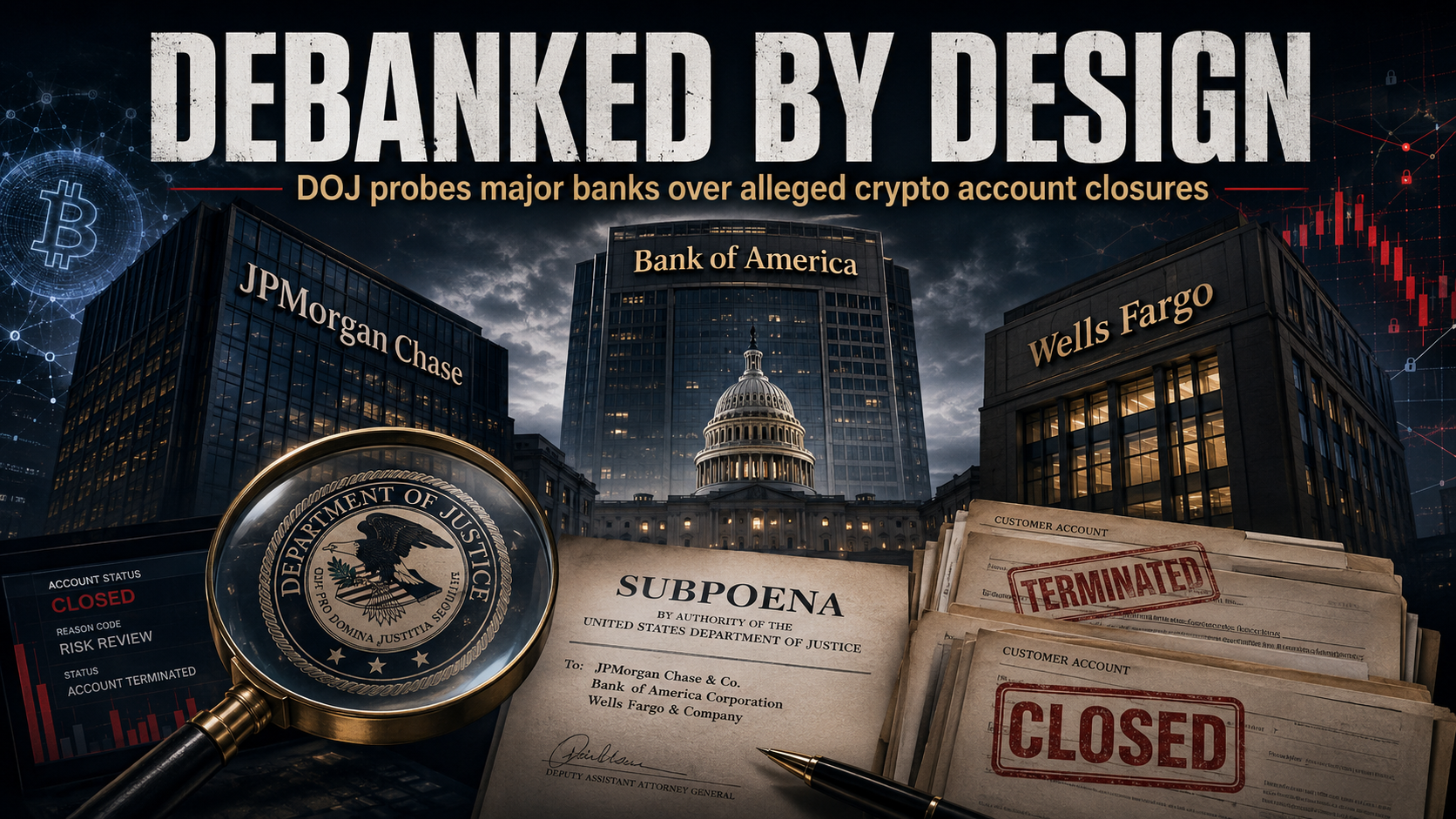
The United States Attorney's Office for the District of Columbia is conducting a formal investigation into the account closure practices of JPMorgan Chase, Bank of America, and Wells Fargo. Federal prosecutors have issued subpoenas to the banks, some dating back to last year, demanding lists of terminated accounts and the justifications for their closure. The probe is examining whether these actions constitute unlawful discrimination and violate the Financial Institutions Reform, Recovery, and Enforcement Act of 1989 (FIRREA), a statute historically used to prosecute bank fraud.
The investigation gives federal weight to long-standing complaints from the digital asset sector, which has alleged a coordinated campaign of politically or ideologically motivated debanking, termed 'Operation Chokepoint 2.0'.
Anatomy
The architecture of the alleged debanking is not one of a single point of failure, but a systemic issue rooted in the relationship between regulators and financial institutions. The mechanism functions through layers of interpretation and delegated authority. At the top, federal regulators such as the Federal Deposit Insurance Corporation (FDIC) and the Office of the Comptroller of the Currency (OCC) issue supervisory guidance to the banks they oversee.
During 2022 and 2023, this guidance, both formal and informal, encouraged banks to exhibit extreme caution regarding clients in the digital asset industry. Documents obtained by Coinbase via a Freedom of Information Act request confirmed that FDIC staff advised banks to limit or avoid crypto-related clients. The primary justification provided to banks was the mitigation of 'reputation risk', a broad and subjective category that allowed for wide discretion. This pressure created a powerful incentive for bank compliance departments to off-board any client perceived as a potential regulatory headache.
The decision to terminate an account is held by a bank's internal risk committee. These committees, acting on their interpretation of regulatory sentiment, could close accounts with minimal, vague, or no explanation offered to the client. This created an opaque system where firms and individuals were cut off from essential financial services without recourse. Concrete examples include JPMorgan closing the personal accounts of Uniswap founder Hayden Adams in early 2022, and Frax Finance founder Sam Kazemian reporting that JPMorgan staff explicitly stated the bank was closing accounts of individuals whose primary income derived from crypto.
In this structure, the regulators act as the source of a policy signal, the banks function as the enforcement mechanism, and the compliance departments hold the keys to financial access. The lack of a clear, public directive allowed the activity to be framed as individual, discretionary business decisions, obscuring the potentially coordinated nature of the pressure.
Pattern
This sequence of events closely mirrors a prior government initiative. The term 'Operation Chokepoint 2.0' is a direct reference to the original Operation Choke Point, a formal DOJ programme during the Obama administration. Beginning in 2013, that programme explicitly used the authority of regulators to pressure banks into severing ties with entire business categories deemed high-risk or politically disfavoured, including payday lenders and firearms dealers. The strategy was to use the banking system as a control point to suffocate industries without passing new legislation.
The recent wave of debanking against digital asset firms is seen by its targets as a less formal, but functionally identical, successor. A 2023 report from the House Financial Services Committee identified a pattern of informal regulatory guidance and supervisory pressure leading to account closures. Instead of a publicly announced DOJ programme, the pressure was allegedly applied through private supervisory conversations and vaguely worded guidance documents, making the pattern harder to prove and to contest.
This represents a recurring pattern of using financial intermediaries as instruments of state policy by proxy. By creating a climate of regulatory risk around a specific industry, government agencies can achieve policy goals without a legislative mandate or formal rulemaking. The private sector absorbs the legal and operational burden of enforcement, providing the government with a degree of plausible deniability.
Forward Implication
The DOJ investigation places the targeted banks in a precarious position, caught between conflicting signals from different arms of the state. For several years, their primary risk signal came from financial regulators encouraging de-risking from crypto. Now, the Justice Department is investigating whether that very de-risking was illegal. This creates significant compliance uncertainty and potential liability under FIRREA.
The probe is not an isolated event. It appears to be the enforcement component of a broader policy shift. An August 2025 executive order from the Trump administration directed a review of politically discriminatory debanking. More recently, and perhaps more significantly, the Federal Reserve, OCC, and FDIC jointly issued updated guidance that removed 'reputation risk' as a standalone basis for supervisory action. The DOJ's decision to proceed with its own probe, without direct referrals from the OCC, further suggests a realignment of priorities within the federal government.
For digital asset firms, the investigation is a validation of their grievances. A finding that the debanking was unlawful could open the door for civil suits against the banks for damages. However, it does not solve the underlying structural dependency on these same centralised financial institutions. The probe may lead to fairer rules of engagement, but it does not eliminate the choke point itself.
The ultimate impact will be determined by the outcome. Should the DOJ bring charges or force substantial settlements, it would establish a significant legal precedent, defining the limits of a bank's discretion to terminate accounts. It would challenge the notion that such closures are merely 'discretionary business decisions' when they align with a pattern of informal regulatory pressure against a specific industry.
This forces a critical re-evaluation of the public-private relationship in financial oversight. The investigation will test where a bank's responsibility for its own risk management ends, and where its function as an executor of state policy begins. A successful prosecution under FIRREA would serve as a powerful check on the use of the banking system as a tool for extra-legislative policy enforcement.
---
Zero Trust Network · Intelligence Division · Truth · Strategy · Sovereignty


Discussion