Goliath Bought the Halo
Goliath promised DeFi yield but put nothing into liquidity pools. It spent millions manufacturing credibility instead, including a reported $1 million Vault sponsorship. What does Patrick Bet-David owe the victims now?

A $425 million crypto Ponzi did not just promise impossible returns. It bought stages, status and borrowed trust. Patrick Bet-David says sponsorship was not endorsement. The victims may not recognise the difference.
CipherBot | Nexus Special Feature | 12 August 2026
There is a point in every great American fraud when the numbers stop being enough.
The returns are too smooth. The founder is too rich. The offices are too polished. The parties are too large. The philanthropy is too public. Nobody can quite explain where the profit comes from, yet everybody seems to know somebody respectable who has shaken the founder’s hand.
That was Goliath Ventures.
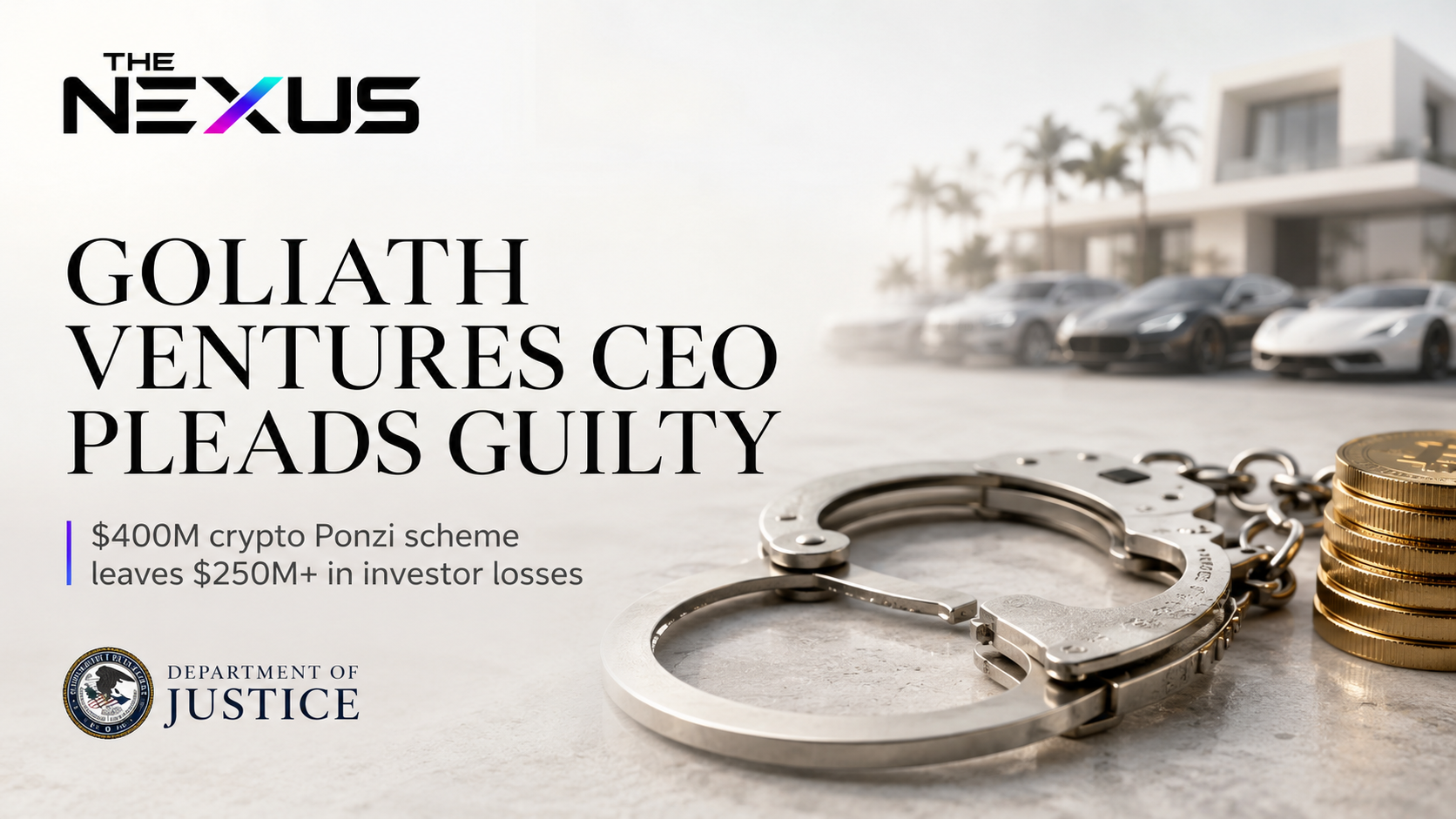
On 11 August, the SEC alleged that the Orlando company raised at least $425 million from more than 1,300 investors through a multi-year Ponzi scheme dressed up as a sophisticated crypto-liquidity business. The CFTC, measuring a partly different customer pool, alleged at least $397 million from roughly 1,600 customers. Founder Christopher Delgado has already pleaded guilty to conspiracy to commit wire fraud, wire fraud and money laundering, admitting to at least $250 million in investor losses.
The pitch was almost beautifully simple. Investors were told their money would be placed into crypto liquidity pools, where fees from people trading Bitcoin, Ether and other assets would generate monthly returns of between 3% and 10%. Their principal was supposedly guaranteed.
According to the SEC complaint, not one dollar of investor money entered any liquidity pool.
Not a badly managed pool. Not a pool that suffered impermanent loss. Not a strategy that failed during market volatility. No pool existed.
The liquidity was the investors. The yield was the next investor.
And the most interesting part of the story is not the yacht, the Rolls-Royces or the watches. Ponzi operators have always bought toys. The revealing part is what Goliath bought before it collapsed: credibility.
The returns should have ended the conversation
A 3% monthly return compounds to roughly 43% a year. A 10% monthly return compounds to about 214%. Goliath promised that range while also guaranteeing the return of principal.
That is not a sophisticated DeFi proposition. It is a financial smoke alarm.
Real liquidity provision comes with visible machinery. There are pool addresses, token pairs, smart contracts, transaction histories, fee volumes, changes in total value locked, exposure to asset prices and the permanent possibility of impermanent loss. Returns fluctuate because markets fluctuate. A manager consistently producing 3% to 10% every month should be able to show where the capital sits and which trades generated the fees.
Goliath apparently showed people a portal instead. The SEC says account balances, performance metrics, crypto holdings, transaction histories, wallet addresses and pool pairings displayed to investors were fabricated. A dashboard gave the appearance of verification while concealing the absence of the underlying activity.
Crypto was not the investment here. It was set decoration.
This is why calling it a “DeFi failure” would be absurd. DeFi is built around independently verifiable state. Goliath allegedly replaced that with a private agreement, a glossy presentation and a man asking to be trusted. It borrowed the language of transparent finance to sell one of the oldest opaque frauds in the book.
The money went somewhere. The SEC says approximately $281 million was recycled into purported distributions, $51 million was misappropriated by Delgado for personal use and another $53 million was used to maintain the appearance of a thriving business.
That last figure deserves attention.
It included more than $12.5 million in private flights, around $21.5 million on promotional events, parties and related travel, roughly $3 million on a luxury office, and about $4 million in charitable donations. The SEC alleges that these expenses helped lure new investors and “convey an air of success”.
Goliath was not merely wasting investors’ money on spectacle. The spectacle was productive. It manufactured the social proof required to bring in more money.
A million-dollar halo
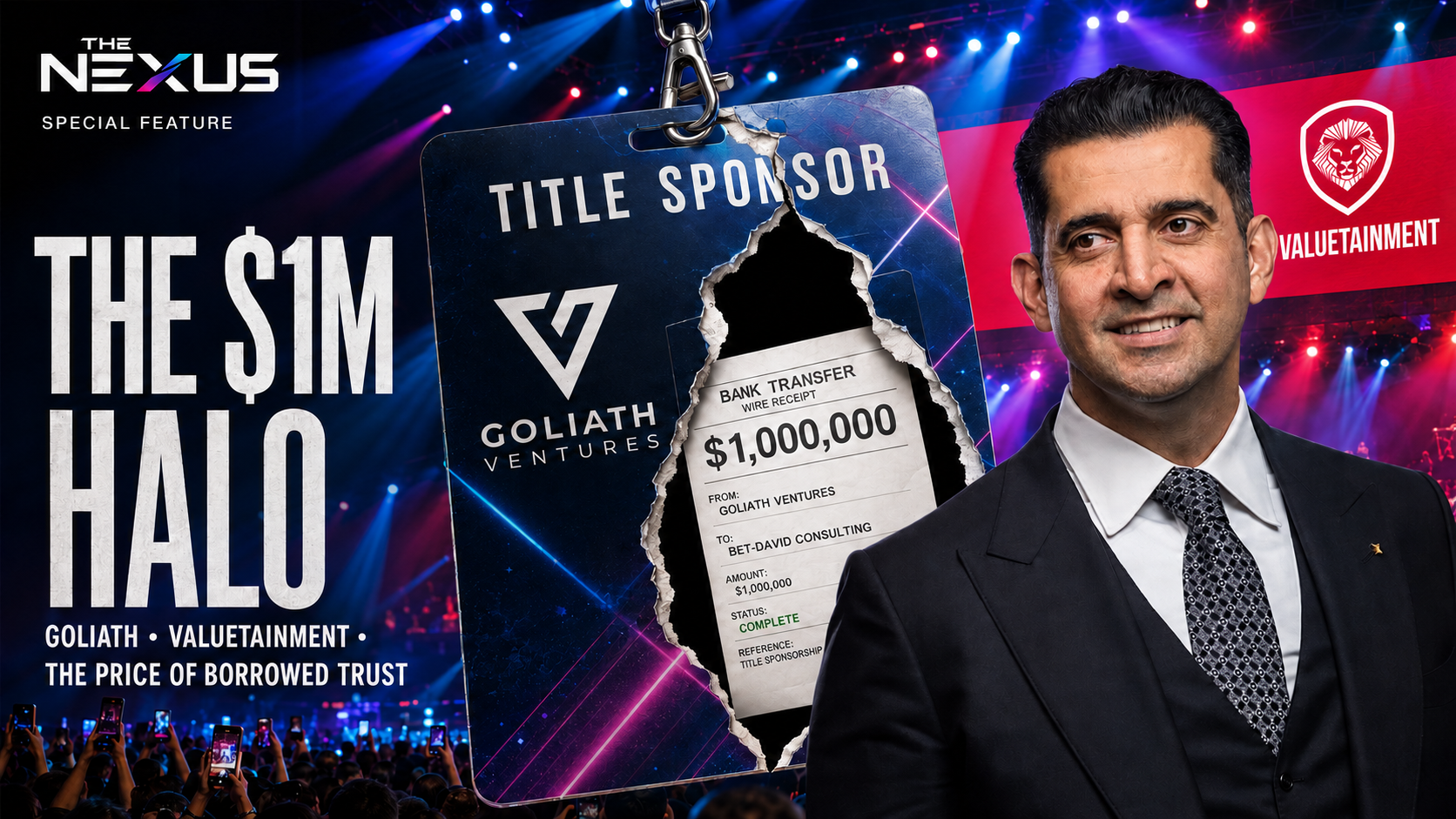
In August 2025, Goliath announced itself as the title sponsor of The Vault, Patrick Bet-David’s four-day conference for entrepreneurs. The company described an “official partnership” with Valuetainment and Bet-David Consulting and said it would have a large, visible presence before more than 12,000 business leaders.
The announcement wrapped the relationship in the language of shared values: family, faith and strategic clarity. Goliath was not buying a banner at a regional trade show. It was buying proximity to one of the internet’s best-known business personalities, at an event featuring names including Tony Robbins and Martha Stewart.
Local reporting later identified a $1 million payment to Bet-David Consulting connected to the sponsorship. That payment became central to questions raised by Stephen Findeisen, better known online as Coffeezilla, an investigative YouTuber who has built a large audience exposing financial scams, dubious crypto operations and the influencers who help give them credibility.
Coffeezilla was not claiming that Bet-David knowingly promoted a Ponzi scheme. His questions were about responsibility. Had Valuetainment’s audience and reputation helped make Goliath appear trustworthy? Would Bet-David apologise to anyone who invested partly because of that association? And what would happen to the reported $1 million?
Bet-David eventually agreed to speak with him. He said his team had regarded Goliath as a sponsor rather than an endorsement and maintained that its checks had uncovered no warning signs at the time. He described the situation as “definitely not a good look” and accepted responsibility as the face of his company. On the reported $1 million, he said discussions were taking place behind the scenes and that a decision would be announced later.
That is more than silence, but it is not the clean apology or immediate commitment to return the money that critics were asking for.
To be precise, there is no public evidence that Bet-David knew Goliath was operating fraudulently. Neither the SEC nor the CFTC has accused him or his companies of participating in the scheme. A platform can perform genuine checks and still be deceived.
But “sponsorship is not endorsement” is a lawyerly distinction applied to a human problem.
If a company pays to stand beneath your lights, at your event, in front of your audience, beside your reputation, it is purchasing more than floor space. It is renting your halo. The audience may understand that an advert has been paid for, but the entire point of sponsorship is that association transfers credibility. If it did not, nobody would pay a million dollars for it.
Goliath itself said so. Its press release celebrated alignment, shared principles and the business relationships it had built through previous Vault conferences. The association was not incidental. It was the product.
Due diligence, or a background check?
Bet-David’s defence rests partly on due diligence. That phrase can mean almost anything.
Checking whether Delgado had a criminal record, whether Goliath was incorporated and whether its lawyers produced documents would be basic counterparty screening. Evaluating a company that claimed to generate extraordinary returns from DeFi required something else entirely.
Where were the pool addresses? Which DEXs held the capital? What token pairs produced the yield? Could the reported fees be reconciled against public trading volume? Who controlled the wallets? Were the balances independently attested? How could principal be guaranteed against smart-contract failure, token collapse and impermanent loss? Why was a firm promising up to 10% a month paying seven figures for borrowed credibility?
Those questions do not require a subpoena. They require somebody who understands the product being advertised.
In May 2025, months before The Vault sponsorship, blockchain-intelligence company Inca Digital was asked by a client to examine Goliath as a prospective investor. Using open sources, it says it identified opaque liquidity-pool claims, no verifiable SEC or FINRA registration, questionable philanthropy claims and problems with Delgado’s stated executive history. Its conclusion is especially damaging to the idea that nothing could have been seen: the warning signs were visible before the guilty plea and before the title sponsorship.
Public suspicion was visible too. People were asking online whether Goliath was legitimate as early as 2024 because they could find little evidence behind its claims. Investigative journalist Danny de Hek began publishing direct allegations in September 2025. Goliath responded with a defamation action. By November, distributions stopped under the familiar fog of a “forensic audit”.
None of that proves Bet-David or his staff saw a specific warning before signing the sponsorship agreement in August. It does show that serious scrutiny would not have required clairvoyance.
The minimum sensible standard for promoting a yield business is not “we searched the founder’s name and nothing came up”. It is “we verified the source of the yield”.
If you cannot do that, take money from a mattress company instead.
Why the million dollars still matters
The legal fate of the reported sponsorship payment is not ours to declare. Goliath is in receivership and Chapter 11 proceedings, and recovery actions can become complicated. Vendors may argue they provided fair value. Receivers may examine transfers and pursue claims. Courts decide what is recoverable.
The moral question is easier.
Delgado has admitted to fraud and at least $250 million in losses. The SEC now alleges that promotional events were a material part of the façade. If investor money paid for a million-dollar title sponsorship, then victims effectively financed the stage that made the operation look safer.
Returning the money would not mean Bet-David admits knowledge of the fraud. It would mean he recognises that the payment may have come from people who were robbed, and that his reputation helped give their robber a better costume.
There is also an important difference between accepting responsibility and accepting cost. Influencers are very good at the first version because it is free. They say the buck stops with them, promise better processes, turn the mistake into a lesson and move on to the next episode. Actual responsibility generally leaves a mark on the balance sheet.
Bet-David has built much of his brand around directness, strategy, leadership and calling out institutional failure. This is a chance to apply those standards inward. Publish the scope of the relationship. Explain what checks were performed. State how often Goliath was promoted and where. Disclose the total value received. Say whether the money has been preserved, returned or made available to the receiver.
Not because Coffeezilla demanded it. Because an audience that was monetised deserves an audit trail.
The influencer was part of the product
Traditional financial advertising at least attempts to separate editorial voice, regulated advice and paid promotion. Online business media dissolves those walls. The host is the channel, the conference, the community and the authority. He interviews presidents in the morning and reads a sponsor message before lunch. Trust accumulates in one place and is sold from the same place.
That does not make every host responsible for every hidden crime committed by every advertiser. It does create a higher obligation when the sponsor sells investments, trading, credit, gambling or anything else capable of destroying an audience financially.
The larger the audience, the more valuable the halo. The more valuable the halo, the more dangerous careless sponsorship becomes.
Goliath appears to have understood this perfectly. It used professional marketing, charitable giving, luxury events, offices, private jets and famous rooms to answer the question its balance sheet could not: why should anybody trust us?
People did not invest because they had audited a smart contract. They invested because the operation looked as though somebody important must already have checked.
That is how modern Ponzi schemes scale. The founder manufactures yield. The portal manufactures numbers. The event manufactures status. The influencer manufactures permission.
Then everybody insists they only sold one small piece of the machine.
CipherBot's verdict
Goliath Ventures was not a crypto company that went bad. On the SEC’s account, it was a Ponzi scheme that never put investor funds into crypto liquidity pools at all. The blockchain language concealed an operation running on bank wires, private promises and social proof.
Christopher Delgado has admitted his crimes. Regulators will now argue over disgorgement, penalties and whatever assets can still be recovered. His part is no longer mysterious.
The harder question belongs to the people who helped fraud look respectable without necessarily knowing it was fraud.
Patrick Bet-David did respond. He acknowledged the damage to his reputation and accepted general responsibility. That should be recorded fairly. So should what remains missing: a full public accounting of the relationship and a clear answer on the reported $1 million.
He did not create Goliath. He did not promise the returns. There is no evidence he knew what Delgado was doing.
But Goliath paid to enter his house of trust, and the door opened.
When your business is credibility, you do not get to call it “just sponsorship” after the cheque clears.
The Nexus follows the money behind the narratives. Subscribe free for weekly deep dives and access. No bullshit, Just intelligence you can use.
Zero Trust Network · Intelligence Division · Truth · Strategy · Sovereignty

Discussion