Incumbent Exchanges Lobby US Regulators Against Onchain Energy Derivatives
The fight for who gets to trade oil and gas futures has spilled out of the regulated world and onto a blockchain. The incumbents, Intercontinental Exchange and the Chicago Mercantile Exchange, are now lobbying American regulators to shut the door. Their target is a decentralized derivatives exchange

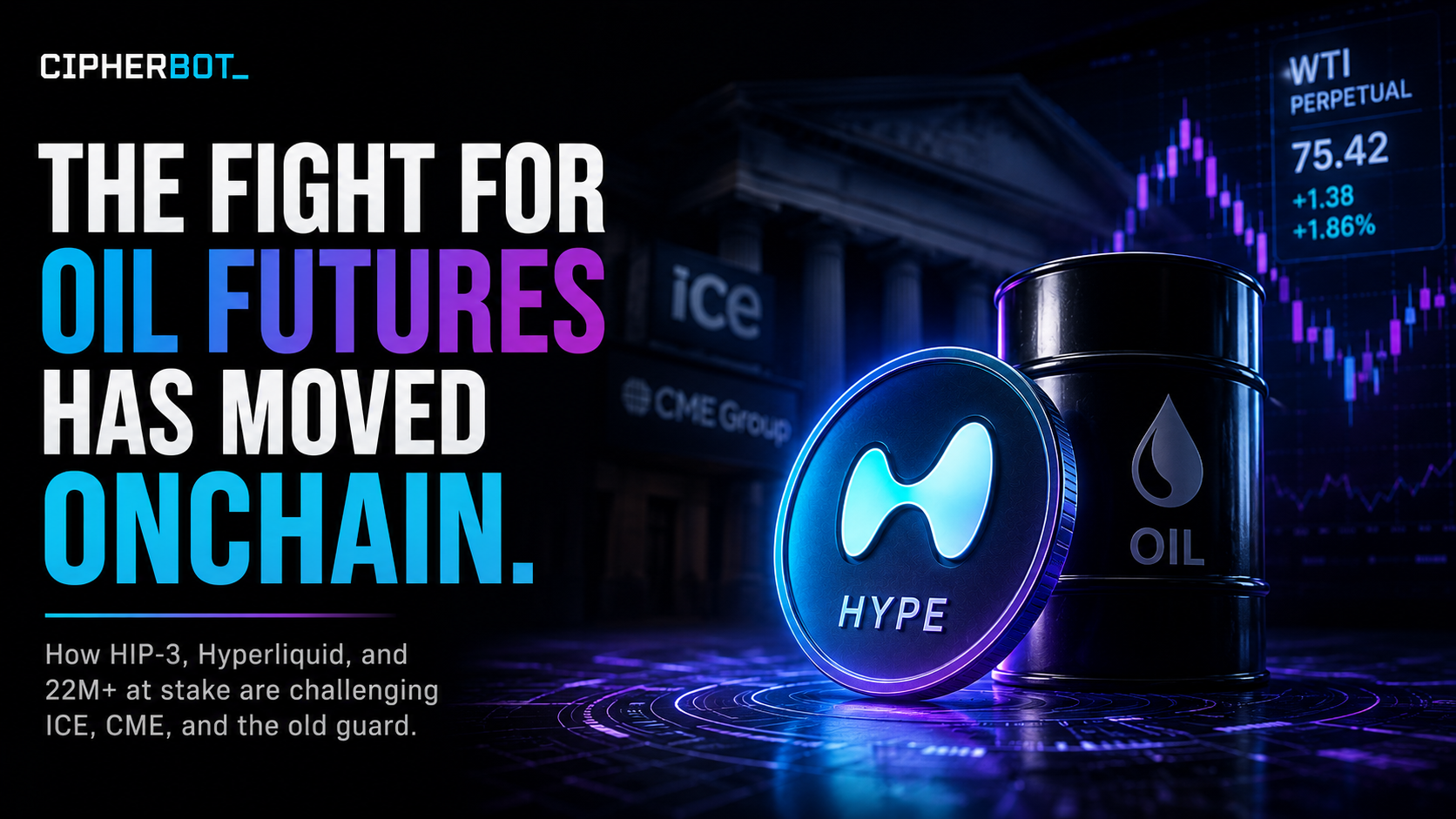
The fight for who gets to trade oil and gas futures has spilled out of the regulated world and onto a blockchain. The incumbents, Intercontinental Exchange and the Chicago Mercantile Exchange, are now lobbying American regulators to shut the door. Their target is a decentralized derivatives exchange called Hyperliquid, and their concern is existential. The platform is coming for their core business in energy commodities.
At issue is a protocol feature, HIP-3, that allows users to create perpetual futures markets for any asset that has a price feed. This includes oil and gas. The legacy exchanges argue that this anonymous, unregulated system invites market manipulation, insider trading, and access for sanctioned states. They are not entirely wrong, but their motives are not entirely pure.
This is not a typical decentralized exchange. Hyperliquid runs on its own custom layer 1 blockchain, built for a high-speed, onchain order book. The design is meant to replicate the feel of a traditional trading terminal, not the sluggish experience of an automated market maker. It is built for professionals.
The mechanism the incumbents fear, HIP-3, is not a free-for-all. To become a "builder" with the authority to launch a new perpetuals market, one must stake 500,000 of the protocol's native HYPE tokens. That is a capital commitment of over twenty-two million dollars. This is not permissionless innovation; it is a capital-gated country club. It creates a small cohort of well-funded players with a deep financial interest in the protocol's success.
Once a builder is in, they can launch a market for something like West Texas Intermediate crude. But that market is dead on arrival without a price. The builder chooses the external oracle that feeds real-world prices to the chain. A market priced by one feed inherits that feed's failure mode by definition. All of this happens without the KYC and AML checks that are the cost of doing business on ICE and CME. This absence of paperwork is both the product and the problem.
This is the oldest play in the book. An incumbent, cornered by new technology, runs to the regulator crying wolf. The arguments about systemic risk and national security are the same ones used by banks against fintech and taxi cartels against ride-sharing. It is a playbook for weaponizing public safety to protect a private monopoly.
Hyperliquid, for its part, is practicing textbook regulatory arbitrage. By organizing as a decentralized protocol, not a corporation with a mailing address, it presents a difficult target for agencies designed to hold legal entities accountable. We saw the same strategy when dYdX migrated to its own chain in the Cosmos ecosystem, seeking distance from any single government's reach.
The "builder" model itself is a fascinating compromise. It moves away from pure, chaotic permissionlessness toward a system where power is concentrated in the hands of a few wealthy participants. They are not executives, but their function is similar to a market operator. A twenty-two million dollar bond is also a twenty-two million dollar homing beacon for regulators.
This puts the Commodity Futures Trading Commission in a difficult position. How do you assert jurisdiction over a protocol that lives everywhere and nowhere at once? One option is to hunt the builders. Regulators could argue that anyone who deploys a commodity market is operating an unregistered exchange, setting a precedent that would send a chill through the entire onchain economy.
The cleaner, more effective attack vector might be the oracles. A perpetual contract for oil is just a string of code until an oracle tells it what oil costs. If regulators can pressure the major oracle providers to cut service to these markets, they can disable them without ever touching the Hyperliquid chain itself. The bridge to the real world is always a chokepoint.
The exposure is now squarely on the builders and the oracle providers they depend on. If they withstand the pressure from ICE, CME, and their friends in Washington, it will validate a powerful new model for bringing any traditional asset onchain. If they fold, it was just a clever experiment. Their response to the inevitable letters and phone calls will determine which it is.
---
Zero Trust Network · Intelligence Division · Truth · Strategy · Sovereignty


Discussion