Ledger Audit Reveals Chip Flaw in Trezor Safe 7 Hardware Wallet
Ledger broke the TROPIC01 secure element with a laser attack. Trezor says Safe 7 funds remain protected by the wider architecture, but the phrase “secure element” now deserves far more scrutiny than the market usually gives it.

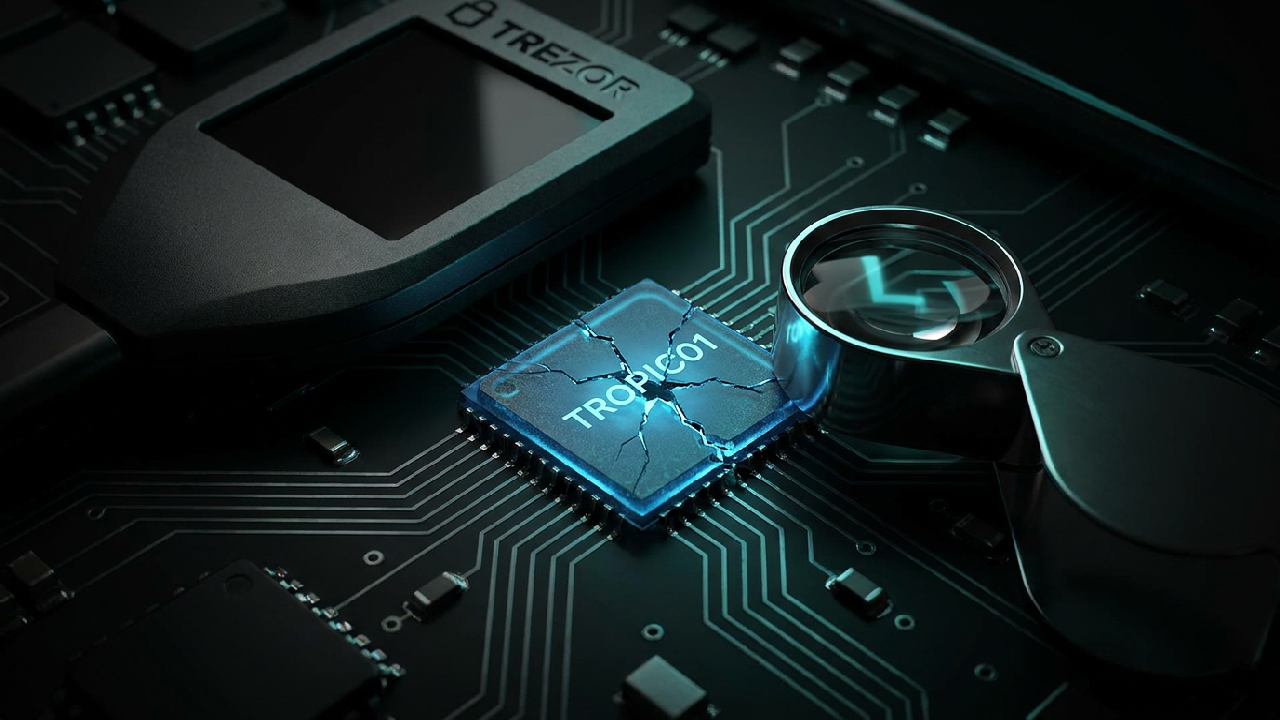
While creating bespoke silicon can offer performance benefits and ideological advantages, it also shifts responsibility onto the designers. A company can no longer lean on the decades of defensive iteration embedded in older certified chips. It inherits the burden of proving that its own design can survive the same class of invasive laboratory attack that smart card manufacturers, payment chip vendors and passport security firms have been battling for years.
That is the uncomfortable part of the TROPIC01 disclosure. The chip was not merely another closed component hidden inside a plastic shell. It was part of a philosophical claim. Tropic Square and Trezor were not only selling a secure element. They were selling the idea that open, auditable silicon could challenge the black box model that dominates hardware security. TROPIC01 was presented as a way out of the old bargain, where users were asked to trust invisible chips designed behind non disclosure agreements, certified by processes most people could never inspect, and defended by a secrecy model that feels increasingly misaligned with crypto itself.
The vulnerability does not destroy that argument, but it complicates it. Open design does not magically produce secure design. Transparency exposes the architecture to review, but the physics of silicon still have to hold under attack. A chip can be auditable and still vulnerable. A security claim can be philosophically attractive and still fail at the transistor level. The strongest version of the open hardware argument is not that openness prevents flaws. It is that openness allows flaws to be found, disclosed, understood and improved in public.
Seen from that angle, this incident cuts both ways. On one side, Ledger Donjon has shown that TROPIC01’s physical attack resistance did not meet the implied strength of its marketing. Laser fault injection is not some casual attack, but it is exactly the kind of invasive technique a secure element is expected to resist. If a chip is promoted as tamper resistant, then a lab attack with lasers is not an exotic unfair test. It is part of the terrain.
On the other side, the disclosure itself is evidence that the open security model is functioning. Tropic Square provided the chip for independent review. Ledger Donjon found a weakness. Tropic Square investigated it, identified an additional exploit path, notified partners, and moved toward public disclosure. That is not the behaviour of an ecosystem trying to bury a flaw. It is the behaviour of one being forced to mature in public.
For users, the practical question is narrower. Does this mean a Trezor Safe 7 is unsafe? Based on the public information, not in any simple sense. The attack requires physical possession of the device, specialized laboratory equipment, invasive fault injection capability, and a successful compromise of only one part of a three chip architecture. Trezor’s defence is that the Safe 7 does not place the entire wallet secret inside TROPIC01. The seed is encrypted on the main microcontroller, and access depends on secret material and PIN logic divided across TROPIC01 and the Infineon OPTIGA secure element. A successful attack against TROPIC01 alone should not reveal the full wallet, authorize spending, or expose the PIN.
That is the clean version. The forensic version is more interesting. The Safe 7 has now moved from marketing claim to adversarial test. Before this disclosure, the phrase “dual secure element” carried a reassuring weight. After this disclosure, the real question becomes how those two secure elements actually cooperate, where secrets are generated, how they are combined, how long derived material exists in memory, what the MCU can see, what it cannot see, and whether a compromised TROPIC01 can influence the wider protocol in subtle ways.
A compromised component does not always need to steal the master secret directly. Sometimes it only needs to lie at the right moment. It might manipulate randomness. It might weaken an authentication flow. It might affect the device authenticity process. It might interfere with PIN related logic. It might help create a downgrade path or a malicious firmware path inside its own boundary. It might not break the whole wallet by itself, but it may become one stage in a chained attack.
That is where the public research will now go. Ledger Donjon has shown that TROPIC01 can be attacked under lab conditions. The next question is whether that compromised chip can be used as a platform against the rest of the Safe 7 architecture. Can it influence the MCU? Can it confuse the second secure element? Can it weaken entropy during wallet creation? Can it participate in a supply chain attack where a device is intercepted, modified, resealed and delivered to a user who believes they are holding a clean product? These are not accusations. They are the next logical questions created by the disclosure.
This is also where Trezor’s design choice becomes both a strength and a liability. The strength is compartmentalization. No single chip is supposed to hold everything. Break one layer, and the others should still stand. The liability is complexity. Every additional layer creates new interfaces. Every interface becomes a protocol boundary. Every protocol boundary becomes a place where assumptions can fail. In security, architecture is not merely a stack of defensive parts. It is the behaviour that emerges when those parts start speaking to each other.
Ledger’s position in this story is not neutral either. Ledger Donjon is a serious research team, and this kind of adversarial testing improves the industry, but Ledger is also Trezor’s competitor. Every Trezor flaw strengthens Ledger’s preferred narrative that closed, certified secure elements offer stronger practical resistance than open silicon. Every Ledger disclosure against Trezor also reopens the older argument about whether users should trust a closed security model they cannot fully inspect.
That rivalry is useful, but it should not be mistaken for pure public service. Ledger benefits when Trezor looks physically weaker. Trezor benefits when Ledger looks philosophically opaque. The user sits between them, watching one company argue that secrets are safer inside certified black boxes, while the other argues that security without transparency becomes a priesthood. Both arguments contain truth. Both contain marketing.
The deeper issue is not Ledger versus Trezor. It is the maturity of hardware self custody itself. Crypto spends most of its energy arguing about chains, tokens, bridges, validators, liquidity and regulation, while the final act of sovereignty often depends on a tiny device sitting in someone’s drawer. That device becomes the border between personal ownership and total loss. If the hardware fails, the ideology does not save you. If the screen lies, the private key may remain technically protected while the user signs away the assets. If the supply chain is compromised, the device may be poisoned before the owner even opens the box.
This is why hardware wallet security cannot be reduced to slogans. “Open source” is not enough. “Secure element” is not enough. “Certified chip” is not enough. “No user action required” is not enough. Each phrase points to one piece of the system, but the wallet is the system. The chip, the firmware, the bootloader, the display, the randomness, the PIN logic, the supply chain, the signing flow and the user’s own verification habits all form the real attack surface.
The TROPIC01 incident should also make the market more honest about certification language. A secure element is not a magical vault. It is a chip designed to resist specific classes of attack within specific assumptions. Some chips have decades of hardening behind them. Some are newer experiments with bold transparency claims. Some are certified through formal processes. Some are open to public inspection. None are invincible. The phrase “secure element” should now be treated less like a badge and more like the beginning of a question. Which chip? Certified by whom? Against what attack class? In what role? Holding what secret? With what fallback if it fails?
For Tropic Square, the road ahead is difficult but not closed. In one sense, the company has suffered the worst possible debut problem. Its flagship chip has been publicly broken in the exact category where it was meant to inspire confidence. In another sense, this is what open hardware security was always going to look like if it became real. Bugs would be found. Weaknesses would be disclosed. Claims would be tested by hostile researchers. The first generation would not be perfect. The question is whether the second generation becomes meaningfully harder because the first one was examined in daylight.
For Trezor, the immediate challenge is communication. Users do not need vague reassurance. They need precise architectural explanation. They need to understand what TROPIC01 does, what OPTIGA does, what the MCU does, where the seed sits, how the PIN unlock path works, and why a TROPIC01 compromise does not cascade into wallet compromise. The company has already published some of this architecture, but this disclosure raises the bar. Once one layer is publicly damaged, the burden moves to proving the isolation of the remaining layers with enough clarity that independent researchers can test the claim rather than merely repeat it.
The strongest outcome would be a full technical postmortem with enough detail for the wider security community to evaluate the real boundaries. Not a panic statement. Not a marketing defence. Not a competitor war dressed as research. A proper map of the attack, the exposed secrets, the limits of those secrets, the affected chip revisions, the manufacturing timeline, the role of future silicon updates, and the exact reason existing Safe 7 devices are not considered at risk. The user does not need to know every transistor path, but the research community does.
For serious holders, the practical lesson is not to throw away every Safe 7. It is to think in layers, just as the device does. A strong passphrase remains one of the most powerful protections against physical wallet compromise because it creates an additional secret not stored on the device. Buying direct from official sources reduces supply chain risk. Verifying addresses on the device screen remains essential. Keeping large funds split across different security setups can reduce single device dependence. Treating any hardware wallet as a perfect object is the first mistake. Treating it as one component in a broader custody system is far more realistic.
The irony is sharp. Trezor built the Safe 7 around the promise of trustless hardware design, and now the trustless process has done exactly what it is supposed to do. It tested the claim. It found the weakness. It forced the architecture into the open. That is uncomfortable, but it is healthier than silence. A hidden flaw inside a closed chip may remain invisible for years. A public flaw inside an open security movement becomes reputationally painful, but technically useful.
The final read is therefore neither panic nor dismissal. The TROPIC01 vulnerability is not, based on current public information, a direct user fund theft route. It is also not a minor branding inconvenience. It is a hardware level failure in a chip that carried a major part of Trezor’s next generation security narrative. The Safe 7 may still be secure as a complete wallet, but that security now depends on the strength of the surrounding architecture rather than the untouched reputation of its most symbolic component.
The market should take the lesson seriously. Self custody is not protected by vibes, logos or philosophical alignment. It is protected by adversarial testing, boring architecture, painful disclosure and the willingness to let trusted ideas get attacked before real users pay the price. TROPIC01 has taken its first public hit. What happens next will show whether open silicon is a genuine path forward for crypto hardware, or whether the industry simply swapped one form of trust for another.
---
Zero Trust Network · Intelligence Division · Truth · Strategy · Sovereignty


Discussion