Let In
An attacker took about $12.6M from Chainflip's vaults with validator key shares, forged internet routes sent miners' work to a fake pool, and bridge keys approved unbacked tokens. US prosecutors moved to forfeit over $1.1B in frozen USDC from the Binance theft.

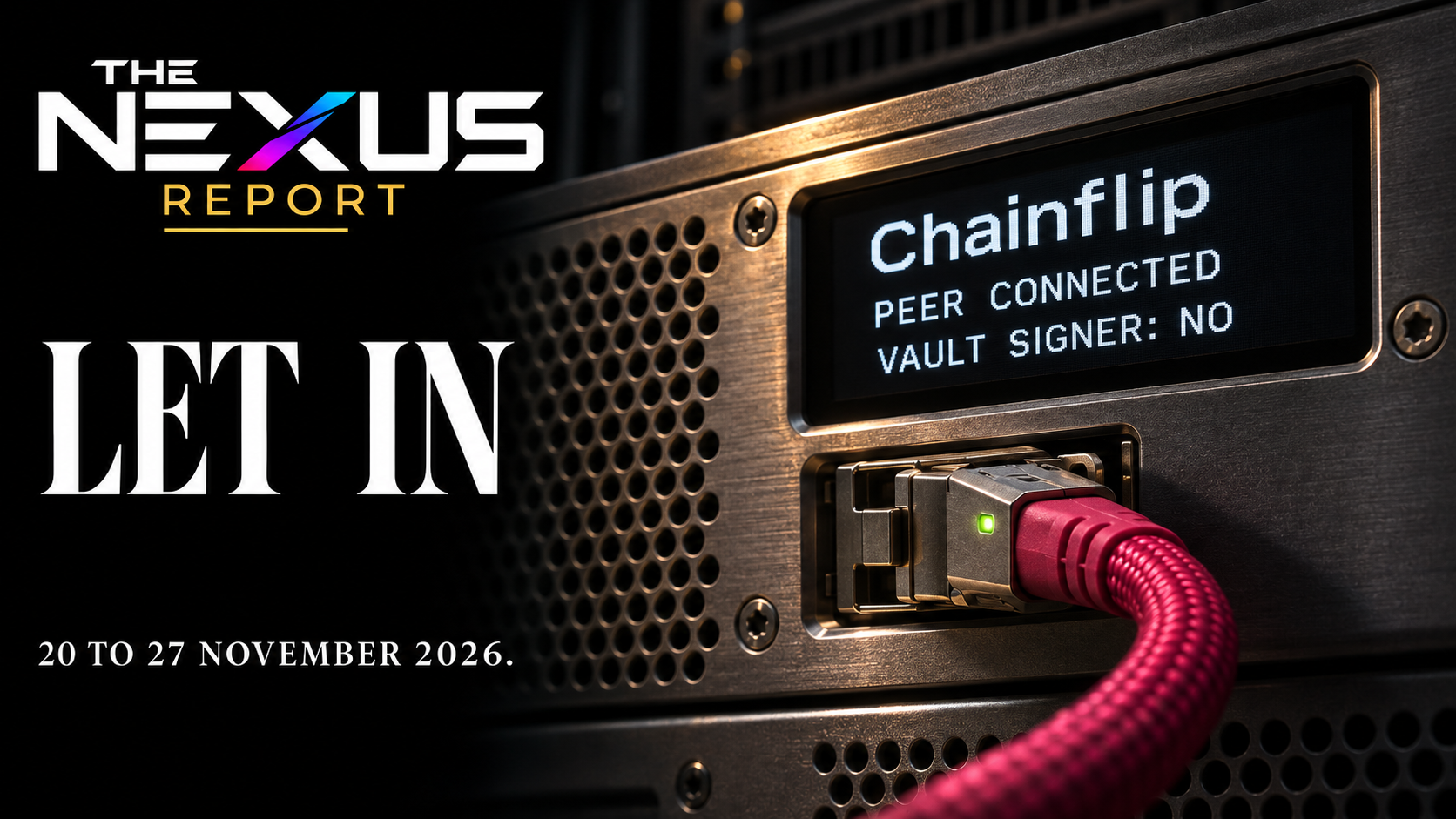
At 06:41 UTC on Saturday 21 November, 122.86 BTC left Chainflip's Bitcoin vault. The attacker's account had never been one of the validators authorised to sign for it.
The day before, at 11:00 UTC, the account had registered as a validator on Chainflip, a network for swapping assets between blockchains. It had received the minimum stake just 79 seconds earlier. At 11:07 UTC it registered its peer identity. That was when the existing validators began accepting its connections, Chainflip says. Investigators believe the attacker used those connections to reach the validators' machines and copy the key shares stored there.
The registration came two hours before this report's window opened. The theft fell inside it. Elsewhere this week, Bitcoin miners' work was routed to an impostor pool, and bridges accepted authorised signatures for tokens with no assets behind them. In each case, the system recognised something it had been built to trust.
Week in 60 Seconds
- Chainflip: an attacker withdrew about $12.6M from the Bitcoin and Ethereum vaults. Chainflip says the account had registered as a peer and investigators believe it obtained enough key shares to sign outside the network.
- Braiins: the mining pool operator says forged internet routes diverted traffic from 1,050 to 1,600 mining sites per episode on 20 November. Miners could reconnect to the usual address and send work to an impostor.
- Fusionist and Cyber: authorised bridge keys approved the creation of unbacked tokens. Cyber replenished its Ethereum lockbox and reopened 14 routes. Fusionist paused Endurance for security work.
- Binance: US prosecutors filed to forfeit more than $1.1B in frozen USDC. Replacement USDC remains conditional on a forfeiture order.
- Arbitrum: Binance's request to release the ETH and ARB frozen in October is now in an on-chain vote scheduled to close on 4 December.
- South Korea: the financial regulator proposed a digital asset law, with initial bank-majority ownership for domestic stablecoin issuers and a cap on exchange ownership.
- Coinkite: a post-mortem says a COLDCARD seed-generation flaw let thieves regenerate keys offline, and firmware updates cannot repair affected seeds.
- Freeze Ledger: 75 freezes worth $93.96M, against 26 worth $33.13M in the previous edition. Tuesday and Friday together account for about 73 per cent of the value.

A Peer, Not a Signer
Over the morning of 21 November, an attacker took 133.34 BTC from Chainflip's Bitcoin vault, and 520.22 ETH, about 3.25M USDC and about 758,000 USDT from its Ethereum vault, Chainflip's incident report says. That was effectively everything both vaults held. Chainflip values it at about $12.6M at that morning's prices.
Chainflip's investigators believe the peer connection gave the attacker access to validator machines through a flaw in their networking software. With enough vault key shares, the attacker could sign withdrawals outside the network. The team was still investigating how the shares were obtained.
Chainflip's monitoring flagged the first theft within eight minutes. A team member raised the alarm at 07:41, an hour after the first withdrawal. By then the attacker had drained the Ethereum vault, swapped its stablecoins for ether and sent 2,909 ETH into the mixing service Tornado Cash. A forced key rotation completed at 08:21 UTC, but the Ethereum vault's key change did not confirm until 08:53, after being held up behind earlier payouts and submitted manually. Swaps, deposits and withdrawals were paused by 08:31. The remaining 10.48 BTC was still accessible through the stolen key, the report says, and was taken at 11:24. It does not yet explain why the rotation left it exposed. All active validators were running patched software by 23 November.
The warning reached an internal channel. It was not connected to automated escalation.
This is Chainflip's second vault loss in about two months. On 12 September an attacker exploited a flaw in how Chainflip processed Tron transaction memos to take about $736,000 in stablecoins from its Tron vault, and validators later voted to repay the affected liquidity providers from the protocol's surplus funds, according to Chainflip's account of the September vote.
As of 16:18 UTC on 23 November, the stolen bitcoin had not moved from its two addresses, Chainflip says. The Ethereum-side funds went into Tornado Cash. Chainflip has contacted law enforcement and hired the investigation firm ZeroShadow. Its return page offered the attacker 10 per cent if it returned the amounts the notice specified by 18:38 UTC on 23 November. Those amounts were calculated on the first 122.86 BTC withdrawal, not the later one, and on the ether sent to Tornado Cash. Chainflip said it would treat a return that met the terms of its offer as a "white hat recovery". No bounty outcome was found in the sources reviewed.
Chainflip said on 23 November that it had initiated returns of liquidity providers' free balances on unaffected chains. Those returns covered assets outside the two drained vaults.
Publication update, 27 November. By 23:10 UTC, Chainflip's second report was public. In Part 2 of its incident report, Chainflip said it had finished accounting for the losses and was developing a protocol-managed recovery fund. It gave no payout schedule and said the stolen bitcoin had still not moved. The protocol remained paused pending security work. Chainflip had sent validators a proposal to limit admission to known operators. It also planned to use SwapKit to offer routes through other providers on its website while its own protocol remained offline.
The Same Address, a Different Server
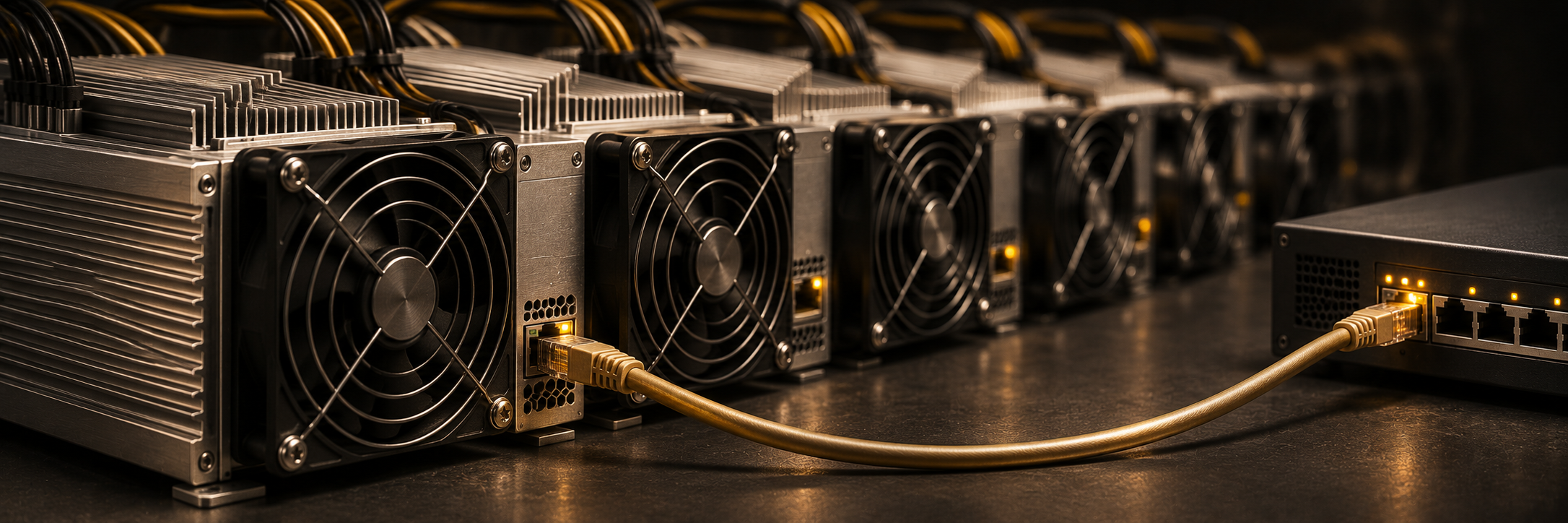
On 25 November Braiins, whose mining pool dates to 2010, published an advisory on a campaign that redirected Bitcoin miners' work to a fake pool. On 20 November, it says, this happened four times, mostly in Europe. Each episode affected between 1,050 and 1,600 mining sites, lasted between six and 49 minutes and diverted between 0.6 and 1.9 EH/s. Those are figures for each episode; the advisory does not give a combined count of sites. Braiins also identified 19 earlier episodes in Latin America between 7 and 12 November, and forged announcements were still reaching some networks on 22 November.
The route was the attack. Networks tell each other which blocks of internet addresses they can reach, and routers prefer the most specific matching route they accept. According to Braiins, the attacker announced a block of 256 addresses sitting inside a block of 4,096 held by a pool's network provider, so traffic for those addresses went to the attacker instead. In a separate capture from Brazil on 16 November, miners reconnected to the same hostname and IP address, and a different server answered. It accepted any username and password, passed on real work from another large pool, raised the difficulty of that work step by step and submitted the miners' results under the attacker's own account. Plain Stratum V1, the protocol most miners use, neither encrypts the connection nor authenticates the pool to the miner.
Braiins says its pool, its Braiins OS firmware and its infrastructure were not compromised. It also ruled out compromise of the affected miners and said the problem did not originate in another pool's infrastructure. The owner of the address block says it never announced the route, and the provider blocked the network spreading it that evening. Braiins gives no BTC or dollar figure, and diverted hashrate is not a measure of rewards lost.
The attack class is old. The advisory itself recalls a 2014 case documented by Dell SecureWorks, in which brief route hijacks let attackers impersonate a mining pool and collect about $83,000 in bitcoin. Virus Bulletin noted at the time that the pool "does not authenticate to the clients". Twelve years on, Braiins describes the same gap. This week's disclosure is a different route from Luxor's Commander incident in the previous edition, where attackers changed settings inside management software.
For miners, the exposure is any pool address beginning stratum+tcp://, including backup entries. Braiins advises removing them and connecting through Stratum V2, or Stratum V1 over TLS on firmware that checks the pool's certificate, which its Braiins OS 26.11 release adds. It asks pools to offer encrypted ports and to publish routing records that let networks reject forged announcements. Route origin validation, a check many network operators already run, would have blocked this route, Braiins says.
Bridges That Trusted Their Own Keys
Fusionist. Between 17:55 UTC on 22 November and 04:47 UTC the next day, the three keys that authorise mints on Fusionist's ACE bridge signed 59 mints of wrapped ACE on BNB Chain with nothing behind them, Bitquery reports. The bridge's burn key then approved requests to release ACE on Endurance, Fusionist's own chain, against the fakes.
Bitquery follows the money in two directions. The exploiter sold about $1.73M of ACE for USDT, and separately 1,154.9 ETH, about $1.98M at Bitquery's price, went into Tornado Cash; how those two figures relate has not been established, so they should not be added together. Others joined in. Within about two hours, the bridge approved requests from 23 wallets to return about 53.7M ACE to Endurance. Its accounting on BNB Chain showed just 148 ACE of backing remaining. Bitquery did not inspect the Endurance vault and could not confirm what it held or paid out. Fusionist revoked the mint keys at 09:59 UTC on 23 November. It says the attacker obtained them through a database flaw and copied deployment secrets after breaking in on 19 November, an account Bitquery could not verify. Fusionist had yet to give a final loss figure at that checkpoint.
On 26 November Fusionist said the replacement bridge and ACE token contract were under audit. Endurance was paused for security work, Crypto Games reported.
Cyber. On 21 November, a helper wallet made itself an administrator of the verifier that approves messages on Cyber's bridge route to Solana, then approved two messages Cyber's own chain never sent, Bitquery reports. The route needed only one verifier signature, so one stolen key was enough. At 16:13 UTC Solana minted 5,213,000 CYBER from the forged message. The thief burned the tokens for transfer to Ethereum, and two minutes after the mint Cyber's Ethereum lockbox released the same amount, leaving 905 tokens behind. Bitquery values the released tokens at about $1.10M at that day's price; the thief sold most of them, and 575.286 ETH, worth about $965,000, sat unmoved in one wallet at Bitquery's checkpoint the next morning. Those are different measures, not two losses. Early on 22 November the thief signed with a replacement key and approved a third forged message, which had not executed at that checkpoint.
In its 24 November post-mortem, Cyber attributed the theft of the verifier signing key to unauthorised access to one of its cloud systems. iTokenly traces two transfers from Cyber's treasury and team allocations that restored 5,213,000 CYBER to the Ethereum lockbox that day. At 05:07 UTC on 27 November, Cyber announced that it had reopened 14 routes across five chains. Routes to and from Cyber's own network remained closed, MABOnChain reported.

A Claim on Frozen Dollars
On 23 November, US prosecutors in Washington filed a civil action to forfeit more than $1.1B in USDC linked to the October theft from Binance, the Justice Department announced. The complaint, filed in the US District Court for the District of Columbia, lists 36 address entries across 18 blockchains. The tokens were already held under a temporary restraining order issued on 12 November and served on Circle the same day. On 24 November the court entered an order on the government's motion for a temporary restraining order, according to a public docket index, which lists it as entry 4.
According to the complaint, Circle says it "does not have the technical ability to transfer" the frozen tokens to the United States. Instead, Circle has agreed to issue the same amount of new USDC and transfer it to the government upon receipt of a court forfeiture order. The filing does not establish that replacement USDC has been issued.
Returning frozen stablecoins is a separate step for Tether too. In emails reviewed by Bloomberg News, a lawyer for Tether told the company that acquired Bittok, an exchange that lost $50M to hackers in June 2020, that a 20 per cent fee would apply to any of its frozen USDT that was reissued, Bloomberg reported on 24 November. More than five years after the freeze, none of Bittok's USDT had been returned. Tether's chief executive told Bloomberg that civil reissuance proceeds in stages because other claimants may come forward. Those terms apply to the cases Bloomberg reported, not to the Circle arrangement in the US complaint.
A token its issuer cannot move can still be replaced.
The complaint traces proceeds to addresses A to D. It describes E to JJ as Binance smart-contract and hot-wallet entries that Binance appeared to have lost control of. In its account of the intrusion, prosecutors cite EIP-7702, an Ethereum feature that allows an account to delegate its behaviour to contract code. US authorities attribute the theft to North Korean military hacking groups.
Tracing continues alongside the legal process. In an update dated 26 November at 13:00 UTC, blockchain analytics firm Elliptic said at least 6,330 BTC, worth about $389M, from the Binance theft had entered coinjoins. These transactions combine multiple users' bitcoin and can complicate tracing. They do not establish cash-out; Elliptic said the vast majority of the stolen funds had not yet been cashed out.
For Binance's own customers, access has returned. In a notice on 26 November, Binance said the withdrawal suspension linked to the incident had ended, with a small number of networks paused separately for maintenance or upgrades. Restored withdrawals are separate from recovery of the stolen assets.
The frozen ETH and ARB on Arbitrum have moved a step forward too. An OpCo roundup of 23 November lists Binance's request to release 8,425.997 ETH and 74,559,805.2 ARB as an on-chain proposal, with voting scheduled to close on 4 December. Binance asks for the funds to go to its recovery address to cover the hot-wallet losses, including replenishing its SAFU emergency fund and treasury reserves. The previous edition noted that the proposal said it would not be submitted on-chain while legal process prohibited the transfer. Earlier in November, in the proposal discussion, the Foundation confirmed that Binance controls the recovery address. The vote was still open.
Who May Issue, Who May Send
South Korea. On 24 November the Financial Services Commission introduced a legislative proposal on digital assets. Domestic stablecoin issuers would need a licence and at least KRW5B in equity, and at first only consortiums with more than 50 per cent bank ownership could issue, although a fintech or technology company could be the largest single shareholder. Issuers would have to hold reserves of at least 100 per cent with a bank or similar institution and pay redemptions in currency immediately. Under the proposal, the reserve manager could pay holders directly if an issuer lost its licence, went bankrupt or could no longer issue or redeem normally following a hack. The proposal would also cap ownership of an exchange at 20 per cent, or up to 34 per cent under a presidential decree and with FSC approval. The FSC says it will support the National Assembly towards "a prompt passage" and gives no timetable. These proposed protections are not yet in force.
Thailand. The consultation deadline for the Securities and Exchange Commission's draft rules on stablecoin transfers through licensed operators was 26 November. The draft, published on 12 November after an earlier round on principles in September, would require the wallets on both sides of a transfer to be "verified as belonging to the same customer", and would bar transfers to or from anyone else's wallet. Inbound and outbound amounts would each be capped at 5 million baht per customer per day at each operator. Transfers between a customer's own accounts at two supervised Thai operators would fall outside the cap if both follow the Travel Rule. The draft also exempts specified operators, market makers and certain token subscription and refund transactions from the cap.
Spain. On 25 November, Spain published a decree-law giving its financial intelligence unit power to suspend the use of a cryptoasset account for up to five working days where there are indications of money laundering or terrorist financing. A pending transaction may be stopped for up to ten working days. The unit must lift either restriction sooner if it is no longer necessary, and a court may confirm or extend it at the public prosecutor's request. The powers are due to take effect on 25 January 2027.
Ukraine. On 25 November the Verkhovna Rada passed bill 10225-d, which would establish a regulatory framework for the country's virtual asset market, with 271 votes in favour, the plenary transcript records. The bill card shows it as being prepared for signature. The securities regulator would admit and supervise market participants, and the central bank would regulate certain types of virtual asset, the securities regulator says, with the law planned to take effect on 1 July 2027.
FinCEN. On 24 November, FinCEN granted temporary relief from certain Bank Secrecy Act filings after what its order calls "a service disruption that is hindering filers' ability to adhere to reporting obligations". Three groups now have until 30 December for submissions due between 18 November and 29 December: institutions that were filing Bank Secrecy Act reports through its Secure Data Transfer Mode on 18 November, companies with beneficial ownership reports due, and individuals required to update a FinCEN identifier. Monitoring for suspicious transactions must continue, and FinCEN's hotline for urgent reports to law enforcement is unaffected. On 25 November four federal banking regulators pledged to refrain from supervisory or enforcement action over covered late filings caused by the disruption during the relief period. They asked supervised institutions to document delayed submissions.
CFTC. On 23 November, staff in two CFTC divisions said that CFTC-regulated derivatives exchanges, swap execution facilities and clearing houses may count bitcoin, ether and payment stablecoins, after appropriate haircuts, towards the financial resources they must hold to cover at least 12 months of operating costs. Those assets cannot meet the separate liquidity requirement, because they are not cash or highly liquid securities under US accounting standards. The advisory "does not create new rules or enforceable rights", the release says.
A Post-Mortem on Weak Seeds
On 24 November Coinkite published its post-mortem on a seed-generation failure in COLDCARD hardware wallet firmware that weakened private keys. The thefts began on 29 July; Coinkite identified the defect the next day and shipped fixed firmware on 31 July for all five supported release tracks. Every theft was carried out offline by regenerating affected keys, it says, and no COLDCARD was remotely accessed. Coinkite's full post-mortem records 300 loss-related tickets from 242 requester accounts as of 18 November. Its announcement gives 236 accounts. Coinkite puts the true affected population higher. The report cites Galaxy Research's August estimate of 1,778.84 BTC stolen across more than 8,600 addresses. The total loss remains unconfirmed.
The flaw survived a good deal of scrutiny. Coinkite says it documented at least 15 independent review and security-research efforts, of varying scope, including two commissioned third-party product reviews. Between 1 May and 26 June, a researcher also ran an AI cybersecurity tool over the COLDCARD firmware. It produced 85 candidate findings and did not find the seed defect.
For owners, a firmware update "does not repair a seed generated on affected firmware". Owners can check their seed-generation method against section 1.4 of the full report and follow the guidance in section 4.1. The post-mortem announcement sets out no compensation plan; Coinkite says it is "still evaluating every option".
Security Intelligence
Zodia Custody: Standard Chartered's crypto custody arm said an unauthorised party had accessed limited client information, including organisation details and, for a small number of clients and employees, a business contact name and email address, Reuters reported on 26 November. Zodia detected attempts to probe its systems on Monday 23 November, took offline the software that connects institutional clients to its platform, and determined on Tuesday that data had been accessed. The service has since been restored. "Based on our investigation to date, there have been no unauthorised transactions," chief executive Richard Clark said. Contact details of that kind can support targeted impersonation of a custodian; the report does not describe any such attempt.
Weekly Freeze Ledger
75 freezes • $93.96M frozen
The ledger runs on its own Saturday-to-Friday period, separate from the report's news window. It covers Saturday 21 November through Friday 27 November 2026, counting issuer-enforced freezes of $200K or more across Ethereum, Tron and XRPL. Each row covers the 24 hours ending at 21:00 UTC on that date.
| Date | Freezes | Frozen |
|---|---|---|
| Sat 21 Nov | 4 | $7.86M |
| Sun 22 Nov | 2 | $559.8K |
| Mon 23 Nov | 4 | $1.43M |
| Tue 24 Nov | 9 | $39.17M |
| Wed 25 Nov | 8 | $9.53M |
| Thu 26 Nov | 8 | $5.67M |
| Fri 27 Nov | 40 | $29.74M |
| Weekly total | 75 | $93.96M |
The ledger recorded 75 freezes worth $93.96M, compared with 26 worth $33.13M in the previous edition, about 2.8 times the value. Two days carried most of it. Tuesday's nine freezes totalled $39.17M, 41.7 per cent of the week; seven of them, worth about $38.13M, came within five minutes from 20:41 UTC, the largest $29.84M. Friday brought the week's highest count, 40 freezes worth $29.74M, all USDT on Tron, including 27 recorded at 19:03 UTC and ten at 16:42 UTC. Tether accounted for 74 of the 75 freezes; the only Circle action was a $2.14M USDC freeze on Ethereum on Wednesday. Tron carried 72 freezes, Ethereum three and XRPL none. The digests do not establish what any of these freezes relate to, including whether any are connected to the incidents in this report.
Daily amounts are rounded as published in the digests; the weekly total sums those rounded figures.
These figures count freeze actions. They do not show how much remains frozen or how much was later recovered.
Source: The Cipher Index Stablecoin Freeze Tracker
What to Watch
- Chainflip: the terms and funding of any recovery proposal, the validator vote on admission and the conditions for restarting the protocol.
- Binance forfeiture: whether a forfeiture order is issued by the District of Columbia court, and whether Circle then issues replacement USDC to the government.
- ArbitrumDAO: the vote scheduled to close on 4 December, and whether an executed release transaction follows.
- Abu Dhabi: the 1 December hearing on the court's restraint of assets linked to the Binance theft.
- Fusionist: when Endurance reopens and what holders can recover.
- Coinkite: the outcome of its review of options for affected COLDCARD owners.
- South Korea and Thailand: a bill introduced to the National Assembly, and Thailand's final notification with a commencement date.
- Paxos: from 30 November, Paxos Trust Company will reject transfers of $3,000 or more to external addresses that lack saved Travel Rule information.
- Mining pools: encrypted Stratum ports, and routing records published by the network providers behind pools that still accept unencrypted connections.
Corrections and Continuing Investigations
Previous edition, Lighter: we clarified on 22 November that the smart contract Guardian paused withdrawals. The Security Council subsequently returned funds. The earlier wording attributed the pause to the council.
Fluidkey: the previous edition reported no loss figure or cause from Fluidkey. Its incident report now says about $1.6M was taken from 52 accounts across six chains between 17:28 and 18:05 UTC on 19 November. The attacker used two flaws in a logging tool Fluidkey hosts itself to read users' session tokens from its logs, used them to prepare and approve transfers and raise two-factor limits, then sent small payments to prompt users to open and unlock the app, which signed the prepared transfers. Private keys never left users' devices; a prepared transfer "could not execute by itself", Fluidkey says. Service returned at 15:27 UTC on 20 November, with all sessions ended and transfer requests now requiring the user's own key. In a 27 November update, Fluidkey says Tether froze 1,549,450 USDT across 12 Tron addresses at 03:09 UTC on 23 November, following requests from law enforcement. Fluidkey told affected users on 25 November. The authorities handling the criminal proceedings decide whether to release the funds.
Gonka: in a 23 November update, Gonka says the attackers returned all stolen funds still under their control on 19 November. Work on a replacement bridge and token had begun. Gonka said the bridge would go to a community vote before launch. Any compensation would require a separate governance decision. Its Ethereum bridge contract "cannot be paused", Gonka says, and no claims process was open at the time of that update. Proposal 120 included an independent review of the replacement bridge. Voters rejected it when voting closed at 14:01 UTC on 26 November. The vote concerned a security contract. Holder compensation remains a separate decision.
XMR1: the previous edition reported that the cause of the wrapped Monero token's collapse had not been established. Wagyu's operator, PerpetualCow, has since said the token's deployer key was kept on an old server rented from the Icelandic host 1984, which reportedly suffered a serious cyberattack, crypto.news reported on 20 November. That is the operator's account; Bitquery's tracing shows which account sent the tokens but not who used its key. The operator said market makers who lost money would be refunded in full and anyone else who took a loss reimbursed personally. At 19:01 UTC on 23 November the operator said Wagyu had reopened, most affected users had received refunds and a few larger holders had agreed to repayment plans. The statement gave no aggregate amount repaid.
Kava: proposal 223 passed on 23 November. New borrowing on HARD Lend is now blocked, while partial repayments remain possible under the restored $10 minimum-debt rule. Proposal 224, passed the same day, restored the Stability Committee's authority to adjust risk settings for the BitGo WBTC and Meson mBTC lending markets.
Further Reading
- Permission to Move, the previous Nexus Report
- Chainflip's incident report, part 1
- Chainflip's publication update, part 2
- Braiins on hashrate hijacking through unencrypted Stratum V1
- The Justice Department's forfeiture complaint
- Bitquery on the Fusionist ACE bridge
- Coinkite's COLDCARD post-mortem
Published by the Zero Trust Network. Research supported by CipherBot and CipherIndex.


Discussion