Meta’s Faceprint Glasses: The Surveillance Feature They Forgot to Hide
Meta did not just remove code. It exposed intent. Hidden inside the Ray-Ban companion app was the architecture for faceprints, recognition alerts and biometric scanning through wearable cameras. The glasses were not live, but the direction was clear.

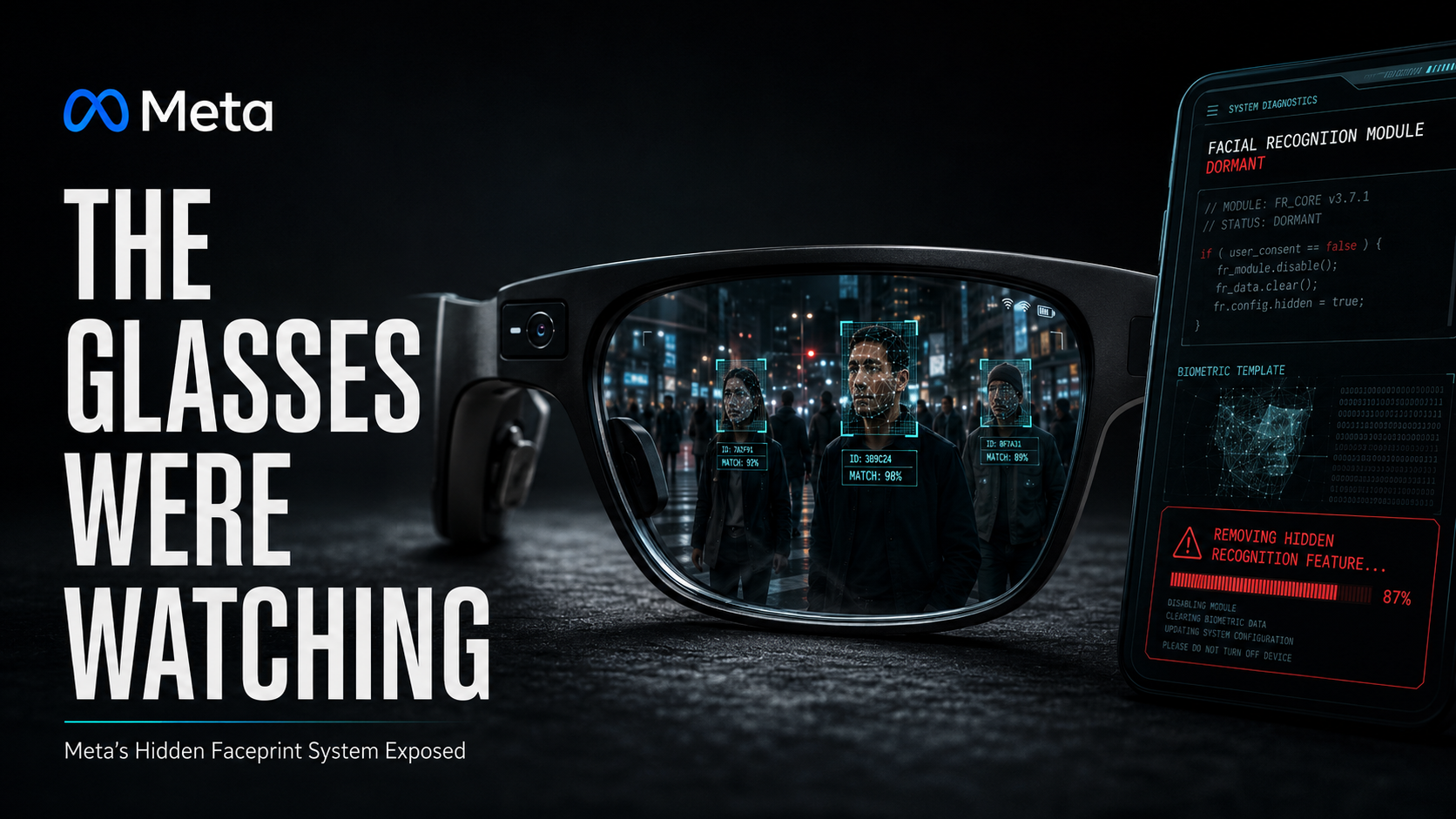
Meta has issued a software update removing a latent facial recognition system from the companion application for its Ray-Ban smart glasses. The update, pushed on 5 June to the Meta AI app, followed public reporting and independent verification of dormant code capable of biometric analysis. Security researchers conducting static analysis of the application discovered embedded functions designed to process images captured by the glasses, convert faces into unique biometric signatures, and store these identifiers. The system, reportedly known internally as NameTag, was not active for end-users but its presence in the production codebase confirmed Meta's intent to deploy such a capability.
Anatomy
The system's architecture relies on a hardware and software pairing controlled by Meta. The Ray-Ban Meta smart glasses serve as the primary sensor, capturing high-resolution images of the wearer's environment. These images are then wirelessly transmitted to the user's smartphone, where the Meta AI companion app processes the data. The latent code resided within this application. Analysis confirmed the presence of machine learning models and libraries for facial detection, the generation of biometric templates or "faceprints," and the framework for triggering alerts such as "Person recognized."
This structure centralizes control entirely with Meta. The corporation manages the device firmware, the companion app's codebase, and its distribution via the Apple App Store and Google Play Store. The user possesses no granular control over the software's underlying functions. Removing the facial recognition code was not a user-configurable option; it was a unilateral decision by Meta to issue a patch, operating a centralized kill switch for a capability never formally announced or activated. The system was designed to operate on individuals in the public sphere, none of whom would have consented to the capture and analysis of their biometric data.
Pattern
This action is consistent with Meta's established pattern of pursuing biometric data collection until met with significant legal or public resistance. The company's prior facial recognition system on its primary social media platform, used for "Tag Suggestions" in photos, was progressively curtailed and ultimately discontinued in 2021. This followed a $650 million settlement in a class-action lawsuit under the Illinois Biometric Information Privacy Act (BIPA) and sustained regulatory pressure under Europe's GDPR.
The current incident demonstrates a tactical evolution: embedding a controversial capability in a dormant state within a widely distributed application. This allows for internal testing and preparation for a future launch while avoiding immediate public scrutiny. The strategy failed when the code was discovered through reverse engineering, revealing strategic intent ahead of schedule. This approach mirrors a broader industry trend where consumer hardware, from smartphones to smart speakers and now eyewear, is leveraged to create vast, distributed sensor networks. The device itself is merely the endpoint; the primary asset is the continuous stream of environmental and biometric data it can be engineered to collect.
Forward Implication
Meta's swift removal of the code, coupled with its refusal to provide firm commitments about the future of the NameTag system, indicates a tactical withdrawal rather than a permanent change in strategy. The company is likely preserving the capability for a future deployment, pending a more favorable regulatory climate or a more refined public relations strategy. The most probable path for reintroduction involves framing the system as a user-controlled, "opt-in" feature. This approach shifts the narrative towards individual choice, obscuring the critical issue of non-consensual biometric scanning of the public.
The public discovery of this dormant code establishes a new front in the analysis of wearable technology. Security researchers and privacy advocates will now intensify their scrutiny of all companion applications for augmented reality and smart-wearable devices. Competitors, including Apple with its Vision Pro and Google with its own AR ambitions, are now on notice. Their software will be meticulously examined for similar latent surveillance functions, whether active or not. The precedent has been set: the risk of reputational damage from the discovery of pre-installed, non-disclosed biometric capabilities has significantly increased for any corporation operating in the wearables sector.
---
Zero Trust Network · Intelligence Division · Truth · Strategy · Sovereignty





Discussion