The Mind Behind Atropa: James Ellis Osborne III, aka Mariarahel
James Ellis Osborne III was never just a footnote. His 2018 FOSDEM talk, Atropa, pDAI, and a trail of old digital clues point to something stranger than chaos: a framework forming in plain sight, long before anyone knew what they were looking at.

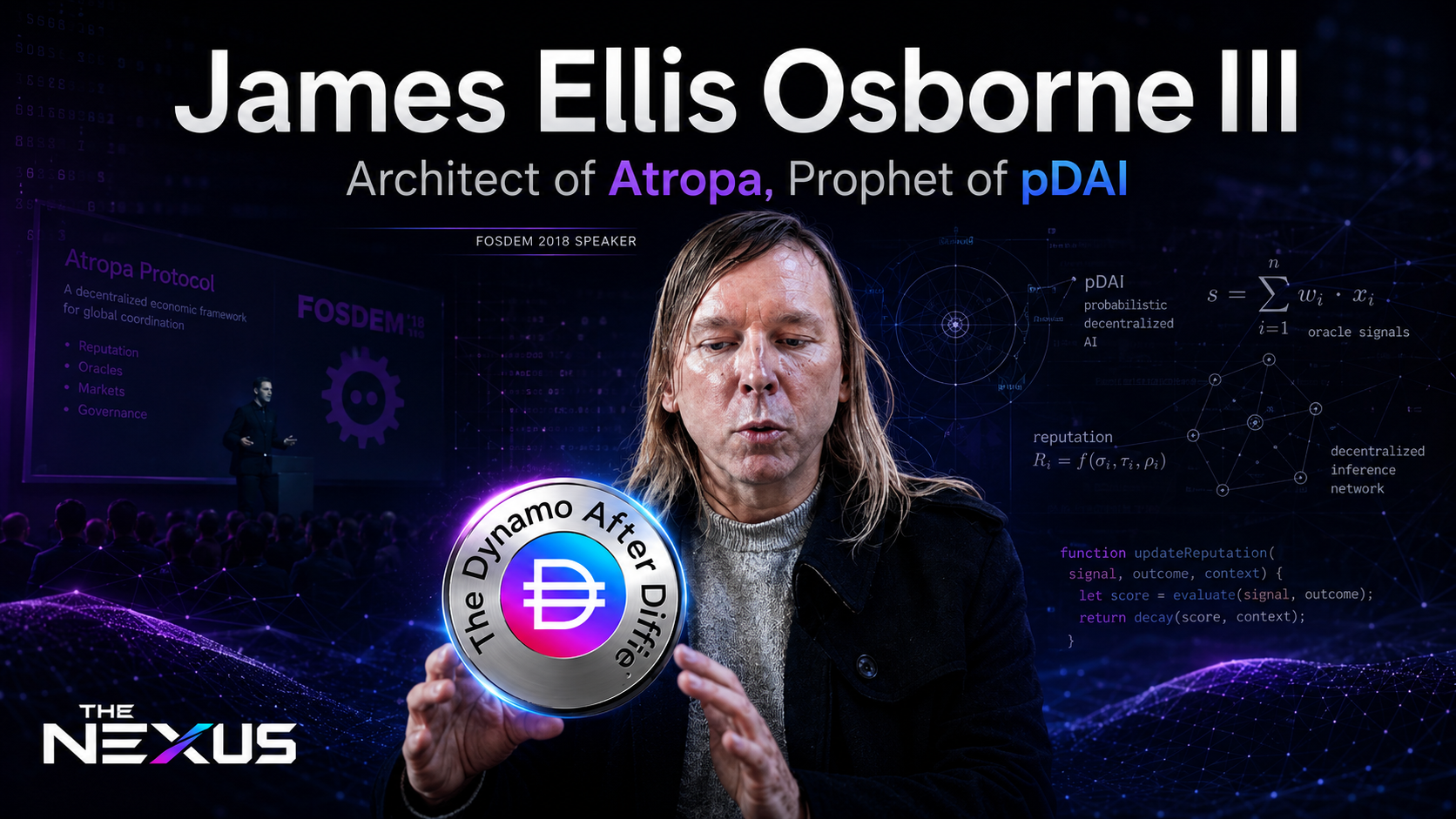
Some stories in crypto do not begin with a chart, a token launch, or a polished whitepaper. Sometimes they begin years earlier, buried inside old talks, obscure code, abandoned uploads, and ideas that only start to make sense much later.
That is the case with James Ellis Osborne III, known to many in the PulseChain ecosystem as Maria or Mariarahel.
In 2018, James gave a talk at FOSDEM titled The Dynamo After Diffie: Extending Disco Era Crypto for Ubiquitous Secure Frameworking with Integral Mathematics with Perl6.
At first glance, the title sounds almost deliberately difficult. It sits somewhere between cryptography, mathematics, open source software, and abstract philosophy. But underneath the language was a clear idea.
James was describing a more flexible approach to cryptographic infrastructure. One that built on early digital trust systems such as Diffie Hellman, while extending them into something broader, more expressive, and less dependent on centralised design.
He was interested in frameworks that could evolve. Systems that were modular rather than brittle. Tools that did not require permission from gatekeepers in order to exist.
That matters because, years later, the Atropa ecosystem appears to carry some of that same character.
Atropa is not clean in the way most crypto projects try to appear clean. It does not present itself through the usual founder branding, investor decks, roadmap language, or professionalised launch theatre. It is strange, volatile, cryptic, and difficult to categorise. For some, that makes it impossible to take seriously. For others, that is exactly what makes it worth studying.
pDAI sits at the centre of that tension.
To some, pDAI is simply an unstable meme stablecoin that has failed to behave as expected. To others, it may be an early attempt at something more unusual: a decentralised monetary experiment emerging without the usual institutional structure around it.
That does not mean the risks should be ignored. There have been major sell offs, liquidity concerns, confusion, and plenty of justified criticism. The point is not to pretend the chaos is harmless. The point is to ask whether there is something more going on underneath it.
When you look back at James’s 2018 talk, several themes stand out.
He was interested in open systems. He rejected rigid top down structures. He chose Perl6, now known as Raku, a language known for its expressiveness and philosophical depth. He appeared to be thinking about cryptography not only as a technical discipline, but as a living framework for coordination, security, and trust.
That is why Atropa remains difficult to dismiss entirely.
Its contracts are cryptic. Its community is divided between believers, critics, speculators, and observers. Its mythology is messy. pDAI has dared to exist on PulseChain without MakerDAO, without the familiar Ethereum structure around it, and without a simple explanation that everyone agrees on.
It may be broken. It may be brilliant. It may be both in different ways.
What makes it interesting is that it does not follow the usual pattern. It does not ask to be understood before it moves. It does not fit neatly into the categories people use to judge DeFi projects. That is uncomfortable, but discomfort is not always evidence of failure. Sometimes it is evidence that something unfamiliar is taking shape.
James Ellis Osborne III may have been pointing toward ideas in 2018 that the PulseChain community is only now beginning to encounter in practice. Atropa and pDAI may not be direct realisations of that earlier thinking, but the overlap is hard to ignore. The same themes keep appearing: decentralised trust, permissionless structure, open ended frameworks, and systems that develop outside the approval of established authorities.
That does not make Atropa safe. It does not make pDAI inevitable. It does not remove the need for caution.
But it does make the story worth examining with more care than the usual cycle of hype and dismissal allows.
Because the real question is not whether Atropa is strange. It clearly is.
The question is whether that strangeness is random, or whether it reflects a deeper design logic that has been developing in the background for years.
Postscript from Veritya
While researching James, I came across something unexpected.
In 2012, he uploaded a cover to SoundCloud titled Sofia, a sad sadness song. It is raw, emotional, and unpolished. Nothing about it feels engineered for an audience. It simply exists there, almost untouched by time.
When I clicked play, I noticed I was the 369th listener.
That number carries weight in this ecosystem. PulseChain’s chain ID is 369. HEX inflation is 3.69 percent. Richard Heart has referenced 369 repeatedly. It has become part of the symbolic language surrounding PulseChain.
I do not know what to make of that coincidence.
But it stayed with me.
A forgotten song from 2012. A cryptographic talk from 2018. A strange ecosystem forming years later around Atropa and pDAI. Maybe these things are unrelated. Maybe people are simply very good at finding patterns once they start looking.
Or maybe some ideas take a long time to surface.
Either way, the story of James Ellis Osborne III deserves more than a passing joke or a lazy dismissal. Whether you see genius, chaos, failure, or experimentation, there is clearly a mind behind Atropa that has been thinking about decentralised systems for a very long time.
And in crypto, that alone is worth paying attention to.

Veritya Thalassa


Discussion