One Request. $344 Million Frozen. So Who Actually Owns It?
The headline writes itself, but most people still won’t see what just happened.

The headline writes itself, but most people still won’t see what just happened.
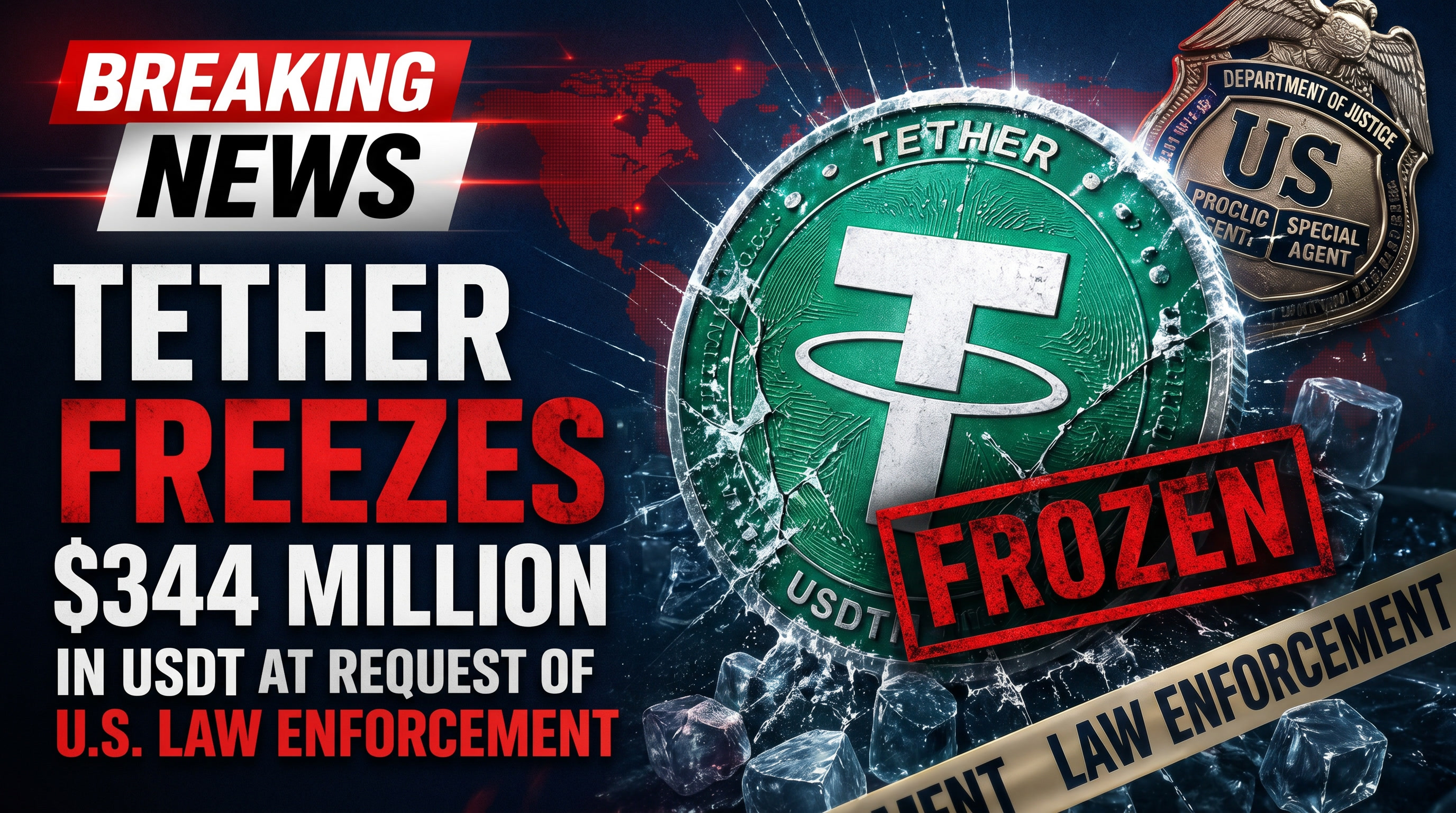
Tether has frozen $344 million worth of Tether (USDT) at the request of United States law enforcement. Just like that, hundreds of millions in so called “digital dollars” were rendered immobile, not by a bug, not by a hack, not by a market event, but by a coordinated instruction that passed cleanly through the system. No friction. No resistance. No delay that mattered.
If you’re paying attention, this isn’t a story about crime or compliance. It’s a story about control, and more importantly, where that control actually sits.
USDT is often spoken about as if it exists inside the same philosophical framework as Bitcoin or other decentralised networks, but that framing has always been a convenient illusion. Tether is not a protocol in the way people like to imagine. It is an issuer. It holds reserves, manages supply, and crucially, it retains the ability to intervene at the contract level. Freezing funds is not an edge case. It is a built in function.
What we are witnessing here is not a failure of crypto. It is the system working exactly as designed.
Because once a token can be frozen, it is no longer a bearer asset in any meaningful sense. Ownership becomes conditional. It exists at the pleasure of whoever has the authority to enforce those conditions. In this case, that authority extends beyond the company itself and into the hands of state actors who can compel action when they see fit.
You can dress that up however you like. You can call it safety, regulation, necessary oversight. But the underlying reality does not change. If an asset can be switched off, it is not neutral. It is not censorship resistant. And it is certainly not trustless.
This is where the wider market continues to trip over its own narrative. Stablecoins have become the bloodstream of crypto trading, liquidity, and onboarding. Billions flow through them daily. Entire ecosystems lean on them as their base layer of pricing and settlement. Yet at the core of many of these systems sits a mechanism that allows for unilateral intervention.
That contradiction is not theoretical anymore. It is operational.
We have now seen repeated instances where addresses are blacklisted, funds are frozen, and activity is halted. Each time, the justification is different. The mechanism is the same. And each time it reinforces a simple truth that many still resist: not all crypto assets operate under the same assumptions.
There is a fundamental divide between systems that require trust in an issuer and systems that remove that requirement entirely. One model depends on governance, discretion, and compliance pathways. The other depends on code that cannot be altered once deployed.
This event lands squarely in that divide.
And it raises a question that cuts through all the noise, all the branding, all the marketing that tries to blur these lines for convenience.
What do you actually hold when you hold something like USDT?
Because if the answer includes the possibility that it can be frozen on demand, then what you are holding is not just a digital asset. You are holding a permissioned instrument operating inside a framework that can reach in and change its state.
For traders, that might be an acceptable trade off. For institutions, it is often the entire point. But for anyone who entered this space under the premise of sovereignty, of self custody that cannot be overridden, this should land differently.
It should force a recalibration.
Not emotional. Not reactive. Just clear.
This is not about attacking one company or one decision. It is about understanding the architecture you are interacting with. The rules are not hidden. They are just ignored when it is convenient.
Events like this remove that luxury.
They make the invisible visible.
---
Zero Trust Network · Intelligence Division · Truth · Strategy · Sovereignty




Discussion