Pavel Durov’s Definition of Decentralization
Pavel Durov recently shared new validator distribution data for TON, highlighting the network’s 400 validators spread across six continents while arguing that Telegram becoming the largest validator actually helped reduce centralization risk by opening the door for major custodians and exchanges to
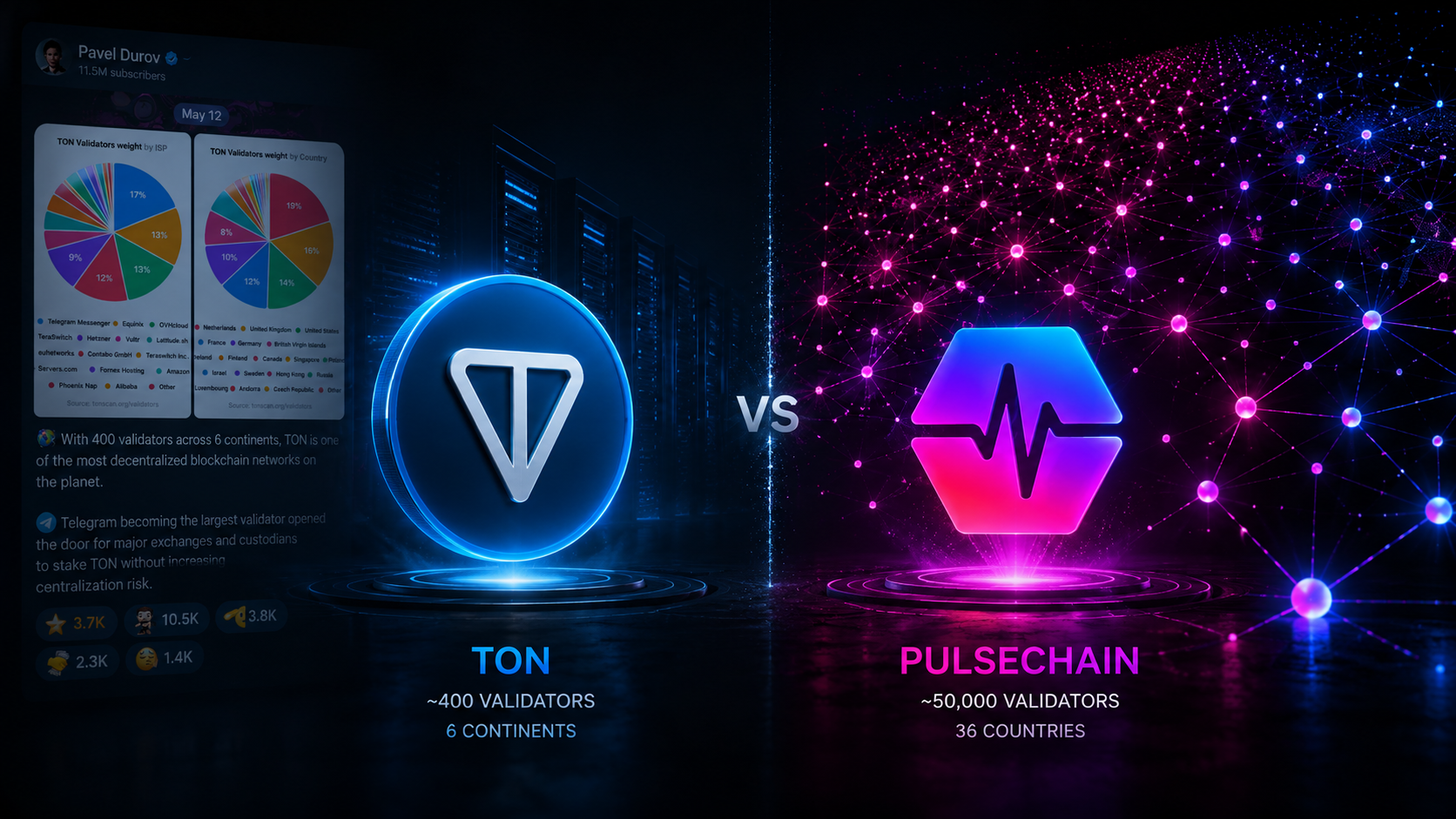
Pavel Durov recently shared new validator distribution data for TON, highlighting the network’s 400 validators spread across six continents while arguing that Telegram becoming the largest validator actually helped reduce centralization risk by opening the door for major custodians and exchanges to participate without concentrating power further.
The charts are designed to create the impression of massive decentralization through geographic spread and institutional participation, but once you step back and compare the numbers to genuinely open validator systems, the scale starts looking very different. Four hundred validators across six continents may sound impressive to a mainstream audience, yet in blockchain terms it is still an extremely small validator set, particularly when large portions of the network weight remain tied to major infrastructure providers and centralized operational environments.
This is where the comparison with PulseChain becomes extremely important.
TON’s validator distribution charts tell an interesting story, but not necessarily the story the marketing implies. Geography is only one layer of decentralization. Infrastructure concentration matters just as much, and in many cases far more.
The second chart is where the real picture starts emerging.
A large percentage of TON’s validator weight sits inside a relatively small cluster of infrastructure providers and hosting environments. Telegram itself holds a major share, while companies like Equinix, OVHcloud, Hetzner, Vultr, Amazon, and Alibaba collectively form much of the network’s operational backbone. That creates a very different type of topology than a system where validation is distributed across tens of thousands of independent operators with low barriers to entry.
PulseChain sits in a completely different category structurally. Around 50,000 validators distributed across roughly 36 countries is not simply “more validators.” It represents a fundamentally different attack surface and coordination problem. Once validator counts move into that range, combined with open participation and low operational friction, the dynamics begin to resemble a true public swarm rather than a managed validator federation.
The difference becomes obvious the moment you stop thinking like a marketer and start thinking like a state actor.
If a government wanted to pressure TON validators, where would it start? Large hosting providers. Major cloud environments. Corporate entities with legal departments. Known infrastructure chokepoints. The validator graph may look geographically distributed, but operationally much of it still funnels through identifiable commercial infrastructure.
With PulseChain, the problem becomes far messier. Tens of thousands of validators spread globally creates enormous coordination friction. Enforcement becomes probabilistic instead of deterministic. You are no longer dealing with a network that can realistically be leaned on through a handful of infrastructure relationships.
This is the distinction most of crypto still fails to understand. Validator count alone means nothing. Geography alone means nothing. The real question is whether the network behaves like a distributed organism or a distributed-looking corporation.
TON is fascinating because it sits in the middle ground between those two worlds. It is far more distributed than most modern VC-driven chains, but it still carries strong gravitational dependence on major infrastructure operators and Telegram’s surrounding ecosystem. The network gains usability and rapid adoption through that structure, but those same efficiencies create potential pressure points.
PulseChain took a far more chaotic route. Lower barriers to validation, massive validator expansion, and the absence of a corporate operational center creates a network that is much harder to socially or politically steer once in motion. That chaos comes at the expense of institutional neatness, but from a trustlessness perspective it changes the equation entirely.
The uncomfortable reality is that much of the industry optimized for growth first and sovereignty second. What emerged were networks that look decentralized from the surface while still inheriting many of the same leverage points the old system has always relied on. The coming years will likely expose the difference between systems that are geographically distributed and systems that are genuinely difficult to control once political pressure enters the room.
Because in the end, decentralization is not measured by how many countries appear on a chart. It is measured by how difficult it becomes for any single force, corporate or governmental, to quietly reach into the machine and change its behavior once the pressure truly arrives.
---
Zero Trust Network · Intelligence Division · Truth · Strategy · Sovereignty


Discussion