Robinhood Chain: The Sheriff Built a Blockchain
Robinhood calls its new chain permissionless. Its own documentation tells a rather different story. The name came from an outlaw. The architecture looks far more like the sheriff.

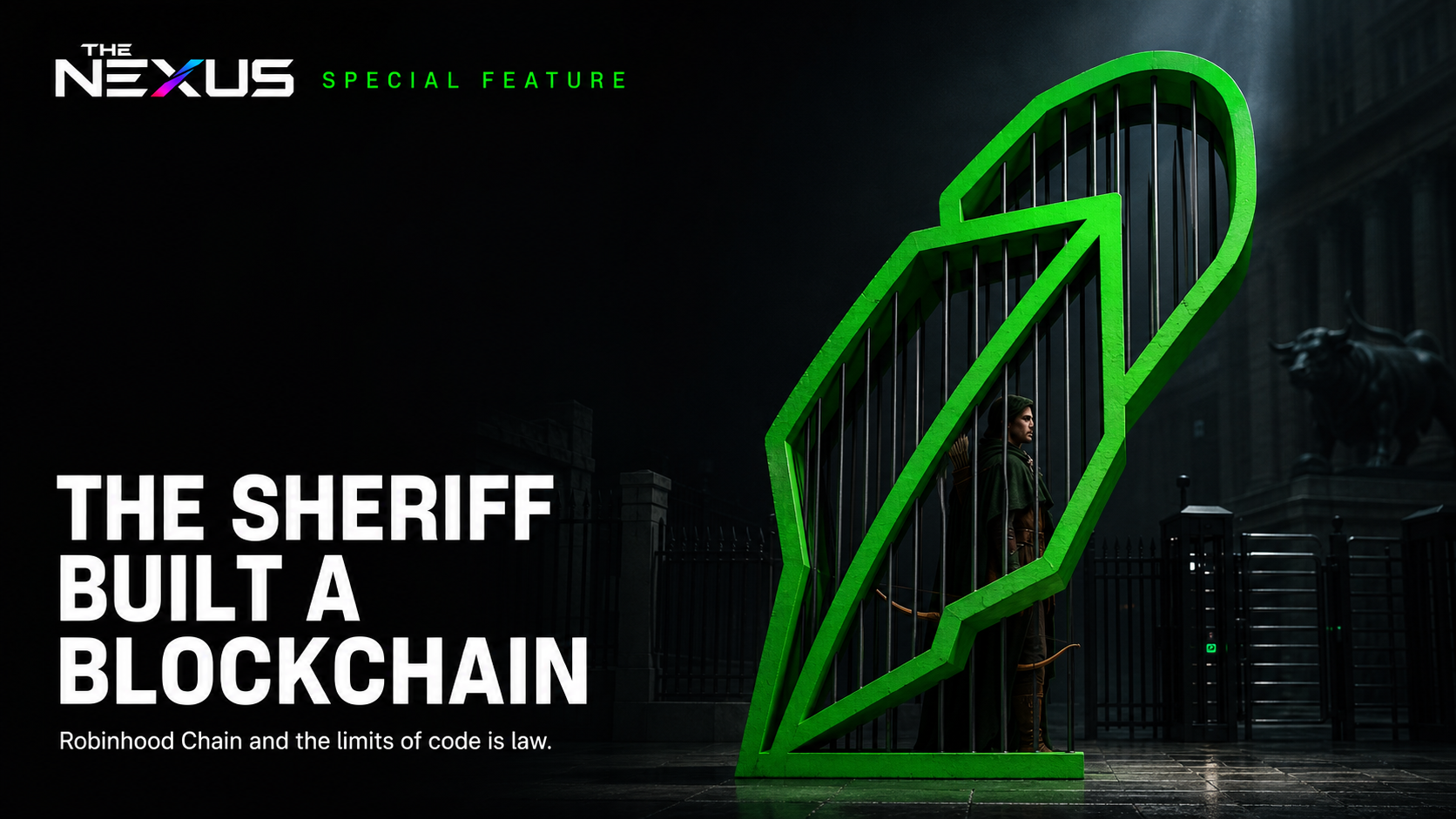
Robin Hood was an outlaw. Whatever version of the legend you prefer, the moral architecture remains the same: power had accumulated behind walls, the rules served those who wrote them, and Robin Hood existed outside the system because the system itself had become the problem.
Robinhood Markets borrowed that name to build a regulated financial company. Now it has borrowed the language of crypto to build Robinhood Chain, an Ethereum Layer 2 designed for tokenised shares, real-world assets, decentralised exchanges, lending markets and automated financial agents.
The public mainnet launched on 1 July 2026. Robinhood describes it as permissionless, open and built to bring traditional finance and decentralised finance together. It is an Arbitrum-based rollup, uses Ethereum blobs for data availability, charges gas in ETH and allows developers to deploy EVM-compatible smart contracts. It is technically real, publicly accessible and considerably more sophisticated than a private corporate database with a blockchain label pasted across it. Robinhood’s launch announcement and developer documentation establish that clearly.
But technical reality is not the same as trustlessness.
A blockchain can publish its data to Ethereum while retaining control over who may transact. It can expose smart contracts to the public while restricting who may validate them. It can allow self-custody while giving an issuer the power to freeze the asset inside that wallet. It can make every intervention visible without removing the authority to intervene.
Robinhood Chain is not interesting because it is fake. It is interesting because it shows how much of blockchain technology can be adopted while leaving the governing power of traditional finance largely intact.
Permissionless, but in which direction?
Robinhood says that anyone can access the chain, transfer assets or build applications without platform lock-in. At the surface level, that is true. The network has a public RPC, a public block explorer, an Ethereum bridge and instructions for running a full node. Developers do not need Robinhood’s permission to deploy an ordinary smart contract. Users can connect through an EVM wallet and pay gas with ETH. Robinhood’s public description calls this “permissionless by design”.
The difficulty is that permissionlessness is not a single switch. There is permissionless access, permissionless transaction inclusion, permissionless validation, permissionless governance and permissionless ownership. A chain can score well in one category and fail completely in another.
Anyone can observe Robinhood Chain. Anyone can reproduce its state. Anyone can submit a transaction. That does not mean every valid transaction will be included, that anyone can defend the chain against an invalid state transition, or that the rules cannot be changed by a selected group.
The entrance is public. The control room is not.
The sequencer sees the transaction first
Like other Arbitrum rollups, Robinhood Chain uses a sequencer to accept, order and execute transactions before batches are posted to Ethereum. Users receive a fast soft confirmation, but Robinhood’s documentation acknowledges that this early confirmation still depends on the ordering returned by the sequencer. Only after the batch has been posted to Ethereum does that ordering become secured by Ethereum, with full finality following later. Robinhood’s finality documentation describes the distinction explicitly.
This is not automatically disqualifying. Most major rollups currently rely on centralised or tightly controlled sequencers because they provide speed, predictable ordering and a smoother user experience. The important question is what authority has been attached to that position.
Robinhood Chain does not operate a neutral inclusion policy. Its documentation states that it maintains compliance through sequencer-level screening and that transactions associated with sanctioned addresses will be excluded. Read calls and balance queries remain available, but prohibited transactions are never executed. The network documentation presents this as a standard difference between Robinhood Chain and Ethereum.
That means the chain does not merely record legal intervention after it occurs. Compliance is positioned directly inside the transaction pipeline.
Arbitrum’s linked compliance architecture goes further. It allows a chain owner to connect an external provider such as TRM Labs or Chainalysis, maintain a restricted-address list and block transactions involving those addresses before execution. The system can examine direct transfers, token approvals, contract calls, contract creation and other interactions.
The conventional escape hatch from a censoring rollup sequencer is the delayed inbox. A user sends the transaction through Ethereum and waits for it to be forcibly included. Arbitrum’s compliance system is designed to close that route as well. An authorised entity can register a transaction hash with a guardian contract so that a restricted transaction arriving through the delayed inbox is forcibly failed during state execution. The transaction can consume gas while producing no successful action. Arbitrum’s compliance documentation describes the system in detail.
Robinhood’s public documentation does not expose every runtime setting behind its deployment. It does, however, state that sanctioned transactions are excluded and directs developers to this Arbitrum compliance system.
Under a code-is-law model, a correctly signed transaction that satisfies the protocol rules is valid regardless of whether an intermediary approves of its sender. Under Robinhood Chain’s model, the protocol rules themselves can contain a privately supplied list of addresses whose otherwise valid transactions must fail.
Code is still law. The problem is that the sheriff helps write the code.
Two validators, both admitted by permission
Robinhood Chain uses Arbitrum’s BoLD dispute protocol to challenge invalid state assertions. BoLD is important technology. It was developed so that a single honest validator could theoretically defend the correct state against multiple dishonest challengers.
Robinhood has chosen not to make that validation process permissionless.
The network currently has two validators, operated by Offchain Labs and Alchemy. Anyone wishing to become a validator must be placed on an allowlist, post a one-WETH bond and contact Robinhood for admission. Robinhood’s governance documentation and node instructions confirm both the current validator count and the admission requirement.
This creates an important difference between running a node and protecting the canonical state.
A public full node can independently reconstruct the network and detect what happened. It cannot automatically join the validator set and challenge an invalid assertion. Observation is open. Enforcement is reserved.
BoLD was expressly designed to enable permissionless validation. Robinhood uses the technology with a permissioned validator set. The cryptography can reduce the amount of trust placed in those validators, but it does not remove the institutional gate around becoming one.
Eight signers govern the machine
Protocol governance sits with an eight-member Security Council. Robinhood controls two seats. The other six are held by BitGo, Chainlink Labs, Fireblocks, Offchain Labs, Paxos and Talos.
Routine actions require six of the eight signatures and then pass through a seven-day onchain timelock. Emergency actions require seven signatures but bypass the delay.
This is more distributed than unilateral Robinhood control. Robinhood cannot casually rewrite the network alone, and the security thresholds make compromise or reckless intervention harder. Any credible assessment should acknowledge that.
It is still a selected institutional council, not permissionless governance. Users do not elect its members. Validators do not gain governance power through open participation. Developers and asset holders cannot veto upgrades. In an emergency, seven approved organisations can change the system without waiting through the normal timelock.
The model is institutional multisignature governance with public execution. It may be competent. It may even be prudent for regulated financial products. It is not governance minimisation.
The asset above the chain
The most important weakness is not the Layer 2. It is the asset issued on top of it.
Robinhood’s new Stock Tokens are standard ERC-20 contracts. They can be held in compatible wallets, transferred onchain, traded through decentralised exchanges and used inside lending markets or other applications. Prices are supplied through individual Chainlink feeds, while corporate actions such as dividends and stock splits are reflected through an onchain multiplier. Robinhood’s Stock Token documentation explains the technical design.
This is genuinely useful infrastructure. A tokenised equity product can move between applications, become collateral, settle outside normal brokerage hours and interact with financial software in ways that a conventional brokerage entry cannot.
But the token is not the share.
Robinhood states that the new Stock Tokens are tokenised debt securities issued by Robinhood Assets (Jersey) Limited. They provide economic exposure to an underlying security, but holders receive no legal or beneficial ownership rights in that underlying security. They are also unavailable in the United States and restricted in several other jurisdictions, including the United Kingdom. Robinhood’s legal disclosure makes that structure clear.
You do not own the NVIDIA share. You own a blockchain-based claim issued by a Robinhood entity whose value is linked to NVIDIA.
The difference becomes unavoidable inside Robinhood’s 167-page base prospectus. The issuer reserves smart-contract functions allowing it to block transfers, freeze individual products, pause all transfers, seize tokens, destroy tokens and update the contract code. It may intervene in response to sanctions, suspected illicit activity, legal orders, vulnerabilities, attempted hacks, technological changes and other specified events.
The documents also permit products to be transferred to a competent authority and allow Robinhood to suspend issuances or redemptions. Redemption can be refused or delayed when the identity of the investor cannot be verified or when the issuer believes processing it may violate applicable law. Robinhood Assets’ base prospectus describes these powers under its Tokenization Functions and product terms.
This is not an undisclosed back door found by an auditor. It is the product.
Self-custody protects the key controlling your wallet. It does not remove the issuer’s authority over the token contract. You may control the address while Robinhood controls whether the asset can move, whether it can be redeemed and, under defined circumstances, whether it continues to exist.
Not your keys, not your coins was already an incomplete slogan. Robinhood Chain introduces the next lesson: your keys can be yours while the asset remains theirs.
The return of the buy button
Robinhood’s history makes this architecture impossible to examine in isolation.
On 28 January 2021, Robinhood temporarily restricted or limited customer purchases of GameStop, AMC and other securities during extraordinary market volatility. Robinhood says increased collateral demands from the National Securities Clearing Corporation forced the decision. Its current filings continue to describe the restrictions in those terms. Robinhood’s 2026 quarterly filing records the event and its aftermath.
This does not require a conspiracy theory. Robinhood was a regulated broker embedded in a clearing system with capital requirements it had to meet. When those obligations collided with unrestricted customer activity, the obligations won.
That is precisely why the incident remains relevant.
The original promise of cryptocurrency was not that intermediaries would always make the wrong decision. It was that users should not have to depend on an intermediary’s decision when the rules could instead be enforced by an open protocol.
Robinhood Chain imports the opposite philosophy. Restrictions are not an unfortunate failure outside the system. They are an intentional function inside it. The buy button has moved onchain, but the authority capable of disabling economic activity has travelled with it.
Ethereum cannot make the issuer neutral
Robinhood Chain publishes transaction data through Ethereum blobs and eventually inherits Ethereum’s settlement finality. This gives the network real security and verifiability. Once a transaction batch is posted and finalised, Robinhood cannot casually rewrite Ethereum’s history.
But Ethereum can only finalise the state it receives.
If a transaction was screened before execution, Ethereum cannot restore it. If an asset contract freezes an address, Ethereum can faithfully preserve the freeze. If the Security Council approves an upgrade, Ethereum can finalise the upgraded rules. If a token represents a contractual claim rather than ownership of a share, Ethereum cannot convert that claim into legal equity.
A highly decentralised base layer can provide immaculate settlement for a centrally administered asset.
The blockchain answers: did the approved state transition occur correctly?
Trustlessness asks a different question: who had the authority to approve, reject or redefine it?
Code is law, until law enters the code
“Code is law” has always been more aspiration than complete description. Software contains bugs. Protocols require maintenance. Courts still exist. Physical assets cannot be placed inside a smart contract, only represented by legal claims that point towards them.
The useful principle is not that human judgement can be abolished. It is that discretionary power should be minimised, visible and difficult to exercise unilaterally.
Robinhood Chain moves in the other direction. Legal discretion is translated directly into executable code. Sanctions screening becomes part of transaction inclusion. Institutional approval becomes validator admission. Corporate governance becomes a Security Council. Issuer discretion becomes freezing, seizure, pausing and contract-upgrade functions.
This is not law being replaced by code. It is law acquiring an API.
For traditional finance, that is an impressive development. It produces faster settlement, composable financial products, public auditability and global software distribution without surrendering the controls institutions and regulators require.
For trustless finance, it is a boundary marker. It shows exactly how far blockchain can spread while sovereignty remains behind.
A provisional Cipher Index reading
Public verifiability
Assessment: Strong
Public explorer, EVM tooling, Ethereum data availability and independently runnable full nodes.
Settlement security
Assessment: Strong after L1 posting
Transactions ultimately inherit Ethereum finality.
Validator openness
Assessment: Very weak
The network currently has two validators, with participation controlled through an allowlist.
Censorship resistance
Assessment: Very weak
Compliance screening excludes transactions connected to restricted addresses.
Governance minimisation
Assessment: Weak
Eight selected institutional signers govern protocol upgrades and emergency actions.
Asset immutability
Assessment: Near zero
The issuer can update, pause, freeze, seize or destroy Stock Tokens.
Asset sovereignty
Assessment: Near zero
Stock Tokens are issuer debt claims rather than ownership of the underlying shares.
Exit guarantees
Assessment: Weak
Canonical withdrawals face a seven-day challenge period, while the assets themselves remain subject to issuer controls.
Provisional Trustless Score: 2.0/10
This score is not an average of technical features. Trustlessness is a bottleneck property. Excellent data availability cannot compensate for an issuer’s ability to seize the asset. Ethereum settlement cannot compensate for transaction-level censorship. A public node cannot compensate for a closed validator set.
Robinhood Chain is transparent enough to verify the enclosure. It is not trustless enough to remove it.
The sheriff built a blockchain
Robinhood Chain may become successful. Robinhood already has distribution, regulatory relationships, a vast customer base and the ability to make complicated financial products feel ordinary. Tokenised assets could become far more useful and liquid because of what it is building.
That commercial strength should not be confused with crypto sovereignty.
Robinhood has not created an unstoppable market beyond institutional control. It has created an institutional market that borrows the settlement machinery, composability and aesthetic of crypto. The chain is open until compliance closes a path. The token is yours until the issuer invokes its powers. The code is law until the governing institutions change the code.
The old Robin Hood stood outside the castle because the castle controlled the rules.
The new Robinhood has built another castle, published its transactions to Ethereum and called the gates permissionless.
They did not inherit the name.
They inverted it.
Veritya Thalassa


Discussion