Russia Proceeds with Digital Ruble Launch Amid Preemptive EU Sanctions
Russia isn't launching a new payment app. It's launching a new layer of money. Every transaction settled on infrastructure controlled by the central bank itself. While the West debates CBDCs, Moscow is building one.

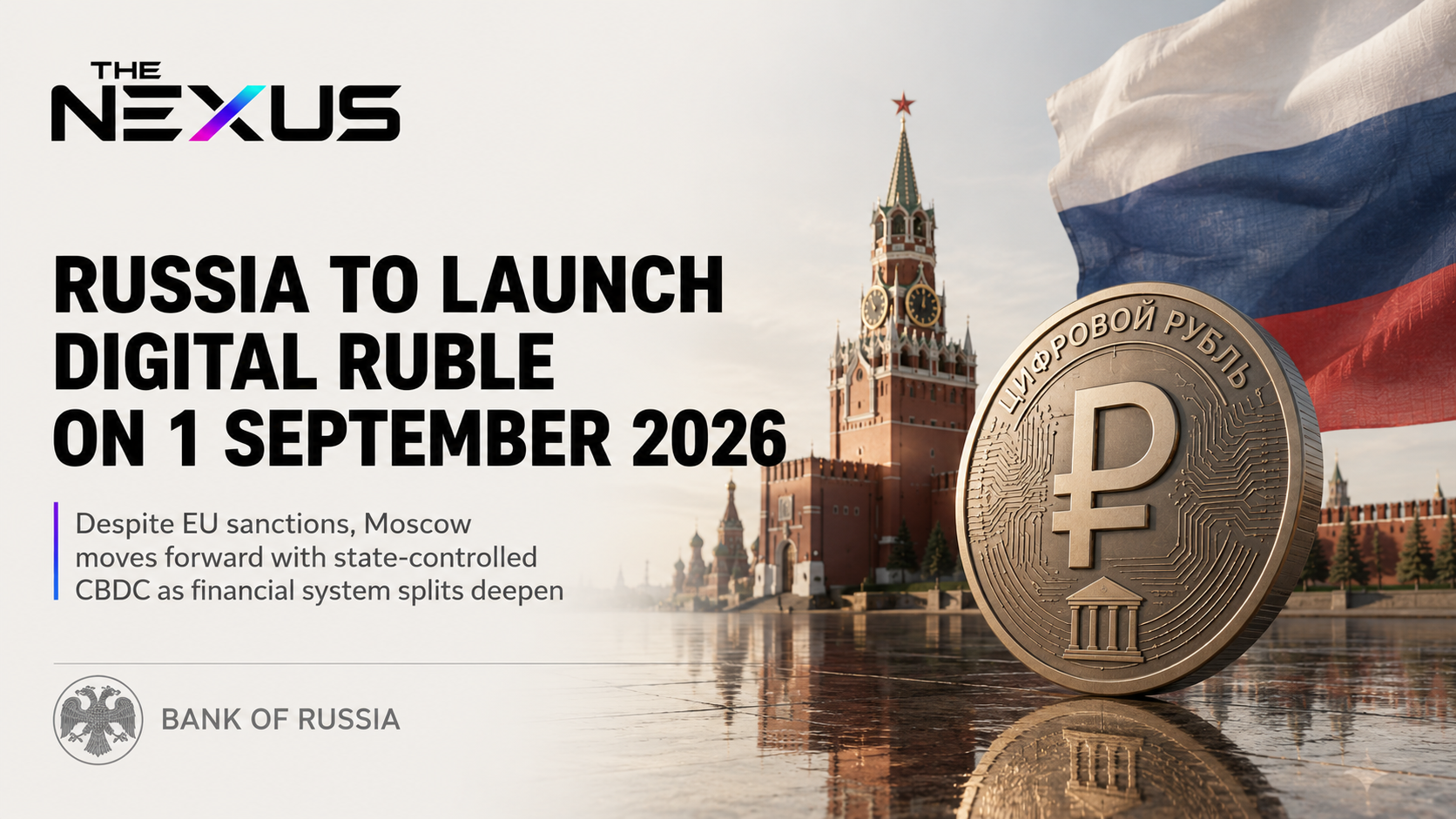
The Bank of Russia is proceeding with the scheduled 1 September 2026 launch of its central bank digital currency (CBDC), the digital ruble. Governor Elvira Nabiullina confirmed all technical and regulatory preparations are complete, adhering to the timeline established in 2025. The launch will proceed despite the European Union’s April 2025 preemptive sanctions on the digital ruble infrastructure, a response to Russia's ongoing war in Ukraine. The law enabling the CBDC's operation will be enacted concurrently with the launch, initiating a formal transition period for financial institutions that extends until July 2027. The digital ruble is designed to function as a third form of money, complementing physical cash and commercial bank deposits. Initial access will be limited to financial and credit institutions before a wider public rollout.
Anatomy
The digital ruble is architected as a two-tier, account-based retail CBDC, a model that prioritizes central authority and control. The Bank of Russia serves as the sole operator of the core platform, maintaining the definitive ledger of all accounts and transactions. This is a centralized database, not a distributed ledger employing public blockchain technology.
In this two-tier structure, commercial banks act as intermediaries. They are responsible for onboarding clients, both individuals and businesses, and providing the interface for them to access their digital ruble wallets. These wallets, however, exist only on the Bank of Russia's central platform. To execute a transfer, a user instructs their commercial bank through a standard banking application to move funds from a commercial bank account to their digital ruble wallet. The commercial bank debits the user's account and settles the transfer with the central bank, which then credits the corresponding digital ruble wallet on its proprietary ledger. All subsequent peer-to-peer or peer-to-business transactions are processed and settled directly on the Bank of Russia's platform, while commercial banks only act as access gateways.
This architecture ensures the state retains absolute control and visibility. The Bank of Russia is the ultimate key holder and the single source of truth for all balances and transaction histories. While users interact through familiar commercial bank interfaces, they do not possess self-custodial private keys. Their access is permissioned and mediated by a banking system subordinate to the central bank. The design explicitly rejects permissionless access and bearer-asset properties, instead creating a system that enhances the state's capacity for monetary policy implementation and financial surveillance.
Pattern
The digital ruble's development and architecture follow a pattern established by nations seeking to insulate their domestic economies from external financial pressure and enhance state control. The most direct parallel is China's Digital Currency Electronic Payment (DCEP) system, or e-CNY. Both are two-tier, centrally managed CBDCs designed to operate alongside existing forms of money but grant the central authority granular control over the financial system. The primary motivation is geopolitical: to build a sovereign financial infrastructure that is not dependent on Western-controlled payment rails like SWIFT.
For Russia, which has been systematically disconnected from global financial networks since 2022, the digital ruble is a strategic imperative. It creates a domestic payment system that is, by design, immune to foreign sanctions. Its utility as an international tool for sanctions evasion is limited. Cross-border transactions would require partner countries to integrate directly with the Bank of Russia's platform, a move that would expose their own financial institutions to secondary sanctions. The EU's decision to sanction the digital ruble infrastructure itself, before it was operational, represents a new front in economic statecraft, targeting the rails of a future system rather than just the actors using the current one.
This state-controlled approach stands in stark contrast to the theoretical use of permissionless cryptocurrencies for sanctions evasion. Russia lacks the domestic energy grid resilience and semiconductor industry required to support a large-scale reliance on proof-of-work mining, like Bitcoin. This structural deficit makes a state-led pivot to decentralized currencies untenable, reinforcing the strategic choice for a fully centralized and controllable digital currency.
Forward Implication
The launch of the digital ruble accelerates the fragmentation of the global financial system. It formalizes the existence of a state-operated digital currency bloc, running on parallel and incompatible rails to the US dollar-denominated system. This will force a strategic adaptation from Western governments and financial institutions. The precedent set by the EU's preemptive sanctions suggests that future economic containment strategies will target the underlying technology and infrastructure of rival financial systems, not just the transactions that flow over them. The compliance burden on international firms will grow, requiring them to monitor and avoid any interaction with these new, sanctioned CBDC platforms.
Domestically, the digital ruble equips the Russian state with powerful tools for social and economic management. The programmability of a CBDC allows for the implementation of targeted monetary policies, such as stimulus payments with expiry dates or funds restricted to specific types of purchases. It also grants the state the ability to freeze, seize, or tax assets with frictionless efficiency, bypassing potential delays or legal obstacles within the commercial banking system. This represents a fundamental shift in the relationship between the citizen and the state, vesting direct, real-time control over individual economic activity in the central bank.
The immediate metric to watch will be which, if any, foreign central banks or governments announce pilot programs to integrate with the digital ruble. Such announcements will serve as clear indicators of geopolitical and economic alignment. The contrast with the United States, where legislation to prohibit the Federal Reserve from issuing a CBDC is under consideration, underscores the divergent strategic priorities shaping the future of money in opposing geopolitical blocs.
---
Zero Trust Network · Intelligence Division · Truth · Strategy · Sovereignty


Discussion