Sui Network Halts Twice in Two Days Following Flawed Software Update
Sui's back to back outages weren't just technical failures. They were a stress test of the network's decentralization.

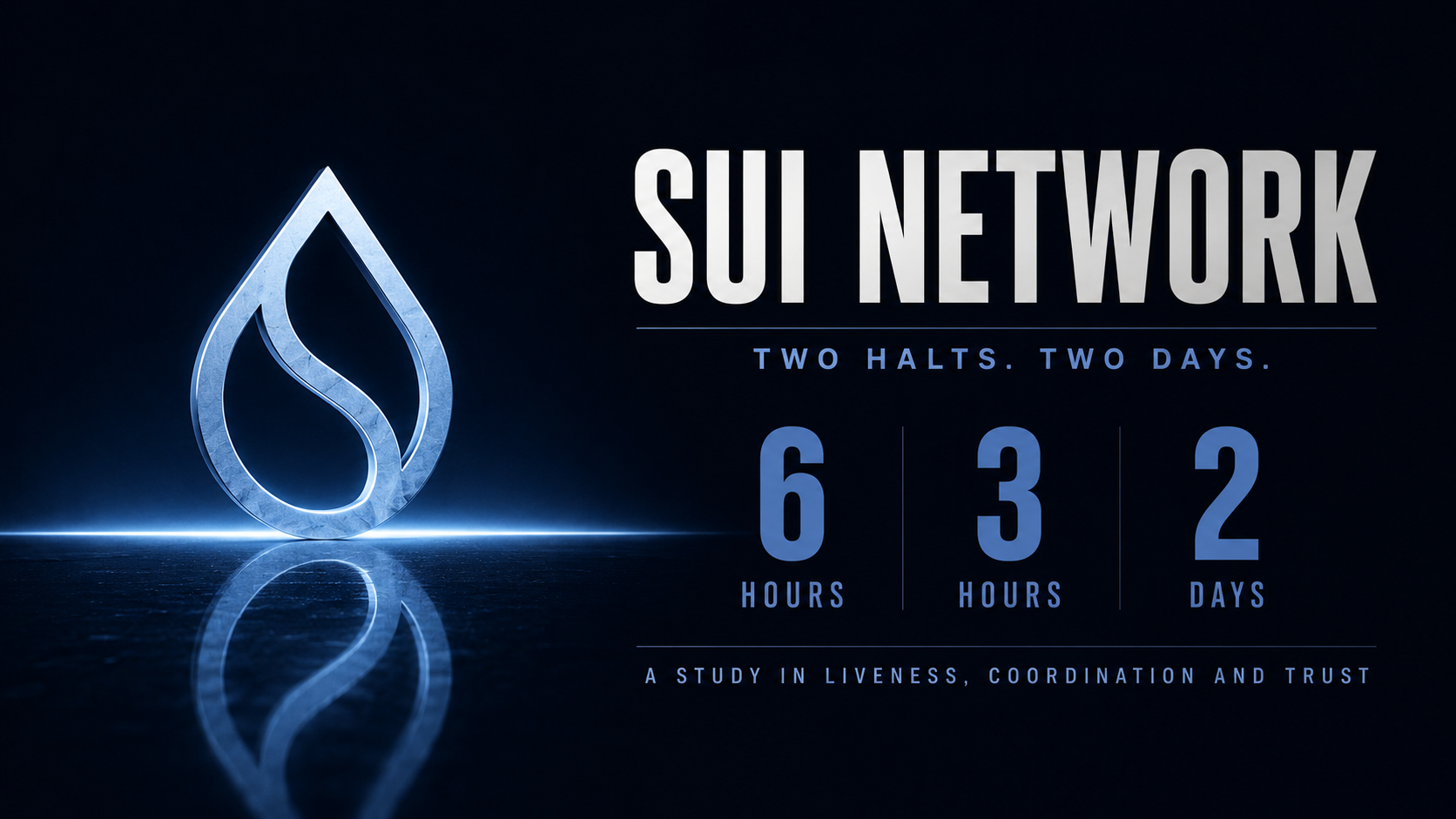
This dependency on human coordination, and the architectural choice to sacrifice liveness for safety, should not be dismissed as a minor operational inconvenience. It is central to the question of what kind of system Sui actually is. A blockchain can market itself around speed, throughput, user experience, and institutional readiness, but if the network can stop completely because of a software release and only restart through validator coordination around a core team fix, then its decentralization claims must be assessed through that reality.
This does not mean Sui is fraudulent, nor does it mean the engineering teams involved are incompetent. Complex systems break. All serious infrastructure experiences failure. The issue is not that a bug existed. The issue is what the bug revealed.
It revealed that the network’s performance model comes with a meaningful operational cost. It revealed that the base layer can lose liveness under conditions triggered by its own software updates. It revealed that the validator set, while distributed in form, remains dependent on rapid collective obedience when the chain enters crisis mode. It revealed that the practical security model includes not only cryptography, stake weight, and consensus design, but also human decision making, emergency patch distribution, validator responsiveness, and trust in a central engineering authority.
For users, this distinction matters. A network that pauses to preserve state consistency may be safer than one that corrupts state or forks unpredictably, but the user still loses access to the chain while the issue is being resolved. Funds may not be stolen, but applications freeze. Markets stop. Liquidations pause. Bridges stall. Traders cannot exit. Protocols cannot settle. The base layer becomes unavailable, and every application above it inherits that failure.
This is where the word “decentralized” becomes too blunt to be useful. The more important question is not whether a chain has validators spread across different operators. The more important question is how much trust is required when something goes wrong.
Does the protocol continue without permission?
Can users transact without waiting for a core team to publish a fix?
Can validators resolve the problem independently, or are they functionally waiting for instructions?
Is recovery automatic, or does it require a social command structure?
Are the rules of the system truly self executing, or does the chain depend on trusted humans to restore the machine when the machine breaks?
These are not abstract philosophical questions. They are operational realities. When a network halts, the truth of its design becomes visible. The marketing language falls away. What remains is the actual dependency map.
In Sui’s case, these outages show that its high performance design is not merely a technical advantage. It is also a source of increased fragility. The complexity required to deliver speed, parallel execution, sophisticated gas logic, and rich on chain functionality creates more places where critical bugs can emerge. The more moving parts a monolithic chain carries at the base layer, the more the entire network depends on the flawless functioning of those parts. When one of those core components fails, the failure is not isolated. It becomes systemic.
This is the deeper lesson for the wider crypto market. Many modern layer 1 networks are competing on throughput, user experience, institutional polish, and developer friendliness. They present themselves as advanced infrastructure for the next generation of finance and consumer applications. But the industry often confuses speed with resilience and complexity with progress. A chain can be fast, elegant, well funded, and technically impressive, while still carrying hidden centralization risks that only become visible during a crisis.
The Sui outages should therefore be viewed less as isolated technical failures and more as stress tests of the network’s real trust assumptions. The first stress test exposed weakness in execution layer fee logic. The emergency response exposed the fragility of rushed patching. The second halt exposed the limits of the initial fix. The January incident exposed a separate weakness in the consensus process itself. Taken together, these events suggest not a single bug, but a broader pattern of architectural sensitivity.
For builders, this creates a serious consideration. Deploying on a fast chain may improve user experience during normal conditions, but the cost of downtime becomes severe when applications depend on uninterrupted access. Lending markets, derivatives platforms, liquid staking protocols, cross chain bridges, payment systems, and high frequency trading applications all depend on base layer reliability. If the base layer can halt for hours, those applications must either absorb that risk, design around it, or admit that their guarantees are only as strong as the chain beneath them.
For investors, the lesson is equally important. Market valuations often reward chains for speed, branding, venture backing, ecosystem growth, and total value locked. But availability risk is harder to price until it manifests. A chain that stops repeatedly begins to accumulate a reputational discount. Developers may continue building. Users may return. The token may recover. But the memory of the halt remains. Every future promise of institutional grade infrastructure must now compete with the historical fact of repeated downtime.
The broader implication is uncomfortable for proof of stake networks that rely heavily on coordinated validator upgrades. In theory, decentralization means no single party controls the network. In practice, when a critical bug emerges, the network may still look to a core team for diagnosis, a patch, instructions, and timing. Validators may be independent businesses, but during an emergency they become participants in a coordinated recovery process led by those who understand and maintain the codebase. That does not make the system fake, but it does make it more socially dependent than many users realize.
This is where trustlessness must be separated from branding. A truly resilient system minimizes the need for trusted intervention. It does not ask users to trust that the core team will find the bug quickly. It does not ask users to trust that validators will all update correctly. It does not ask users to trust that emergency patches will hold. It does not ask users to accept downtime as the cost of innovation without questioning why the system is fragile in the first place.
Sui’s defenders may argue that halting was the responsible choice. In one sense, they are right. If the alternative is a fork, corrupted state, or invalid execution, stopping the chain may be the safest option available. But that defense only proves the deeper point. The system reached a state where stopping was considered preferable to continuing. That is not a small design detail. It is a fundamental expression of the chain’s priorities.
Safety over liveness is a valid engineering philosophy. But it must be understood honestly. It means the protocol may protect the accuracy of the ledger by denying access to the ledger. It means users are protected from one class of failure by being exposed to another. It means the network preserves internal consistency while external users, applications, and markets experience interruption.
That trade off may be acceptable for some use cases. It may be unacceptable for others. But it should not be hidden beneath the language of speed, scalability, and decentralization.
The more serious question is what these repeated incidents tell us about the future of high performance layer 1 design. If the path to mass adoption is built on increasingly complex base layers, then the industry may be reproducing the same pattern seen in traditional finance and cloud infrastructure. Systems become faster, more integrated, and more convenient, but also more dependent on centralized coordination, trusted maintenance, and emergency intervention. The surface looks decentralized. The recovery process reveals the center.
This is why uptime is not merely a technical metric. It is a measure of sovereignty.
A network that can halt is a network whose users can be temporarily locked out of their own assets. A network that requires coordinated validator action to recover is a network whose operation depends on human alignment. A network that depends on a core team to restore liveness is a network where control, expertise, and authority remain concentrated, even if token ownership and validator operation appear distributed.
The real test of decentralized infrastructure is not how fast it runs when everything is working. The real test is how little trust it requires when something breaks.
Sui’s outages have made that question unavoidable. They do not end the project. They do not prove that the network has no future. But they do provide a sharp and useful case study in the difference between performance and resilience, between decentralization as structure and decentralization as lived reality, between a chain that is distributed in normal operation and a chain that becomes socially centralized during crisis.
For the wider market, the lesson is simple. Do not judge a blockchain only by its speed, funding, transaction count, user interface, or developer activity. Judge it by its failure modes. Judge it by what happens when the code breaks. Judge it by who must act, who must be trusted, and who has the power to restore the system.
Because when the blocks stop, the truth comes out.
And in that silence, the architecture speaks.
---
Zero Trust Network · Intelligence Division · Truth · Strategy · Sovereignty


Discussion