Thailand Intensifies USDT Audits in State Crackdown on Illicit Finance
Thailand is tightening its grip on USDT, cash and gold as authorities hunt the billions flowing through scam networks and the grey economy. The real target is not the blockchain itself, but the regulated gateways where crypto meets the financial system.

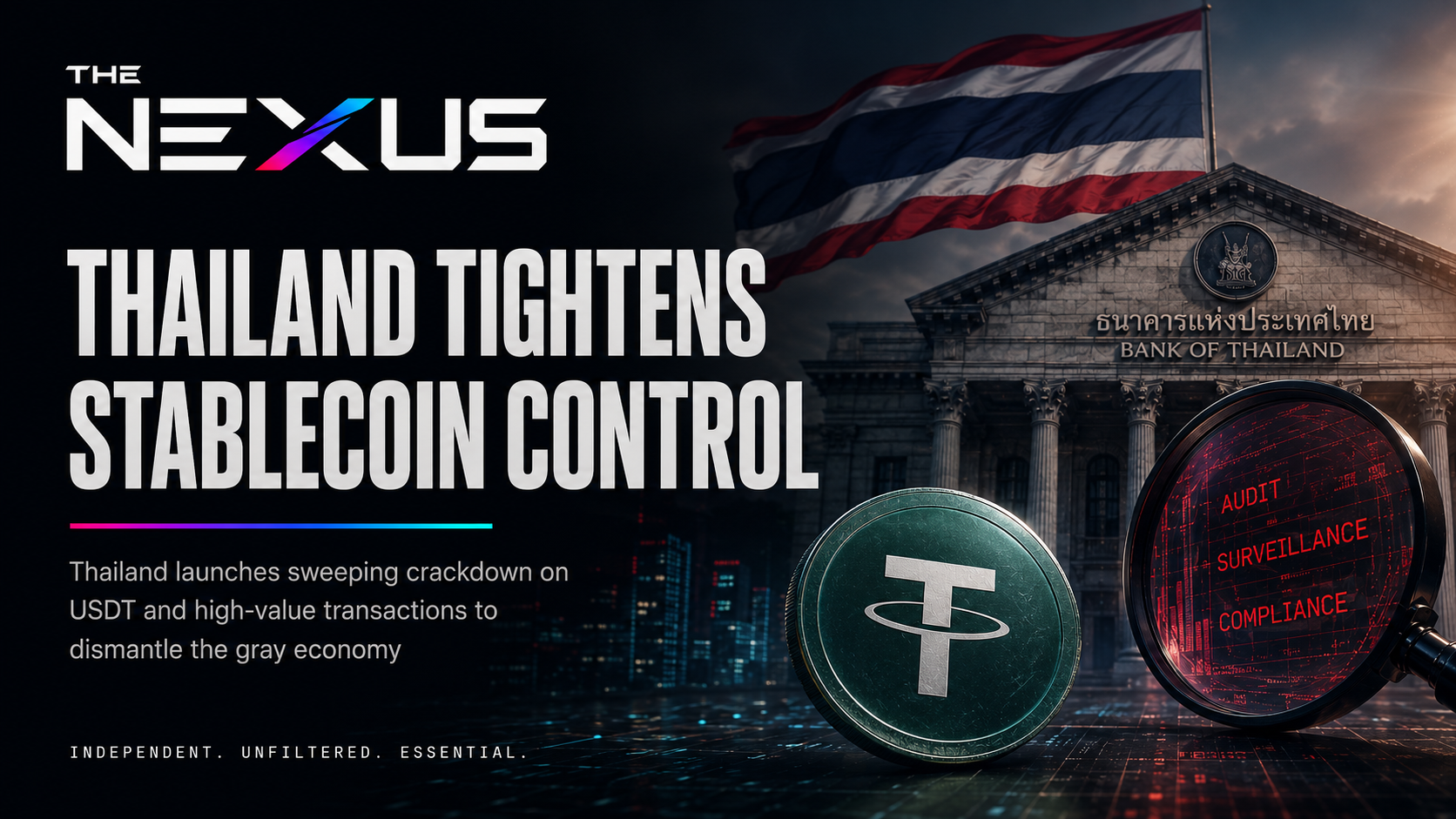
The Bank of Thailand and the kingdom’s Securities and Exchange Commission are initiating heightened surveillance and auditing of high-volume stablecoin transactions, primarily targeting Tether’s USDT. The action is part of a broader strategy to dismantle the country's "gray economy," a network of illicit financial flows linked to Chinese-affiliated scam centers. Bank of Thailand Governor Vitai Ratanakorn framed the measures as a continuous strategy, not a short-term initiative. The crackdown extends beyond digital assets, expanding compliance duties for commercial banks to include scrutiny of large cash transactions, currency exchanges, and gold bullion trading. New rules require source-of-funds declarations for high-value cash movements and monitor unusual banknote exchanges. Cash deposits exceeding 5 million baht, approximately $150,000, now require full disclosure.
Anatomy
This enforcement action leverages centralized points of control in Thailand’s financial system. The Bank of Thailand and the SEC project their power through regulated intermediaries: commercial banks and licensed digital asset exchanges. The primary chokepoint is the on-ramp and off-ramp between the crypto economy and the Thai Baht (THB).
Illicit funds, estimated at $3.4 billion from scams in 2025 alone, are frequently converted into USDT to facilitate rapid, cross-border transfers that circumvent conventional banking controls. The critical node for this activity is the local exchange ecosystem. At Bitkub, the country’s largest exchange by volume, the USDT/THB trading pair constitutes nearly 40% of daily activity. This pair serves as the principal liquidity bridge between the offshore, dollar-denominated stablecoin world and the domestic fiat currency. By mandating audits of suspicious stablecoin transactions, the state is effectively deputizing Bitkub and its peers as agents of financial surveillance.
This strategy does not directly address decentralized protocols or peer-to-peer activity. It focuses instead on the custodians and gateways that hold customer transaction data and are subject to national licensing. State control is asserted at the application layer, where centralized entities provide services, not at the protocol level. The new regulations on cash and gold are designed to constrict parallel avenues for money laundering, forcing more volume through digitally traceable paths. The system of control is a pincer movement: tightening surveillance on digital gateways while squeezing the physical, cash-based components of the gray economy.
Pattern
This initiative follows a pattern of broad-net enforcement previously deployed by Thai authorities. In 2025, a similar crackdown on mule accounts and suspicious activity resulted in the freezing of approximately three million bank accounts. The operation, widely reported as having gone wrong, ensnared thousands of legitimate individuals and businesses, demonstrating the state’s tolerance for significant collateral damage. This history suggests the current measures will likely be implemented with similar force, prioritizing disruption over surgical precision.
Globally, this action aligns with regulatory pressure on stablecoins. Financial authorities from the United States to the European Union view USDT, in particular, as a high-risk vector for illicit finance and sanctions evasion. The common strategic response is to target the regulated intermediaries that provide fiat connectivity. Thailand’s approach is a classic example of this model, tolerating the asset's existence but heavily regulating the points where it interfaces with the national economy.
A dual-layer control structure is also at play. The first layer is national, where the Bank of Thailand pressures exchanges like Bitkub to monitor and report activity. The second is at the asset issuer level. Tether, the organization behind USDT, has an established policy of cooperating with international law enforcement to freeze addresses associated with crime and terrorism. This means funds identified as illicit by Thai authorities could be frozen at the exchange gateway and on-chain by the asset’s central administrator.
---
Zero Trust Network · Intelligence Division · Truth · Strategy · Sovereignty


Discussion