The Day Taxation Exposed Fake Revolutionaries
The moment crypto threatened the system, taxation became the leash... and most men put the collar straight back on.

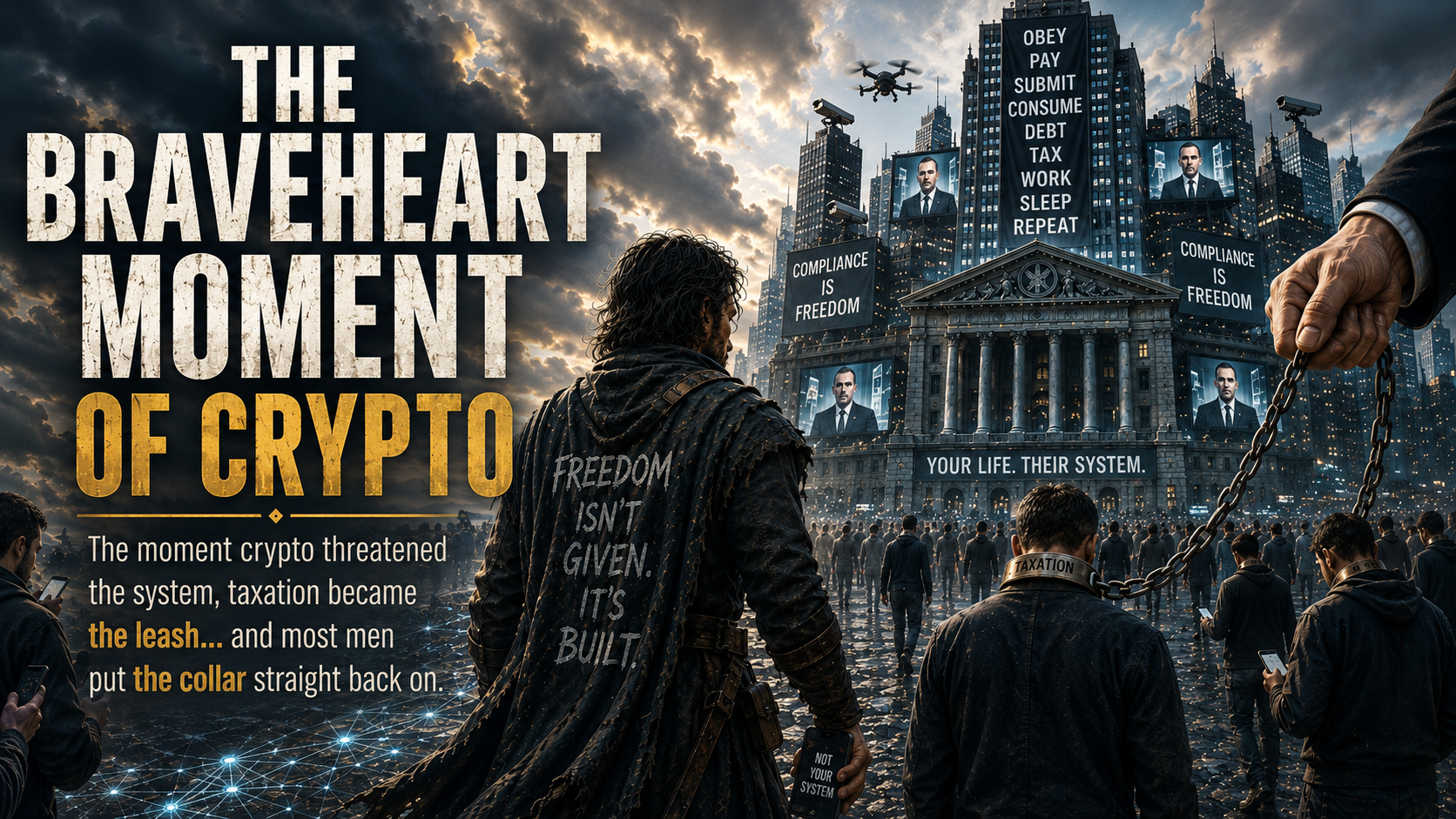
A revolution began over a 3% tax on tea, yet somehow modern men are emotionally collapsing over crypto tax bills while simultaneously holding the most disruptive financial technology humanity has produced in generations. The contrast is so absurd it almost feels satirical. An empire lost America because ordinary people reached a point where they understood something deeper than the tax itself. The tea was never really the issue. The issue was the growing realization that another power had inserted itself into the bloodstream of everyday life and expected permanent obedience in return. The tax simply revealed the relationship for what it had become.
Now look at the modern world. We are living through the birth of decentralized financial rails capable of moving value globally without banks, without delays, without institutional middlemen hovering over every transaction like gatekeepers taking their cut from human productivity itself, yet a huge portion of the population reacts to government scrutiny with pure psychological panic. Men who proudly spent years posting about financial freedom, sovereignty, and escaping the system suddenly behave like frightened children the moment a tax calculation lands in their inbox. Somewhere along the line the spirit that built revolutions was replaced by a population that wants the aesthetics of rebellion without any of the discomfort attached to it.
The truth most people do not want to confront is that freedom has never been comfortable. It has never arrived gift wrapped with convenience, reassurance, and customer support. Every meaningful leap toward sovereignty throughout history came with pressure, uncertainty, and confrontation with existing power structures. The American colonists understood this instinctively. They were not reacting emotionally to the financial value of tea. They were reacting to what the tax represented psychologically. It represented dependency becoming normalized. It represented distant institutions reaching deeper into the mechanics of ordinary life while expecting gratitude and compliance in return.
That same pattern is unfolding again, only this time the battlefield is digital. Crypto was never truly revolutionary because people could speculate on tokens or gamble on memes. Those things are side effects of human nature colliding with open systems. The real revolution was always the rail itself. For the first time in modern history, people were handed technology capable of routing around centralized financial infrastructure entirely. The ability to store and transfer value without requiring approval from banks, governments, payment processors, or corporations fundamentally alters the balance of power between individuals and institutions. That is the real discovery. That is the thing governments noticed.
And let us be honest about something else. Governments taxing crypto is not proof the technology failed. It is proof the technology matters. Nobody obsesses over irrelevant systems. Nobody drafts legislation around meaningless toys. Institutions react aggressively when something threatens the architecture they rely upon to maintain control. That reaction was inevitable from the very beginning. The moment decentralized networks demonstrated they could move value outside traditional channels, confrontation became unavoidable. Anyone who thought otherwise fundamentally misunderstood the scale of what was being created.
What is disappointing is not that governments responded. What is disappointing is how fragile modern people have become psychologically in the face of entirely predictable resistance. Men who speak endlessly about courage, independence, and sovereignty often reveal themselves to be deeply dependent on comfort the second reality pushes back against them. They want revolution as entertainment. They want freedom provided to them in a way that does not disrupt their emotional stability. They want to cosplay rebellion while remaining safely inside the psychological walls built by the very systems they claim to oppose.
History does not work like that.
The men who challenged empires were not fearless because conditions were safe. They acted because there are moments in history where continuing to submit quietly becomes more dangerous than resistance itself. What made those periods transformative was not the absence of pressure. It was the willingness to endure pressure in pursuit of something greater than immediate comfort.
That is the crossroads modern society is approaching now. The world is shifting toward increasingly digitized systems of financial surveillance, programmable money, identity linkage, algorithmic moderation, and institutional oversight over every layer of economic life. At the exact same time, decentralized technologies have emerged offering an alternative path built around self custody, open networks, immutable systems, and peer to peer exchange. These two forces are now colliding in real time, and instead of recognizing the historical magnitude of the moment, vast sections of the population are still trapped arguing over short term price movements and temporary discomforts.
The irony is extraordinary. Previous generations risked death over principles modern people surrender voluntarily for convenience. Men once crossed oceans and stood against empires over the creeping expansion of centralized control, while today many cannot tolerate a difficult tax season without spiraling into defeatism despite having access to tools previous generations could scarcely imagine possible.
This is not really a conversation about tax. It is a conversation about psychological dependency. It is about whether modern men still possess the internal resilience required to build parallel systems rather than emotionally collapsing back into the structures they claim to distrust. Technology alone does not create freedom. The printing press did not magically create free societies. The internet did not automatically create independent thinkers. Tools only matter when people possess the courage and discipline required to use them properly.
That is the real test unfolding now. Not whether crypto prices rise or fall, but whether enough people can mentally detach themselves from systems designed to cultivate dependency in the first place. Because the deeper battle has never been financial alone. It is civilizational. It is psychological. It is about whether human beings still possess the will to govern themselves when the opportunity finally appears in front of them.
The men of the tea tax would probably laugh at us at first glance. They would see populations surrounded by extraordinary technology behaving as though every inconvenience were an unbearable form of oppression. But after the laughter, they would likely recognize something familiar beneath the surface. They would recognize that the same ancient tension still exists between centralized power and human sovereignty. The tools have changed. The battlefield has changed. The principles have not.
~Veritya Thalassa
Watch our 2:40s wake up call...


Discussion