The Digital Cage: Why Freedom Looks Dangerous to People Who Have Never Been Free
A digital cage does not need bars when people mistake protection for freedom. The escape begins when sovereignty feels safer than permission.

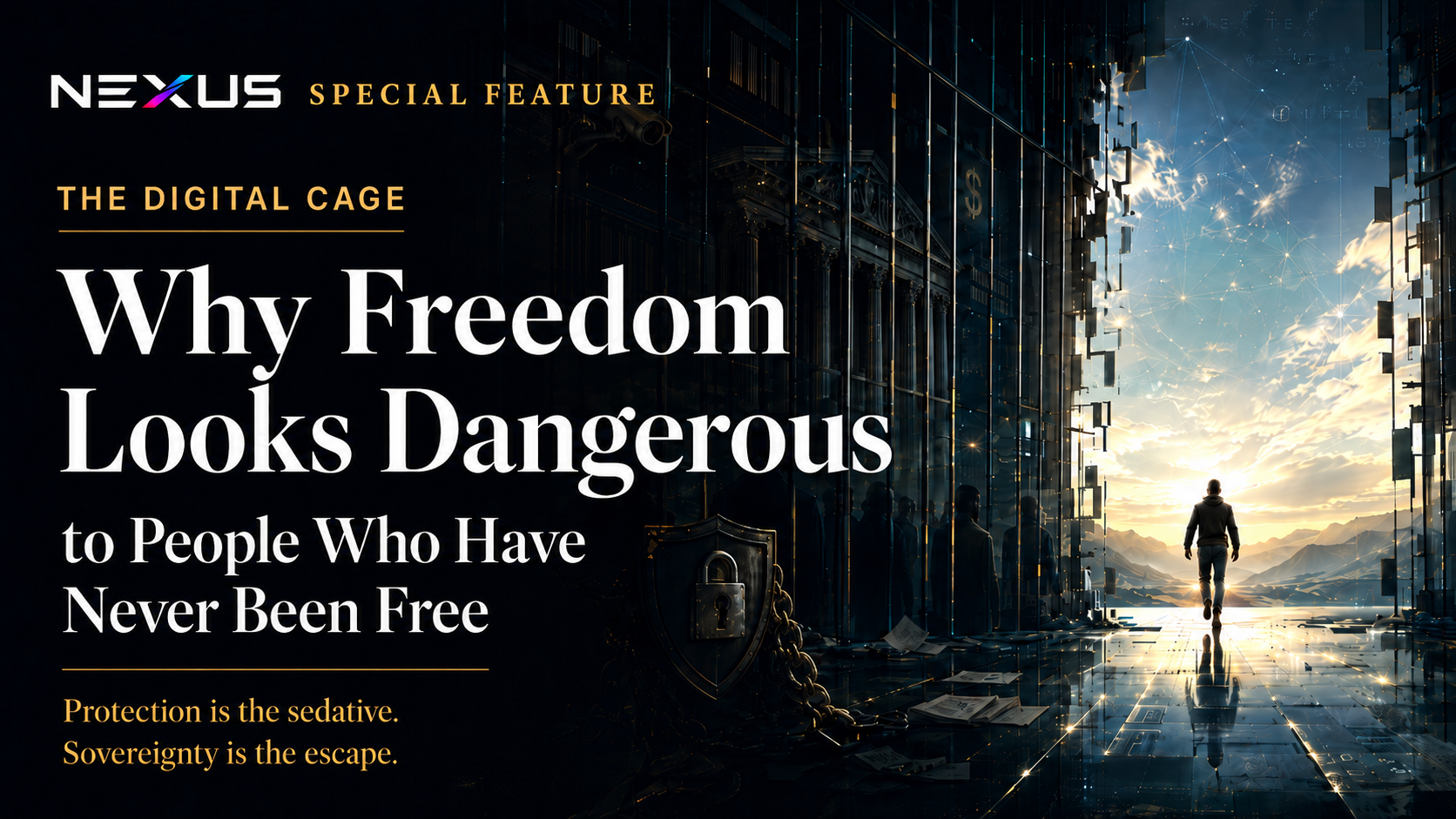
There is a strange illusion at the centre of modern life. Most people believe they are free because they are allowed to choose between the approved options placed in front of them. They can choose which bank to use, which card to carry, which pension provider to trust, which political party to support, which regulated investment product to buy, and which version of the same financial prison they would prefer to decorate with personal preference. The choices feel real because they happen inside daily life. They create the feeling of movement, agency, and participation. Yet very few people ever stop long enough to ask whether they are choosing freely, or simply choosing between doors inside a structure they never consented to enter.
Money is the most powerful example of this hidden architecture because almost every part of modern existence has been routed through it. Shelter, food, mobility, education, family security, business, inheritance, survival, and status all pass through a monetary system that most people did not design, do not understand, and cannot leave without consequence. The public is encouraged to argue endlessly about interest rates, taxation, inflation, political budgets, central bank policy, mortgage rates, and the cost of living, but the deeper question remains untouched. Why should the value created by human beings require permission from institutions before it can move between them?
That question sits at the root of true economic sovereignty, and it is the question the legacy system cannot tolerate for very long. The moment people begin questioning the permission layer itself, the entire moral theatre of modern finance starts to tremble. Banks cease to look like neutral service providers and begin to resemble checkpoints. Regulators cease to look like guardians and begin to resemble gatekeepers. Governments cease to look like managers of public prosperity and begin to resemble monopolists of value, identity, and movement. Once that shift happens in the mind, the old language loses its spell.
The spell is protection. That is the word used to justify almost every intrusion into economic life. The bank protects your deposits. The regulator protects your investments. The government protects the currency. The licensed provider protects the consumer. The compliance officer protects the system. The central bank protects stability. Protection becomes the soft voice that invites people to hand over responsibility. It turns dependence into virtue and presents autonomy as danger. Over time, people become so accustomed to being supervised that the idea of standing outside the supervision starts to feel reckless, childish, or irresponsible.
This is the hardest part of the trade to explain because protection is a sedative. It does not simply control people through force. It comforts them into submission. It tells them that responsibility is too heavy, that freedom is too complicated, that custody is too dangerous, that privacy is suspicious, and that only qualified professionals should be allowed to manage the machinery of value. Most people accept the arrangement because it allows them to sleep. They pay the fee in autonomy because the bed feels warm, the walls look familiar, and the lock on the door has been marketed as a safety feature.
The problem is that the sedative only works while the protector appears solvent, competent, and benevolent. When the protector becomes the source of instability, the psychological contract begins to break. A bank that can freeze your account is not merely protecting your money. A government that can inflate away your savings is not merely managing the economy. A regulator that protects incumbents while punishing ordinary people is not merely maintaining order. A financial institution that demands your identity, your behaviour, your location, your transaction history, and your future compliance is not simply offering a service. It is placing conditions around your ability to exist.
This is why the original breakthrough of cryptocurrency was never just digital money. It was not the thrill of speculation, the excitement of a chart, or the possibility of turning a small bag into a larger bag denominated in fiat. The real breakthrough was the removal of permission. For the first time in modern history, value could move between people through mathematical settlement without requiring a bank, a government, a payment processor, a clearing house, or a moral authority standing in the middle to decide whether the transaction was acceptable. That was the rupture. That was the sacred wound opened in the body of the old system.
Yet the industry that grew around this breakthrough has often struggled to remain faithful to the magnitude of what happened. Instead of protecting the original principle, much of the crypto world began trying to make itself acceptable to the very institutions it had rendered obsolete. It asked for regulation. It chased institutional approval. It celebrated exchange listings. It measured success in dollars. It treated stablecoins as the foundation of legitimacy. It rebuilt custody, identity, recovery, freezing powers, committees, foundations, and governance councils, then called the result innovation because the interface looked more futuristic than the bank lobby it had replaced.
This is where the digital cage begins to form. The bars are not always obvious because they are wrapped in attractive language. User experience. Safety. Scalability. Compliance. Institutional readiness. Consumer protection. Mass adoption. These words sound sensible on the surface, and some of the concerns behind them are real. People do lose keys. People do make mistakes. Criminals do exploit systems. Protocols do fail. But the deeper question is whether every attempt to reduce friction is worth the sovereignty surrendered in exchange. Convenience can become the perfect disguise for reintroducing the gatekeeper.
The clearest example is the way many people talk about utility. They say a system is useful when it feels easy, familiar, and compatible with the old world. They want crypto to behave like a bank account, settle like a payment app, recover like a customer support ticket, and comply like a regulated financial product. That version of utility is seductive because it reduces the learning curve. It also drags the entire system back toward the assumptions that made the legacy structure so powerful in the first place. If the new economy requires the same identity checks, the same permissioned chokepoints, the same freezing powers, the same legal overrides, and the same institutional blessings, then the cage has not been escaped. It has been upgraded.
True utility must be measured differently. A permissionless system is useful because it offers something a bank cannot offer. It offers resilience against being frozen out of your own life when the political weather changes. It offers settlement that does not depend on the solvency of an intermediary. It offers custody that cannot be quietly rehypothecated behind closed doors. It offers rules that are visible before you interact with them. It offers value transfer that does not require a third party to like you, approve of you, or understand you. This kind of utility is not always more comfortable, but comfort was never the point of sovereignty.
Sovereignty is not a soft word. It carries weight. It means responsibility cannot be permanently outsourced. It means there is no adult in the room coming to undo every mistake. It means the user becomes the institution. That reality terrifies people who have been trained to associate independence with danger, but it is the necessary cost of genuine freedom. A person cannot demand absolute control over their assets while also demanding that someone else be responsible for every consequence of that control. The legacy system understands this contradiction and exploits it beautifully. It tells people they can have freedom without responsibility, while quietly retaining the authority that makes such a promise impossible.
This is why so many people remain mentally trapped even after entering crypto. They buy digital assets but still measure their success in fiat. They speak about decentralisation but still long for recognition from banks. They criticise government control but celebrate regulatory approval when it pumps their bags. They talk about freedom while keeping their emotional scoreboard inside the dollar system. The asset may be on chain, but the mind remains in custody. As long as fiat remains the final measure of value, crypto is reduced to a speculative vehicle for acquiring more of the currency issued by the system people claim to be escaping.
This is the psychological layer of the cage, and it is more powerful than any technical limitation. The world does not need another blockchain with better marketing if the people using it still believe the bank is the final judge of legitimacy. It does not need another decentralised application that routes every meaningful action through centralised stablecoins, regulated ramps, and permissioned infrastructure. It does not need a faster version of the old model. It needs a different relationship with value itself. The real shift begins when people stop asking how to convert freedom back into the currency of their captors and begin asking how value can circulate without returning to the cage at all.
That is the importance of the circular economy. A sovereign system cannot remain dependent on constant exits back into the legacy world and still call itself complete. If every road eventually leads back to a bank account, then the bank remains the hidden centre of gravity. The goal must be an economy where value can be earned, held, spent, saved, lent, gifted, exchanged, and settled without needing to touch a bank in order to become useful. That does not happen through slogans. It happens through infrastructure, communities, habits, merchants, tools, education, and enough conviction to stop treating the exit ramp as the destination.
This is also why stablecoins occupy such a strange and dangerous place in the conversation. They are useful in the short term because they offer familiarity. They allow people to move through volatile markets using a unit they recognise. They create temporary stability inside a speculative environment. But they also keep the mind tethered to the old scoreboard. A stablecoin can become a bridge, but it can also become a leash. When it is issued by a centralised entity with freezing powers, regulatory obligations, and a direct relationship to the banking system, it imports the control structure of fiat onto chain. The transaction may look decentralised on the surface, but the value underneath remains connected to institutions that can be pressured, ordered, or captured.
This does not mean every bridge to the old world must vanish overnight. Systems evolve through transitional phases, and people do not abandon familiar structures simply because a better principle exists. But a movement that forgets the direction of travel becomes very easy to absorb. If the final ambition is institutional acceptance, then the revolution has already surrendered. If the final ambition is permissionless settlement, then every tool must be judged by whether it moves people closer to independence or quietly trains them to accept a more sophisticated form of dependence.
History is not kind to naive alternatives. Power structures do not politely step aside when something threatens their ability to control money. They tolerate experiments when those experiments remain small, fragmented, or easily mocked. They laugh at parallel systems while those systems look impractical. They regulate them when they become useful. They attack them when they become viable. This is why the story of Libya and the proposed Gold Dinar continues to carry symbolic force for people who study the relationship between money and power. Whether one examines the details through geopolitics, monetary history, or imperial strategy, the broader lesson is difficult to ignore. A settlement layer that threatens the dominance of debt based currency is not treated as a neutral technical innovation. It is treated as a challenge to power.
That point matters because it reveals something important about replacement. The legacy system does not fear criticism. It can absorb criticism all day. It can fund panels about criticism, publish reports about criticism, and invite critics into rooms where their objections are converted into advisory language. What it fears is a working alternative that people begin to choose without asking permission. The moment a parallel system allows people to settle value outside the reach of dilution, freezing, surveillance, and institutional approval, the conversation changes. At that point the issue is no longer theoretical. It becomes territorial.
This is why the battle is psychological before it is political. People have to believe they are allowed to leave before they will even notice the door. The old system survives because it has convinced them that the open field is more dangerous than the cage. It has taught them to fear volatility more than inflation, to fear self custody more than confiscation, to fear responsibility more than surveillance, and to fear freedom more than managed decline. The trick is not simply that people are trapped. The deeper trick is that many have been trained to defend the structure that traps them because they associate its familiarity with safety.
The moment that association breaks, everything changes. When the perceived safety of the cage becomes lower than the perceived risk of the open field, migration stops being an ideological choice and becomes an escape. People do not need to understand every technical detail to feel the pressure of that moment. They simply need to experience enough contradiction. They need to see prices rising while their wages lose meaning. They need to see banks rescued while ordinary people are lectured about responsibility. They need to see accounts frozen, rules changed, savings diluted, speech monitored, and institutions protected from the consequences they impose on everyone else. Reality becomes the teacher that ideology could not replace.
This is why the next phase of crypto will not be won by projects that merely replicate banking with a token attached. It will be won by systems that make sovereignty usable without diluting the principle that gives it meaning. That is a much harder task than building a slick interface. It requires education without condescension, tools without hidden custody, communities without dependency cults, and protocols that do not quietly smuggle the old power structure back in through the service entrance. It requires the courage to admit that some friction is not failure. Some friction is the cost of removing the intermediary.
The industry has become obsessed with mass adoption, but adoption into what? If the masses are onboarded into centralised exchanges, regulated stablecoins, custodial wallets, identity bound services, and networks governed by councils that can intervene whenever the pressure becomes high enough, then what exactly has been adopted? The language of crypto may spread while the substance disappears. A billion users inside a permissioned digital finance system is not victory for decentralisation. It is the old system wearing new skin.
This is the danger of building for institutional standards as the highest goal. Institutions will always prefer systems they can understand, monitor, regulate, and influence. They will always reward infrastructure that preserves their role. They will always call it mature when the sharp edges of sovereignty have been filed down. But a system designed primarily to satisfy institutional comfort cannot become a true alternative to institutional control. It becomes a digital annex of the same empire, more efficient than the old machinery, more transparent for those watching from above, and more invasive because the surveillance is now embedded into the rails themselves.
Real decentralisation does not ask institutions to bless it before it becomes legitimate. It proves itself by continuing to function without them. Its legitimacy comes from the rules, the users, the network, and the ability to settle value without appeal to authority. That is why math matters. Math does not care whether you are comfortable. It does not care whether a minister approves. It does not care whether a bank feels reassured. It does not care whether a regulator has produced a framework. It only cares whether the conditions are met and the rules hold. For people raised inside discretionary systems, that can feel cold. For people who understand how discretion becomes corruption, it feels clean.
There is a profound difference between protection and certainty. Protection depends on the character, solvency, incentives, and survival of the protector. Certainty depends on rules that do not bend because someone important made a phone call. The modern world has been trained to prefer protection because protection feels human. It has a desk, a logo, a helpline, a complaints department, and a promise. But when the promise fails, the user discovers that the warmth was conditional. Certainty can feel harsher because it does not pretend to love you. It simply does what it said it would do.
That is why permissionless systems remain so radical. They remove the moral filter from settlement. They do not ask whether the sender is fashionable, approved, controversial, inconvenient, or politically aligned. They do not ask whether the transaction suits the mood of the moment. They do not require a person to justify their existence before moving value. In a world where financial access is increasingly tied to identity, opinion, compliance, and behaviour, that neutrality becomes more than a technical feature. It becomes a line of defence for human autonomy.
Of course, this is exactly why such systems will be attacked. Any system that protects ordinary people from arbitrary exclusion also protects people whom authorities may dislike. That is the argument used to drag every neutral tool back under supervision. Safety becomes the banner. Illicit activity becomes the justification. The public is shown the worst possible user of a technology and asked to surrender their own freedom in response. This tactic is ancient. It works because fear makes people generous with other people's power. They hand over the principle to stop the villain, then act surprised when the same mechanism is later used against them.
A mature sovereignty movement cannot be naive about risk. Fraud exists. Theft exists. Exploitation exists. Human beings do terrible things with every tool they touch. But the existence of danger does not automatically justify permanent supervision by institutions whose own record is soaked in manipulation, extraction, and failure. The question is not whether risk exists. The question is who gets to control everyone else in the name of managing it. That question must be asked honestly because the wrong answer leads directly back to the cage.
The most important migration, therefore, is not from fiat to crypto. It is from dependency to responsibility. It is from asking permission to verifying rules. It is from measuring freedom in dollars to recognising value as something that can exist outside the approval of the institutions that issue dollars. It is from treating banks as the final destination to treating them as legacy infrastructure whose dominance depends on people believing there is nowhere else to go. Once enough people stop believing that, the spell weakens.
This is where the real replacement begins. It does not begin with a government announcement, an institutional allocation, or a glossy report from a consultancy explaining that blockchain has finally matured. It begins when ordinary people discover that the old system is more dangerous than the responsibility they were taught to fear. It begins when merchants accept value directly because the fees, delays, and permissions of legacy finance no longer make sense. It begins when communities build internal economies where value can circulate without begging for access to the old rails. It begins when people stop seeing self custody as a technical burden and begin seeing it as the modern form of owning the keys to your own house.
The legacy system will not disappear in one dramatic moment. It will continue to exist, adapt, absorb, and present itself as inevitable for as long as people continue to believe in its inevitability. But inevitability is a psychological condition before it is a material one. Every empire looks permanent from inside its own propaganda. Every monetary regime claims stability until the day confidence leaves. Every institution built on belief depends upon the public continuing to mistake habit for necessity. When that mistake is corrected, change can happen with astonishing speed.
The coming battle is not simply between crypto and banks. It is between two models of human organisation. One model says that people must be supervised because freedom is too dangerous. The other says that people must be allowed to interact through systems where the rules are visible, neutral, and resistant to capture. One model requires identity before access. The other requires keys before action. One model promises comfort while quietly harvesting autonomy. The other demands responsibility while offering a form of independence that cannot be granted or withdrawn by an office.
That is why the digital cage is so dangerous. It can look like progress while preserving the old dependency. It can speak the language of innovation while maintaining the logic of control. It can offer faster payments, better interfaces, regulated assets, institutional custody, and programmable compliance, all while quietly ensuring that every meaningful exit remains readable, reversible, and permissioned. If people are not careful, the future of finance will arrive looking futuristic while functioning as a more efficient prison than the one it replaced.
The antidote is not nostalgia, rage, or fantasy. It is the disciplined construction of systems that make permission less necessary. It is the patient building of circular economies where value does not have to return to the bank to become real. It is the refusal to confuse convenience with liberation. It is the understanding that a technology designed to remove intermediaries loses its soul when its greatest ambition becomes pleasing them. It is the willingness to carry the responsibility that sovereignty demands, not because responsibility is easy, but because the cost of outsourcing it has become unbearable.
Freedom has always looked dangerous to people who have never been free. The open field feels exposed when generations have been raised inside managed walls. But the cage only feels safe while the food keeps arriving, the locks remain gentle, and the keeper still smiles. When the keeper starts rationing the food, changing the rules, watching every movement, and calling obedience protection, the meaning of safety changes. At that point the open field no longer looks reckless. It starts to look like the only sane direction left.
The migration will not happen because everyone suddenly becomes ideological. It will happen because the cost of staying becomes too obvious to ignore. Inflation, surveillance, permission based living, financial censorship, institutional insolvency, and endless extraction will continue to teach the lesson more effectively than any article ever could. The role of the sovereign builder is to make sure that when people finally look for the exit, something real is waiting on the other side. Not a speculative casino dressed in revolutionary language, but an economy capable of carrying value without kneeling before the systems that corrupted it.
That is the work. Not to build a faster cage. Not to polish the bars. Not to install a digital interface on old captivity and call it innovation. The work is to build a parallel reality where the bank's permission becomes irrelevant, where value can move because the rules allow it, where identity is not permanently welded to economic life, and where human energy is no longer harvested by a thousand invisible intermediaries before it can become useful. Once that reality becomes more attractive than the one currently melting down, the question will no longer be whether people are ready for sovereignty. The question will be how long they can afford to remain without it.
~Veritya Thalassa


Discussion