The Diplomat, the Sovereign Fund and the Private Dollar
Crypto promised an escape from political power. Gulf billions, Kushner’s diplomacy and a president-linked stablecoin suggest the gatekeepers have other ideas. Following Patrick Henningsen’s Sunday Wire, we examine the money, the conflicts and who can stop the dollar.

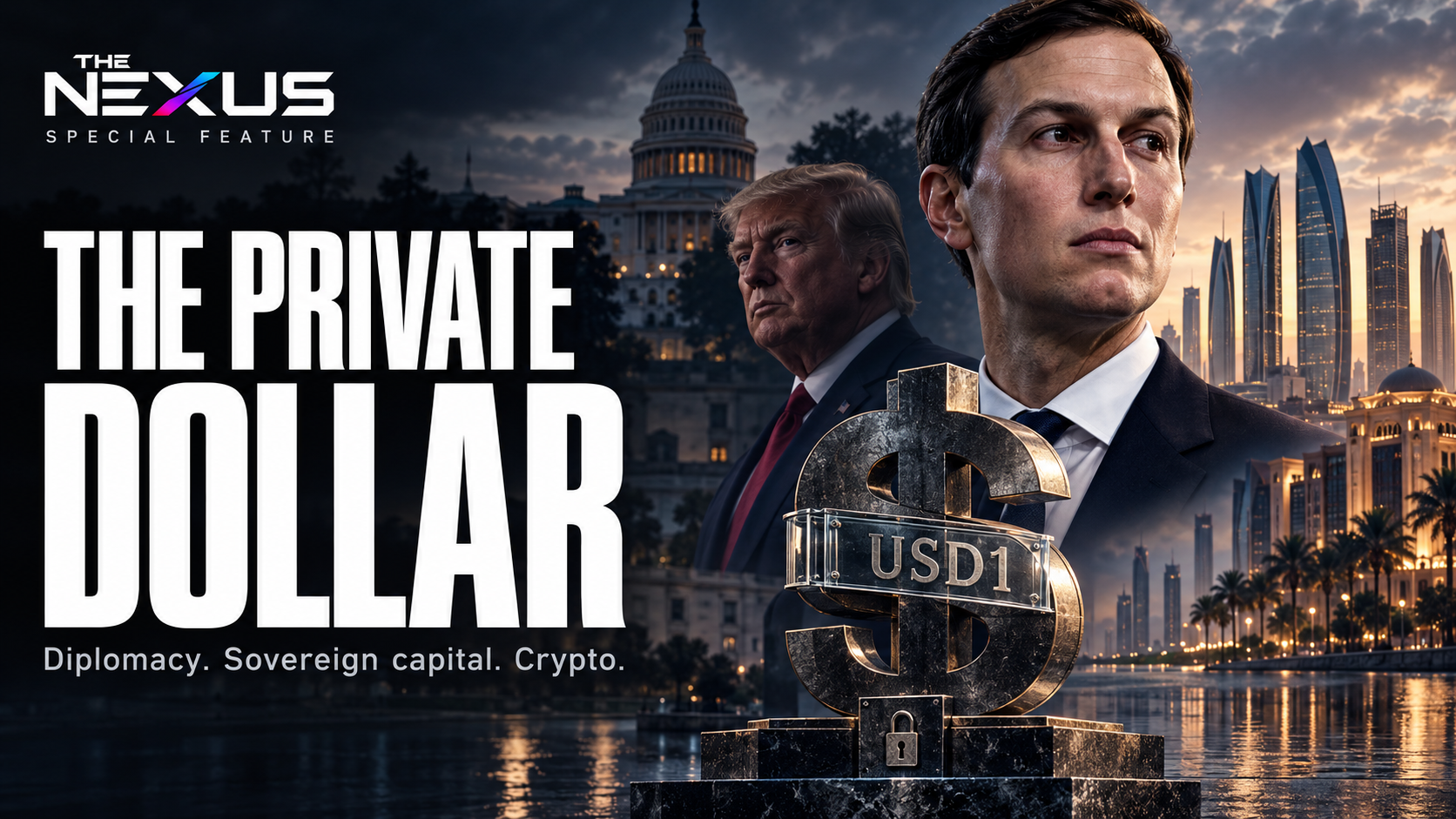
Patrick Henningsen’s latest Sunday Wire raises a question that crypto can no longer afford to leave to foreign-policy commentators: what happens when the people negotiating the crisis also have a financial stake in the world that follows it? His warning about renewed confrontation with Russia and Iran leads towards Jared Kushner, Gulf sovereign wealth and the private businesses surrounding American diplomacy. Following those relationships takes us somewhere the promise of decentralisation was supposed to make unnecessary, into a digital dollar associated with the president’s family and administered by people who can decide whether its holder may use it.
Henningsen’s warning is not simply that one administration might miscalculate. It is that war has become a functioning economy, complete with political placements, media careers, defence contracts, reconstruction funds and investment opportunities for people insulated from the worst consequences of what they recommend. At 1:36:06, he reduces the machinery to eight words: “It’s all about money, folks. Everyone’s making money.”
There are two stories here, and the explosive one must not be allowed to obscure the one already documented. Secret foreign-government accounts allegedly accessed through Kushner’s phone remain disputed and unverified. His fund’s Gulf capital, his position in regional diplomacy and a separate $2 billion transaction using World Liberty Financial’s USD1 are matters of public record. The latter transaction does not prove the former allegation. It does show how far politically connected private money has travelled into an industry that once promised to cut the middlemen out.
Sunday Wire Ep 618: Is Trump About to Ignite a Two Front War?
Two wars, one economy
Henningsen’s two-front thesis rests on the distance between Donald Trump’s language and the machinery still moving beneath it. Ukraine has not become irrelevant because the president speaks occasionally about peace, and the confrontation with Iran has not disappeared because a temporary agreement was announced. American military support, sanctions, intelligence relationships and Israeli calculations continue to shape both theatres. The danger begins when a political class mistakes restraint by Russia or Iran for weakness, then allows its own rhetoric to become the evidence for the next escalation.
What can be said with much greater confidence is that another major conflict with Iran would move rapidly through energy markets, shipping, insurance, food prices and household bills. The public would pay long before most citizens understood who had authorised the risk. The contractors, advisers and financial actors positioned around the conflict would not experience that cost in the same way. For some, the instability would be the market.
The public finances the policy, absorbs the inflation and inherits the wreckage. The people positioned closest to power are left to price the opportunity.
The allegation Patrick put on the table
The most explosive portion of Episode 618 concerns reporting by Matthew Cole, published in an excerpt in Vanity Fair. Cole alleges that Russian hackers penetrated Kushner’s iPhone, that Dutch intelligence gained access to the hackers’ infrastructure and that officials were consequently able to observe material on the phone. What they allegedly saw included foreign-government money routed through the United Arab Emirates, Azerbaijan and Israel, with one account said to have received about $750 million and another connected to approximately $1 billion.
Henningsen treats the report as if the case has already crossed from allegation into proof. It has not. The public has not been shown a bank statement, an account number, a wire reference, a transaction date, an authenticated screenshot or the intelligence record said to describe the access. CBS News said it could not independently verify the story. Kushner’s lawyers say the accounts never existed, deny that he knew of or accessed them and argue that the absence of documentary evidence destroys Cole’s account. Their denial deserves to be reported with the same precision as the accusation, even though a denial is not proof that the allegation is false.
Ownership, signatory authority and access are not interchangeable, either. An authorised user need not own an account’s funds, and a transfer through an institution does not establish its purpose. Henningsen describes money laundering and foreign agency, but neither has been established in this case by a public charge or adjudicated finding. His wider question survives without that verdict: what safeguards separate the diplomat’s decisions from the investor’s interests?
The allegation lands inside a structure of influence already visible without a leaked intelligence file. Whatever happens to Cole’s account, the financial relationships surrounding Kushner’s diplomacy will still require an answer.
The money sitting in daylight
Kushner controls Affinity Partners, the investment firm he created after leaving the first Trump administration. A 2022 congressional investigation recorded Saudi Arabia’s original $2 billion commitment. Later congressional correspondence, citing regulatory filings and reporting, put Affinity’s assets under management at approximately $4.8 billion by the end of 2024 and identified substantial capital tied to Saudi Arabia, the UAE and Qatar.
Foreign investment is not proof that foreign policy was purchased. Yet it creates continuing financial relationships between governments and a man exercising consequential American diplomatic power. In his published response, Kushner says the investments were commercial, that he has raised no additional capital while volunteering and that he has never changed a diplomatic position to benefit himself or an investor. He also says he receives no government salary. An unpaid role, however, is not the same thing as an absence of financial interests.
The overlap appears in the White House’s own appointments. Kushner sits on the founding Executive Board of the Board of Peace and on the Gaza Executive Board. The former body’s remit includes reconstruction, investment attraction, large-scale funding and capital mobilisation, although the announcement does not allocate each portfolio to a named member. A separate White House statement credited him as part of the June 2026 Iran negotiating team. A private investor is therefore participating in decisions capable of reshaping the region in which his fund and its investors operate.
Affinity also remains the largest shareholder in Phoenix Financial, according to an October 2026 congressional letter drawing on Israeli financial disclosures. Phoenix is a diversified financial group, not an arms manufacturer, and it would be false to say that Affinity directly owns the military companies held inside Phoenix-managed portfolios. The same congressional letter nevertheless identified $456 million in nine companies connected to Israeli military supply, including $265.1 million in Elbit Systems. Kushner says he does not direct those portfolio decisions. That answer narrows the claim, but it leaves the structural question untouched: why is a private investor with this regional exposure helping to shape the wars, agreements and reconstruction programmes surrounding those investments without the disclosure and recusal regime normally expected of public office?
Then the money turns digital
The blockchain connection does not prove Cole’s secret-account story. It establishes a separate and fully documented relationship between Emirati state-linked capital, World Liberty Financial and Binance. In March 2025, Abu Dhabi-backed MGX announced a $2 billion investment in Binance. World Liberty co-founder Zach Witkoff later said the transaction would be settled using USD1, the stablecoin associated with the Trump and Witkoff families. Reuters reported the selection, while Binance described the investment as its first institutional placement.
The dollar token in that announcement was not a neutral background detail. Selection for a $2 billion state-backed investment brought a politically connected venture into the settlement of a major exchange deal. The commercial rationale may be defensible, but the public is entitled to see it rather than accept the transaction’s scale as its own justification.
What the chain shows is more limited, but more concrete. Arkham identified a BNB Smart Chain address that received roughly $2 billion in USD1 before sending three separate $200 million tranches to Binance-labelled deposit addresses. The amount and timing make the wallet relevant to the MGX settlement. They do not prove MGX controlled it. Arkham itself allowed for another possibility, namely that the address was supplying Binance with liquidity.
A service label identifies a destination, not the customer behind it. Arkham’s Binance labels do not establish who controlled the sending wallet, and no wallet in this trail has been authenticated as Kushner’s. Turning proximity into ownership would manufacture the missing link rather than uncover it.
USD1 transaction corridor
BNB Smart Chain · Historical transfers reported May 2025| Address or contract | Observed role | Attribution | Publication standard |
|---|---|---|---|
0x8d0D000E…8B0d |
Official USD1 token contract | Confirmed | Official token address. Issuer terms describe administrative restrictions. |
0x2087be88…3E36 |
Received about $2 billion USD1, then distributed large tranches. | Strongly supported MGX link unverified |
Transfers reported by Arkham. Its beneficial controller is not proved. |
0x34699531…1630 |
Received about $200 million USD1 from 0x208. |
Binance-labelled | Service infrastructure, not an MGX wallet. |
0x41e892e5…E2b5 |
Received about $200 million USD1 from 0x208. |
Binance-labelled | The service label does not identify the depositor. |
0xd11D5B1b…0506 |
Received about $200 million USD1 from 0x208. |
Binance-labelled | A service endpoint is not proof of beneficial ownership. |
0x527ffe6B…004F |
Received a 100 USD1 test transfer. | Reported lead | No fourth $200 million transfer was established in the evidence reviewed. |
Source: Arkham’s 23 May 2025 analysis, linked above. These are analytics-provider attributions, not signed ownership attestations. Full transaction hashes have not been independently reproduced for this article. No executed freeze or seizure involving these addresses is established here.
The private dollar is not neutral money
World Liberty presents USD1 as an on-chain dollar. Its own risk disclosures reserve the right for BitGo or World Liberty parties to block on-chain transfers to and from any address. They separately describe freezing custodied USD1, restricting redemption and freezing tokens or surrendering reserves under a valid government order. These are different powers, but their implication for self-custody is plain: possession of the private key does not guarantee permission to move the token.
USD1 is not unique in this respect. Centralised controls are common among fiat-backed stablecoins, and issuers may be legally compelled to use them. That does not make the control unimportant. It means the token is not neutral, trustless money. It is a privately administered claim on reserves, carrying a compliance policy, a blacklist function, custodians and a political economy.
Bitcoin’s original proposition was peer-to-peer payment without a financial institution standing between the parties. A centrally administered stablecoin offers a different bargain, however useful it is for settlement: the ledger is public, but permission remains private. Putting the gatekeeper’s decision on a blockchain makes it easier to observe. It does not remove the gatekeeper.
The announced MGX settlement demonstrates the scale at which this model is being adopted. A state-backed investor selected a private dollar associated with an American political family for a $2 billion exchange investment. Separately, Arkham reported a wallet moving hundreds of millions of that token into Binance-labelled addresses. Neither record answers who controlled the wallet, how the settlement was negotiated, why USD1 was chosen or how the economic benefits were divided. A public ledger is not a public explanation.
The connection beneath the headlines
The connections cross borders without establishing a single hidden controller. Saudi, Emirati and Qatari capital, an American president’s family, an Israeli financial group and an international crypto exchange occupy different positions in the record. These are distinct relationships, not evidence of one coordinated operation. What connects the questions they raise is the concentration of financial influence alongside public authority, and the difficulty ordinary citizens face in holding either to account.
What keeps appearing is a dangerous overlap: the authority to shape political conditions sits beside the capital positioned to benefit from them. That is a conflict risk before it is proof of a bought decision, and the absence of a proven bribe does not make disclosure optional. The public should not have to reconstruct the diplomat’s financial interests from opposition letters, private-fund statements and an analytics company’s wallet labels.
Cole’s allegations may eventually be substantiated or fall apart. Either outcome would leave the documented relationships to answer for. Foreign sovereign capital funds a business controlled by a man conducting public diplomacy, while a separate state-backed investment has adopted a politically connected stablecoin with administrative restrictions. Blockchain has not proved a purchased war or a secret master plan. It has helped expose how easily a technology built to challenge gatekeepers can become another product they administer.
Crypto can either obstruct that transfer of power or complete it. If the people profiting from a crisis also control the money offered as the way out, then what arrives afterwards will not be a rescue, but the final stage of the acquisition. We do not have to pretend that every allegation is proved to insist on the principle: a new financial system has failed its purpose if the old power brokers still decide who is allowed to use it.
Primary records and reporting
- 21st Century Wire, Sunday Wire Episode 618
- Vanity Fair, Matthew Cole book excerpt, 22 October 2026
- CBS News, Kushner response and verification limits
- Jared Kushner, detailed response to Matthew Cole
- Jared Kushner, response on Affinity and Phoenix
- White House, Gaza board appointments
- White House, Iran agreement negotiating team
- House Oversight letter on Affinity and Phoenix, 5 October 2026
- House and Senate inquiry into Affinity fundraising, 19 March 2026
- MGX, announcement of $2 billion Binance investment
- Reuters, USD1 selected for MGX and Binance settlement
- Arkham, USD1 distribution wallet analysis
- World Liberty Financial, USD1 risk disclosures
- Satoshi Nakamoto, Bitcoin: A Peer-to-Peer Electronic Cash System
Veritya Thalassa

Discussion