The Permission Economy
Watch the terms attached to the rescue. A crisis can leave you paying twice: once for the shortage, then with your freedom. Fuel. Food. Water. Compute. How much of your life are you willing to put behind an approval screen? The Permission Economy.

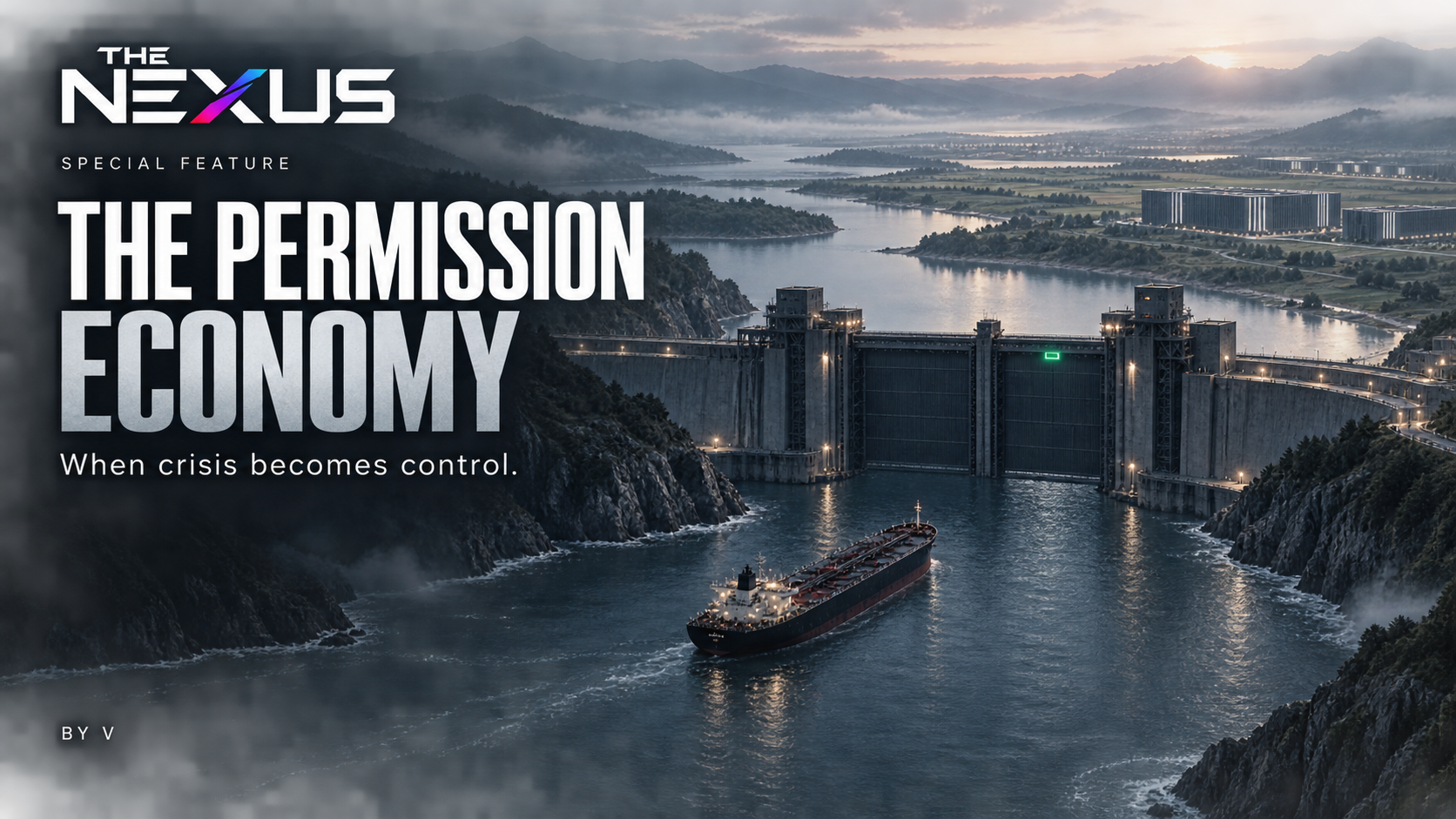
An emergency changes what people are prepared to accept. When fuel becomes unaffordable, food bills climb and businesses struggle to keep operating, the promise of stability acquires enormous political value. Measures that would once have demanded months of argument can arrive as administrative necessities. The immediate question becomes how to keep the country running. The question that receives less attention is how much authority changes hands along the way, and whether anyone is obliged to give it back.
The disruption around the Strait of Hormuz has exposed how much of everyday life depends on infrastructure most people never see. A shipping route becomes a fuel bill. A fertiliser shipment becomes a planting decision. A refinery outage becomes a cost embedded in almost everything that reaches a shop. Those dependencies give governments difficult problems to solve. They also create openings for systems that make access to ordinary life increasingly conditional.
I call that risk the permission economy: a society in which your ability to buy, move, produce and exchange depends on continuing approval from the institutions operating the system.
The physical emergency is real. On 11 March, IEA member countries agreed
to make 400 million barrels of emergency oil stocks available. By
18 September, the agency reported that more than 300 million barrels
had been released, while observed global oil inventories were 507 million
barrels below their level at the start of the war. Its latest analysis
also describes substantial demand reductions, additional production
outside the Gulf and supplies diverted through alternative routes.
Those adjustments explain part of the gap between the severity of the
disruption and the experience of consumers. They have bought time,
at considerable cost.
IEA: the emergency response
·
IEA: September market assessment
That time is unevenly distributed. A large company can absorb a more expensive shipment, negotiate finance or secure another supplier. A small haulier may have to park a vehicle. A farmer can postpone buying an input, but the growing season will not postpone itself. A household can cut discretionary spending until there is nothing discretionary left. An economy can continue to function while quietly exhausting the people inside it.
Food is particularly exposed. The Gulf supplies energy, fertilisers
and the industrial inputs used to manufacture them. Natural gas is
a key feedstock for nitrogen fertiliser; sulphur is used to produce
the sulphuric acid needed in phosphate processing. In May, the FAO
warned that the Hormuz disruption could develop into a severe global
food-price crisis within six to twelve months. A warning about future
harvests can feel remote precisely when the decisions affecting those
harvests are being made.
IEA: affected commodities
·
Reuters: FAO warning
The policy response is already visible. The IEA’s March report,
Sheltering From Oil Shocks, includes working from home, lower speed
limits and alternating private-car access to designated urban areas
according to number plates. These are published policy options,
with implementation left to governments. The agency also maintains
a tracker covering energy-saving measures, financial support and
longer-term responses. Calling the whole package a lockdown would
flatten meaningful differences between voluntary conservation,
subsidies and compulsory restrictions. The serious scrutiny belongs
at the point where a recommendation becomes an enforceable condition
on someone’s life.
IEA: road transport measures
·
IEA: policy response tracker
A temporary restriction should come with an explanation people can examine, a defined scope and an expiry that requires a fresh decision to extend. It should be possible to challenge an error without losing access to necessities while the appeal sits in a queue. The burden should also fall visibly on the people making the rules. Public trust becomes difficult to sustain when sacrifice is mandatory for one group and negotiable for another.
Water brings these questions into even sharper focus. In January,
before the current Hormuz crisis, United Nations University researchers
published their assessment of global water bankruptcy. It describes
chronic overuse and damage to water systems that cannot simply be
reversed by a wet season. The authors advocate limits reflecting
available supply, protection of ecosystems and support for vulnerable
communities. They explicitly warn against arrangements that protect
powerful users while cutting supplies to the poor. The report is
a scientific and policy intervention, not a global legal order
transferring control of water to the UN.
UNU: what water bankruptcy means
Its diagnosis nevertheless leads directly into a political struggle. Someone must decide whose use takes priority, whose livelihood changes and whose consumption remains protected. A household, a small farm and a major industrial operator do not enter that negotiation with equal influence. Any credible response must make those choices visible. Scarcity gives the allocation decision enormous power; describing it in technical language does nothing to remove the interests involved.
Agricultural technology deserves the same precision. The EU adopted
new rules for certain gene-edited plants in June 2026, following
a Commission proposal from July 2023. The rules entered into force
in July, but apply from July 2028; the existing GMO framework remains
applicable in the meantime. That chronology cannot honestly be
presented as an overnight response to Hormuz. The enduring questions
concern competition, patents, seed access and the freedom of farmers
to choose how they produce. Those questions deserve answers whether
the technology succeeds brilliantly or disappoints.
European Commission: legislation and implementation timetable
Digital systems could make decisions over access much easier to enforce. Consider the design of a hypothetical allocation system: an identity establishes who you are, a database records what you may receive, and a transaction check decides whether a purchase proceeds. Join those functions together and a rule can be applied at the point of sale, thousands of times a second. That is a capability to examine, rather than evidence that a single universal system has already been adopted. Its consequences would depend on who writes the rules, what information is collected and what alternatives remain available.
Tokenisation raises a related issue. A token can represent a claim, but the practical strength of that claim depends on the rights behind it and the powers retained by its issuer or administrator. When evaluating a proposed system, ask who can freeze a transfer, change eligibility, refuse redemption or reverse an entry. Ask what happens if the operator disappears. Putting a claim on a blockchain does not answer those questions. A beautiful interface can still leave its user entirely dependent on someone else’s discretion.
Compute extends the debate into the tools people use to create,
research and build. Proposals to govern AI through access to computing
power are documented. A 2024 research paper examines monitoring
compute, influencing its allocation and enforcing restrictions through
infrastructure. Its authors also identify risks to privacy and the
concentration of power. These are proposals with varying degrees of
readiness, not proof that ordinary computing already requires
a universal licence. They do, however, put control over productive
capacity squarely on the policy agenda.
GovAI: computing power and AI governance
The danger is that compliance becomes affordable only to the organisations large enough to administer it. An independent developer, a small agricultural producer and a local energy cooperative could each find their freedom narrowed by a different rule, written by a different institution, for a different stated purpose. Centralisation does not require every participant to share a secret plan. It can emerge from decisions that repeatedly favour scale, legibility and institutional convenience, until independent participation becomes prohibitively difficult.
The Nexus case for resilience begins with keeping people capable. More diverse supply, local production, practical skills, open technology and direct exchange give communities options when central systems fail. Public accountability, meaningful appeals and clear limits on emergency authority help preserve those options when institutions overreach. Technical expertise has a necessary role in managing shortages. The authority to determine the terms of daily life must remain open to challenge.
We should judge each proposed solution by the independence it leaves behind. Can a family still provide for itself? Can a farmer change suppliers? Can a developer build without seeking an incumbent’s blessing? Can a person leave a platform without losing the means to earn, communicate or transact? A system that cannot tolerate those freedoms deserves far more scrutiny than a reassuring promise about safety or efficiency.
Hormuz has made our dependence on a narrow physical passage painfully visible. As the response develops, we should pay equal attention to the administrative checkpoints being proposed around the rest of our lives. The immediate task is to restore supply and protect people from hardship. The lasting test is whether people emerge with more ways to support themselves, or more obligations to ask permission.
The emergency will be measured in barrels, bills and harvests. Its political legacy will be measured in who is still allowed to say no.
V
The Nexus · Truth. Strategy. Sovereignty.


Discussion