The Troll has always Owned the Bridge
Tether’s latest action against wallets linked to Iran shows how stablecoins have turned public blockchains into programmable extensions of the financial sanctions system.
Tether’s latest action against wallets linked to Iran shows how stablecoins have turned public blockchains into programmable extensions of the financial sanctions system.
The United States has immobilised approximately $131 million in USDT linked to the Central Bank of Iran without taking control of a blockchain, compromising a private key or persuading a decentralised network to reverse a transaction. It simply reached the company that issued the asset.
On Tuesday, Tether froze four wallets operating on the Tron network after they were identified as part of Iran’s financial infrastructure. On-chain investigator Specter first reported the blacklisting, before US Treasury Secretary Scott Bessent publicly stated that the wallets were connected to the Central Bank of Iran. The action forms part of Operation Economic Fury, Washington’s expanding campaign against Iranian financial networks, which Bessent says has already captured or immobilised roughly $1 billion in Iranian digital assets. (Bitget)
The timing gives the action an importance beyond another routine sanctions announcement. It arrives amid renewed military exchanges, attacks on commercial shipping and the continued deterioration of relations between the United States and Iran. Economic warfare is no longer running alongside physical conflict as a separate policy instrument. The two are converging, and stablecoins are becoming part of the machinery through which that pressure is applied.
Nothing happened to Tron itself. The network continued producing blocks and processing transactions. Its validators were not asked to approve the freeze, and the underlying addresses remain visible on the public ledger. The US government did not seize control of the chain. It did not need to.
Tether altered what the owners of those wallets were permitted to do with the USDT recorded against them.
That distinction is the entire story.
The Asset Above the Network
USDT may travel across a blockchain, but it is not native money in the same sense as BTC on Bitcoin or PLS on PulseChain. It is a dollar-denominated liability issued by a private company, represented through smart contracts that retain administrative controls. Tether can create tokens, redeem them, destroy them and blacklist addresses. Once an address is blacklisted, the network may continue to recognise the balance, but the token contract refuses to honour attempts to move it.
The result is an asset that can appear permissionless at the surface while remaining permissioned at its centre. Anyone can create a Tron wallet. Anyone can receive USDT. Transactions normally settle without an account application, a bank manager or a payment processor standing between the parties. Yet the final authority over whether those tokens remain transferable does not reside with the holder or the Tron network. It resides with Tether.
This is not a hidden exploit or an accidental weakness. It is part of the product.
Tether operates within the international dollar system and has repeatedly cooperated with US authorities to freeze assets linked to sanctions, fraud, theft and terrorist financing. In April, it reportedly immobilised another $344 million in USDT associated with Iranian financial activity after coordination with US law enforcement. Blockchain analysis connected those funds to wallets associated with the Central Bank of Iran and sanctions-evasion networks. (Chainalysis)
Taken together, these actions demonstrate that the dollar’s enforcement perimeter has not been weakened by moving onto public blockchains. In some respects, it has become faster.
A conventional international seizure may involve correspondent banks, court orders, disputed jurisdictions and institutions capable of delaying or resisting an instruction. A centrally issued stablecoin compresses much of that process into a relationship between the state, the issuer and a smart-contract blacklist. Once the relevant addresses have been identified and the issuer agrees or is compelled to act, hundreds of millions of dollars can be rendered unusable without physically taking possession of anything.
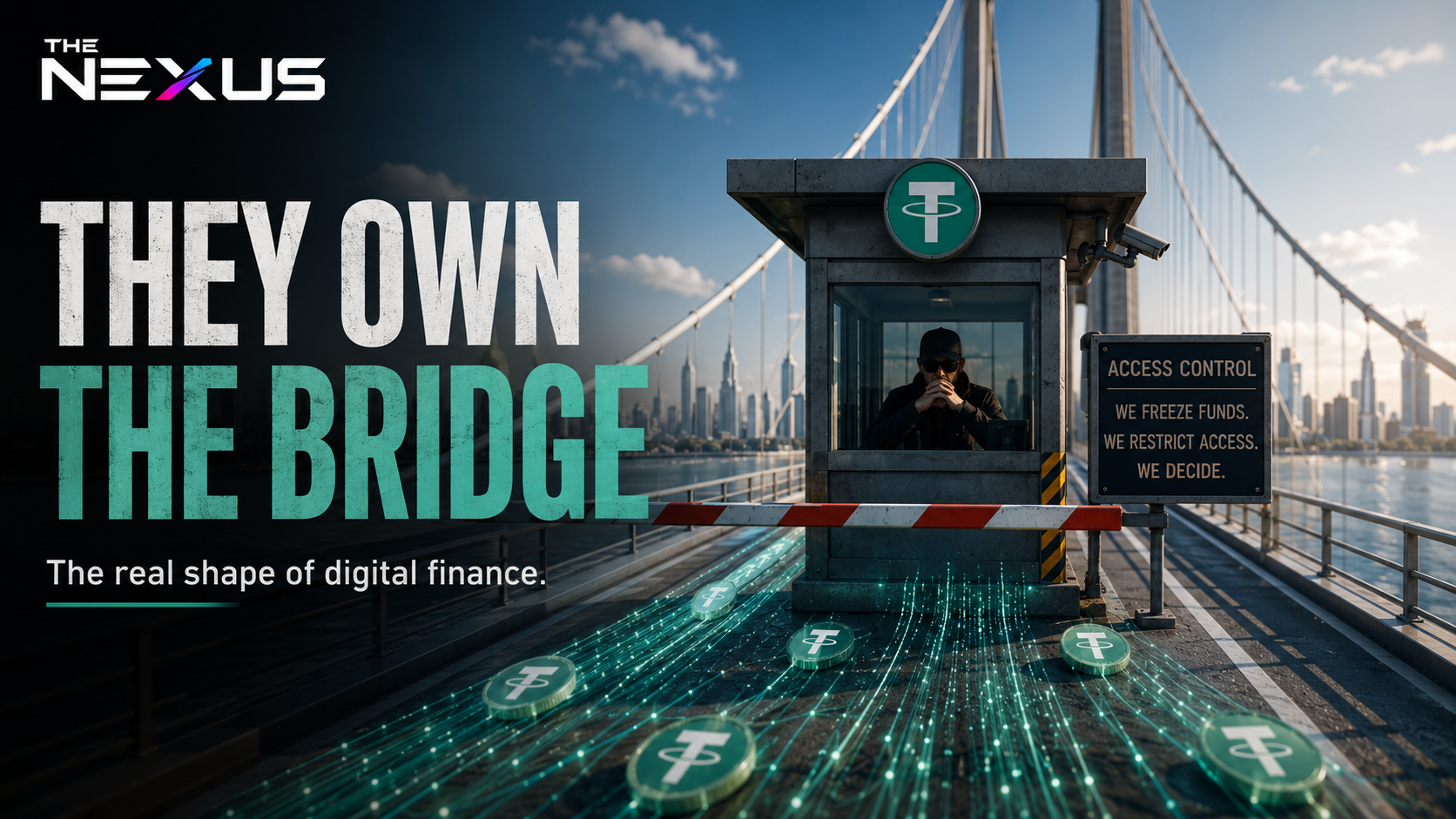
The blockchain provides the settlement rail. The issuer provides the control point.
A Better Sanctions Machine
Cryptocurrency was once discussed as a means of escaping the political boundaries of the banking system. Bitcoin could move without permission, balances could not be rewritten by a central administrator and governments could not simply telephone the network and ask it to reject a particular user.
Stablecoins changed that equation. They gave the market something it urgently wanted: dollars that could circulate continuously across blockchain networks, move between exchanges and settle globally without waiting for banks to open. In exchange, users accepted an issuer standing above the asset.
For traders and ordinary users, that bargain can feel almost invisible. USDT behaves like cash until the moment it does not. It moves from wallet to wallet in seconds, works across borders and often requires no direct relationship with Tether. The administrative layer remains in the background until a wallet enters the sanctions system, becomes associated with criminal activity or attracts the attention of a government powerful enough to demand action.
At that point, the supposed bearer asset reveals itself as a revocable claim.
This makes stablecoins unusually attractive to states. Their transactions are publicly traceable, their issuers are identifiable and their balances can often be frozen at the contract level. Unlike physical cash, the funds leave a permanent trail. Unlike Bitcoin, they contain an administrator capable of disabling them. Unlike a bank account, they can be monitored across an open ledger before enforcement reaches the issuer.
It is difficult to imagine a more efficient financial-surveillance instrument: globally transferable dollars moving over transparent databases with centralised switches built into the asset.
The irony is that Iran appears to have turned towards stablecoins partly because of its exclusion from the conventional dollar system. US sanctions have restricted Iranian access to banking relationships, foreign reserves and international settlement, creating a strong incentive to find alternative channels. Reuters reported earlier this year that Iranian crypto activity reached an estimated $8 billion to $10 billion during 2025, although much of that activity involved ordinary Iranians attempting to protect themselves from the deteriorating rial rather than state-directed sanctions evasion. US investigators have nevertheless focused heavily on activity associated with the Islamic Revolutionary Guard Corps and the Central Bank. (Reuters)
USDT offered liquidity, dollar exposure and international reach. It also carried the authority of a company deeply integrated with the very system Iran was attempting to bypass.
The escape route contained the checkpoint.
Operation Economic Fury
Operation Economic Fury is broader than cryptocurrency. The campaign combines sanctions, asset seizures, pressure on foreign intermediaries and efforts to disrupt the networks through which Iran sells commodities, acquires equipment and repatriates funds. The administration has targeted exchange houses, trading companies, shipping infrastructure and entities accused of moving money on behalf of Iranian institutions and political elites. (New York Post)
Digital assets have become a significant front because they give Iran access to financial channels beyond the traditional correspondent-banking system. They also give US authorities a remarkably detailed map of the activity once investigators can associate addresses with real organisations.
A public blockchain does not hide the movement of money. It records it permanently. The difficulty lies in attribution: determining who controls an address and what the transactions represent. Once that connection is established, every historical transfer becomes available for analysis. Investigators can map counterparties, follow intermediary wallets, identify exchanges and isolate the points where centrally controlled assets or regulated businesses become involved.
This means Iran can create new addresses, route funds through intermediaries and move between platforms, but it remains exposed whenever those flows return to an issuer-controlled stablecoin, a compliant exchange or another institution susceptible to US pressure. The network may be decentralised, while the useful liquidity surrounding it remains concentrated in systems Washington can reach.
The latest $131 million freeze therefore does not prove that blockchains have failed. It proves that governments have become better at identifying which parts of the cryptocurrency economy are not meaningfully decentralised at all.
Not All Crypto Is the Same
The industry damages its own credibility when it describes every token on every network as though it carries the same security and ownership model. USDT on Tron, BTC on Bitcoin and a token controlled by an upgradeable contract are not merely different investments. They represent different forms of property.
A person holding a genuinely native, non-custodial blockchain asset controls it through possession of the private key, subject to the rules enforced by the network. There may still be risks from exchanges, frontends, bridges and wrapped representations, but no issuing company can ordinarily blacklist the native asset inside the protocol.
A person holding USDT controls a token that also recognises Tether’s authority. The private key authorises the holder to submit a transfer, but the issuer retains the ability to decide that the transfer will no longer be accepted.
That is shared control, whether the industry chooses to describe it that way or not.
The distinction becomes especially important when USDT is marketed informally as a refuge from unstable banks, capital controls or hostile governments. It may provide an effective refuge from one institution while placing the holder under another. Someone escaping the Iranian banking system can hold a digital representation of the dollar, but the asset remains within the enforcement reach of the United States. Someone escaping a domestic currency collapse may gain stability, but not monetary sovereignty.
This does not make USDT useless. Its enormous adoption reflects the fact that it solves real problems. It gives people in unstable economies access to dollar-denominated value, allows businesses to settle across borders and provides the liquidity foundation for much of the cryptocurrency market. The mistake is not using it. The mistake is pretending its convenience eliminates its issuer.
Freezing the Money Without Freezing the Chain
The technical mechanism matters because it exposes where power really sits.
The four Iranian-linked wallets were not removed from Tron. Their transaction histories were not deleted and the network did not rewrite its ledger. The addresses may still hold other assets that remain transferable. Only the USDT balances were immobilised because only Tether controlled the relevant token contract.
This creates a peculiar form of financial possession. The blockchain continues displaying the balance, yet the balance has lost its economic function. The tokens can be observed but not spent, transferred or redeemed by the blacklisted holder. They remain present as entries in the ledger while becoming inert through a decision made outside it.
To an unsophisticated observer, the wallet still contains $131 million. To the owner, it contains a record of money that an issuer has withdrawn permission to use.
That is why the familiar phrase “not your keys, not your coins” is no longer sufficient. The wallet holders may still possess their keys. Nobody needed to steal them. The problem is that the keys were never the only source of authority.
A more accurate rule would be: not your contract, not entirely your asset.
The Programmable Dollar Arrives Early
Western governments have spent years debating central bank digital currencies and the political risks of programmable money. The argument is often framed as a future choice between physical cash and a state-issued digital currency capable of surveillance, restrictions or direct intervention.
Stablecoins have already introduced much of that functionality without waiting for a central bank.
They are issued privately rather than by the Federal Reserve, but their value depends on access to dollar reserves, banks, government debt and the legal infrastructure of the United States. Their issuers can monitor activity, comply with blacklists and immobilise particular balances. The state does not need to operate the ledger directly if it can exercise authority over the institution that controls the token.
This arrangement may prove politically easier than launching an official digital dollar. The private sector builds the technology, acquires the users and carries the commercial risk. The government retains influence through regulation, sanctions and control of the underlying financial system. Stablecoins export dollar usage around the world while preserving many of the powers that have always accompanied the dollar.
The US Treasury is not fighting stablecoins. It is learning how useful they can be.
Operation Economic Fury demonstrates the result. Iran attempted to use cryptocurrency infrastructure to operate beyond the reach of conventional finance. The United States followed the flows onto public ledgers, identified the centralised asset inside them and used the issuer’s administrative powers to turn the balances off.
No troops entered a bank vault. No blockchain was breached. No consensus rule was changed.
A company updated a blacklist.
The Network Beneath the Money
There is a tendency to interpret freezes like this as evidence that cryptocurrency itself has been captured. That conclusion goes too far. Public blockchains continue to provide a form of settlement that no stablecoin issuer created and no government wholly controls. The Iranian wallets were frozen because they held an asset with an external administrator, not because Tron had suddenly acquired a sanctions department.
The more uncomfortable conclusion is that much of what people call crypto is built from layers with radically different trust assumptions. A permissionless network can host a permissioned token. A self-custodial wallet can contain an issuer-controlled asset. A transaction can be technically decentralised while the thing being transferred remains politically revocable.
Users must decide which layer they are actually relying upon.
For most of the market, liquidity has won that argument. Traders overwhelmingly prefer an asset accepted by exchanges, payment providers and counterparties, even when that asset carries a blacklist. The demand for stable dollars has proved stronger than the demand for monetary independence.
That may remain true until the enforcement perimeter reaches someone who believed it did not apply to them.
The Central Bank of Iran is not likely to attract much sympathy in Washington, and supporters of the freeze will argue that an adversarial state should not be permitted to use dollar-linked infrastructure to evade sanctions during a military confrontation. That is a political judgement. The technical lesson exists independently of whether the target is considered deserving.
The same control that can immobilise the reserves of a hostile government can immobilise the funds of an exchange, a company, a protest organisation or an ordinary wallet incorrectly connected to suspicious activity. The mechanism has no moral understanding of its target. It executes the decision of the authority operating it.
The Real Shape of Digital Finance
The $131 million freeze is not merely another example of governments catching up with cryptocurrency. It shows the architecture taking shape as crypto is absorbed into the existing financial order.
Public blockchains will remain open enough to provide global distribution, continuous settlement and transparent movement. Stablecoin issuers will provide familiar units of account and deep liquidity. Exchanges and custodians will connect those assets to businesses and consumers. Above them, governments will apply sanctions, compliance obligations and financial-surveillance powers through the organisations capable of enforcing them.
The system will look decentralised from the wallet and centralised from the control room.
That may be exactly what mainstream digital finance becomes: open rails carrying assets whose permissions can be altered by institutions far above the people using them. It will be faster than banking, more transparent than banking and in certain respects easier to police than banking.
Iran did not lose access to $131 million because the United States controlled Tron. It lost access because the dollars moving across Tron were never beyond the reach of the dollar system.
The blockchain remained sovereign.
The money did not.
---
Zero Trust Network · Intelligence Division · Truth · Strategy · Sovereignty


Discussion