They Didn’t Ban Crypto. They Chartered It.
World Liberty’s bank charter is bigger than another Trump crypto controversy. It reveals how stablecoins, custody and public blockchains are being absorbed into a regulated system of identifiable issuers, enforceable controls and permissioned exits.

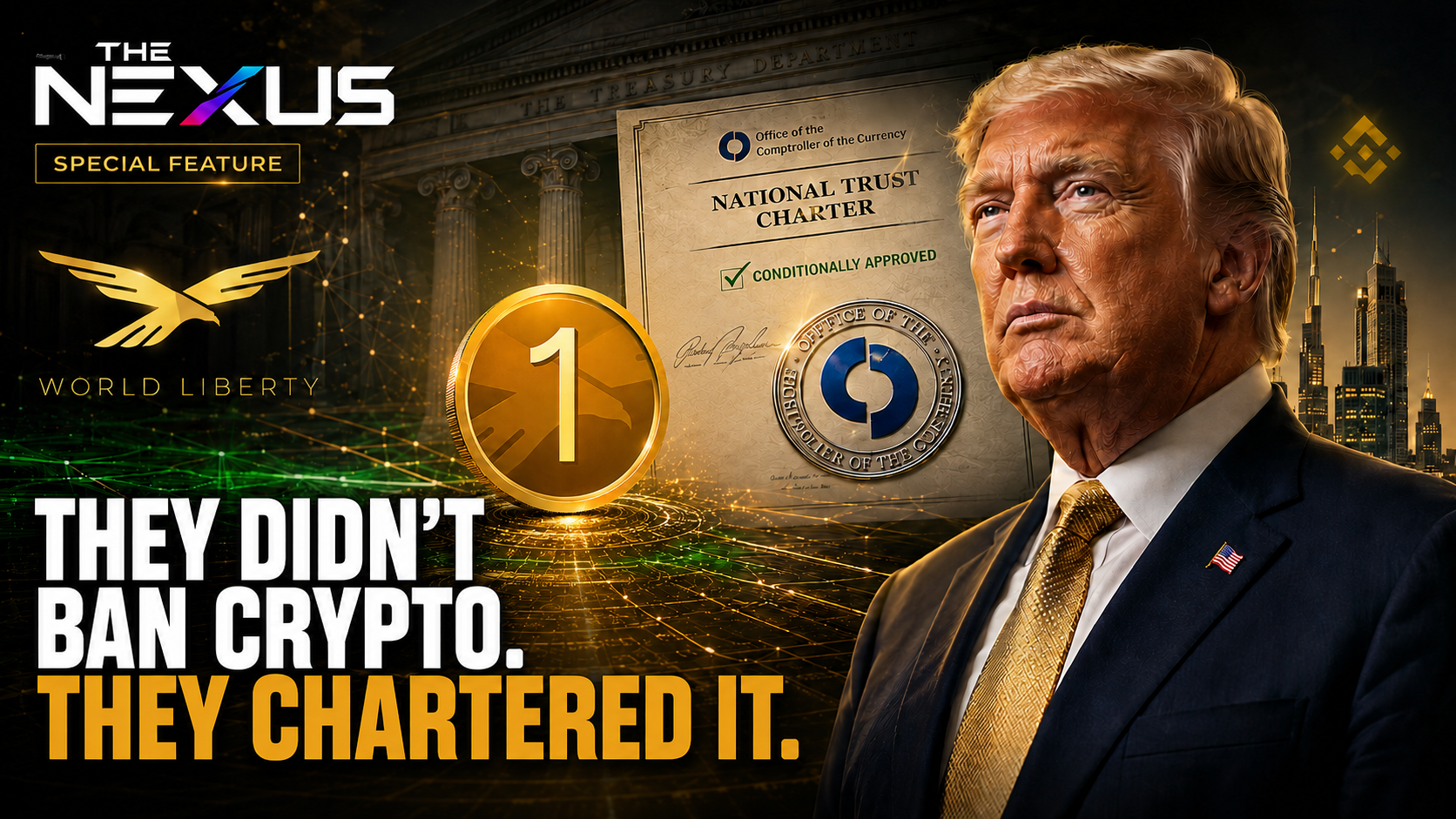
Crypto spent years preparing for Washington to attack it.
What arrived was far more intelligent.
A bank charter.
On 14 August, the US Office of the Comptroller of the Currency conditionally approved World Liberty Trust Company, National Association — the proposed banking arm of World Liberty Financial.
World Liberty is not merely another crypto company. An entity affiliated with President Donald Trump and members of his family owns approximately 38% of its corporate parent. The company issues USD1, a rapidly growing dollar-backed stablecoin whose circulation has reached roughly $4 billion.
The charter is not final. World Liberty must satisfy a list of regulatory and operational requirements before it can begin operating as a national trust company.
But the signal has already been sent.
Crypto is not being driven out of the financial system.
It is being absorbed into it.
This Is Not Quite the Bank You Think It Is
World Liberty has not been given permission to open branches, take ordinary customer deposits or issue mortgages.
This is a national trust charter.
If final approval is granted, World Liberty Trust will be permitted to issue and redeem USD1, custody digital assets, manage the reserves supporting the stablecoin and provide settlement and asset-servicing functions under federal supervision.
The distinction matters.
This is not a conventional bank built around lending. It is a regulatory chassis built around digital dollars.
World Liberty’s own documentation currently states that BitGo issues USD1, processes its purchases and redemptions, provides the technical infrastructure and holds or maintains its reserve assets. The proposed trust company would bring those critical functions closer to World Liberty itself.
In other words, World Liberty is attempting to vertically integrate the entire stablecoin stack:
Issuance.
Redemption.
Reserve management.
Custody.
Conversion.
Institutional access.
The company calls that a “full-stack” stablecoin offering.
From a Zero Trust perspective, it is also a full-stack control surface.
The OCC’s conditional approval requires World Liberty Trust to maintain at least $20 million in capital, appoint a qualified internal audit manager and notify the regulator before making major changes to its business plan.
It will be supervised. It will be examined. It will have rules.
None of that makes it decentralised.
From “DeFi” to a National Trust Company
World Liberty Financial entered the market wrapped in the language of decentralised finance.
Its stated mission was to democratise access to financial services and reduce dependence on a restrictive banking system.
Less than two years later, its flagship product is heading towards a federally supervised trust company operating under the US Treasury’s banking regulator.
That is not necessarily bad business. In fact, it may be extremely good business.
But it exposes the difference between selling the aesthetic of decentralisation and building something that is actually beyond central control.
USD1 can travel across public blockchains. It can settle at any hour. It can interact with exchanges, wallets and DeFi protocols.
Yet its value still depends on centrally managed reserves, recognised issuers, approved redemption routes and institutions willing to exchange it for actual dollars.
The blockchain records the token.
The issuer decides whether the token remains economically useful.
That is the absorption model in one sentence: the state does not need to control every blockchain when it can regulate the assets, custodians, issuers and exits that most users depend upon.
The Charter Is Conditional. The Direction Is Not
World Liberty is not being admitted alone.
The OCC has granted conditional national trust approvals to Circle, Ripple, Coinbase, Paxos, BitGo and Fidelity Digital Assets, among others. Stripe-owned Bridge has received approval for a trust company intended to provide stablecoin issuance, custody and reserve-management infrastructure.
The OCC’s own digital-asset licensing pipeline now contains applications from exchanges, payment companies, custodians and tokenisation businesses.
This is not a collection of unrelated licence applications.
It is the construction of a regulated digital-asset banking layer.
The industry spent years demanding regulatory clarity. It is now receiving it in the form governments understand best: licensed entities, accountable management, capital requirements, compliance departments, identifiable reserves and enforceable points of control.
Crypto is being allowed into the building.
It is simply being asked to leave its sovereignty at reception.
The Trump Conflict Is Structural
World Liberty’s political problem cannot be dismissed as branding.
The company’s own website disclosure states that DT Marks DEFI LLC — an entity affiliated with Donald Trump and members of his family — owns approximately 38% of WLF Holdco.
The disclosure also states that the Trump-affiliated entity and certain family members hold 22.5 billion WLFI tokens, while DT Marks is entitled to fees equal to 75% of WLFI token-sale proceeds after agreed deductions.
A second Trump-affiliated entity has an indirect economic interest, through approximately 38% beneficial ownership, in an affiliate entitled to interest earned from the reserves supporting USD1.
That last point is important.
Stablecoin issuers generally do not need to charge holders a visible fee to make money. They can earn interest from the Treasury bills, money-market instruments and cash equivalents held against the tokens in circulation.
The larger the stablecoin becomes, the larger the potential reserve income.
According to Reuters, World Liberty and its products had channelled more than $1.6 billion to Trump and his family by April 2026, while USD1 itself had generated an estimated $50 million for the family by the end of June.
Those are estimates, not court findings. World Liberty says Trump and his family are not officers, directors or employees of the operating companies.
But the economic interest is publicly disclosed.
The OCC sits within the Treasury Department. Comptroller Jonathan Gould was appointed by Trump. The regulator has now approved a charter that could strengthen a company in which a Trump-affiliated entity possesses a significant financial interest.
The OCC says its staff acted consistently with their statutory and ethical duties. It says the application was examined by career officials and that the trust will be supervised by non-political examiners.
That may all be true.
It still does not make the conflict disappear.
A structural conflict does not require proof that somebody secretly interfered with the application. It exists because the President’s family can economically benefit from a decision made by an agency operating inside his administration.
The question is not merely whether the application passed the test.
It is whether the public can trust who designed, administered and benefited from the test.
Then There Is Abu Dhabi
The foreign-investment story contains two different transactions. They should not be lazily collapsed into one.
The first involved ownership.
According to Financial Times reporting, an Abu Dhabi vehicle backed by Sheikh Tahnoon bin Zayed al-Nahyan — the UAE’s national security adviser — agreed to pay $500 million for a 49% stake in World Liberty.
The agreement was reportedly signed four days before Trump’s January 2025 inauguration.
A Senate Banking Committee minority report claims the deal’s initial payment directed $187 million towards Trump-family entities. World Liberty has said neither Donald Trump nor Steve Witkoff was involved in negotiating the transaction.
The second transaction involved USD1 itself.
In May 2025, World Liberty announced that Abu Dhabi-backed investment company MGX would use $2 billion of USD1 to complete its investment in Binance.
That deal instantly gave a newly launched stablecoin enormous scale. It also placed billions of dollars into reserves from which World Liberty-affiliated entities could potentially receive interest while the corresponding tokens remained outstanding.
MGX’s use of USD1 was confirmed at the TOKEN2049 conference by World Liberty co-founder Zach Witkoff, appearing alongside Eric Trump.
One transaction purchased almost half of the company.
The other helped transform its stablecoin from a new product into a major market asset.
The OCC says non-US investors were not regarded as principal shareholders of the proposed trust bank. It also obtained “passivity agreements” under which several investors promised not to control or influence the bank’s decisions.
Eric Trump reportedly signed one of those agreements on behalf of a Trump-family investment vehicle.
Passivity agreements may restrict formal influence over the bank. They do not erase ownership, economic incentives or the geopolitical relationships surrounding the parent company.
Elizabeth Warren Is Right — But Not All the Way
Senator Elizabeth Warren repeatedly asked the OCC to halt its review until Trump and his family eliminated their financial conflicts.
In January, she warned that the application placed the regulator in an unprecedented position. During a February hearing, she pressed Gould over whether World Liberty had fully disclosed its principal shareholders and foreign ownership.
Her conflict-of-interest argument is difficult to dismiss.
The President should not be able to shape the regulatory environment for an industry while a family-linked company profits from that same environment.
But the Zero Trust analysis has to go further.
Remove Trump from World Liberty tomorrow and the absorption machine remains intact.
Circle still has its charter. Ripple still has its charter. Coinbase still has its charter. More issuers, custodians and payment companies are waiting in the queue.
Warren is challenging who is allowed to own one of the gateways.
The deeper question is why so much control is being concentrated at those gateways in the first place.
Stopping one politically exposed issuer would address a serious conflict.
It would not decentralise the stablecoin system.
The GENIUS Act Tells You Who Controls the Coin
The GENIUS Act was sold as the legislation that finally legitimised stablecoins in America.
It requires permitted issuers to maintain liquid reserves on at least a one-to-one basis, publish regular reserve disclosures and comply with anti-money-laundering and sanctions obligations.
Those protections have value. A token claiming to represent a dollar should have a real dollar or an equivalent liquid asset behind it.
But the legislation contains another requirement that should matter to anybody interested in financial sovereignty.
According to the White House’s own summary, permitted stablecoin issuers must possess the technical capability to seize, freeze or burn stablecoins when legally required.
Read that again.
The blockchain may be public.
The asset operating on it must still have a controller.
This is where much of the “decentralised dollar” narrative falls apart.
Holding USD1 in a self-custody wallet means you control the private key used to sign a transaction. It does not necessarily mean you possess an unconditional claim that no issuer, regulator, sanctions authority or redemption provider can interfere with.
World Liberty’s current FAQ says eligible BitGo customers can redeem USD1 directly. Other holders may have to exchange through participating exchanges, platforms or regulated custodians, subject to their individual terms and eligibility requirements.
Settlement is on-chain.
The reserves are off-chain.
Redemption is permissioned.
Compliance is centralised.
That is not trustless money. It is a regulated financial claim moving across a blockchain.
The Absorption Route
The control chain is not complicated:
OCC, Treasury and OFAC → World Liberty Trust → USD1 issuance, reserves and redemption → exchanges and institutions → users
The pressure source is the state.
The reachable actor is the regulated issuer, custodian or exchange.
The executable powers include examinations, capital conditions, transaction monitoring, wallet restrictions, reporting obligations, sanctions enforcement and legally required freezing or burning.
The affected asset is USD1.
The user consequence is that a token may remain visible inside a wallet while its transferability, redemption or access to meaningful liquidity is restricted elsewhere.
The underlying blockchain does not need to be halted.
It can continue producing blocks perfectly.
The user can still lose the practical ability to use the money.
Not a CBDC — But Not Quite the Escape From One
USD1 is not a central bank digital currency.
It is privately issued, backed by reserves and operated through commercial entities rather than directly by the Federal Reserve.
That distinction is real.
Yet regulated stablecoins can deliver several of the controls that made people suspicious of CBDCs in the first place: identity checks at gateways, sanctions screening, monitored redemption, blacklisting and the technical ability to freeze or destroy token balances under lawful authority.
The government does not need to build a retail CBDC wallet for every American.
It can allow private companies to distribute digital dollars and compel those companies to enforce the rules.
The branding is private.
The reserve assets support the dollar and US government debt.
The compliance perimeter remains governmental.
It is the dollar system extended onto public blockchains without surrendering control over the dollar.
The Charter May Be the Most Valuable Product
World Liberty calls federal oversight a source of legitimacy and accountability.
Institutional investors will probably agree.
A national trust charter offers a single federal supervisory relationship, a recognised custody framework and a far easier story to present to banks, asset managers, exchanges and corporate treasurers.
It does not provide FDIC insurance. It does not make USD1 legal tender. It does not remove commercial, operational or political risk.
But the letters “N.A.” and the presence of the OCC give World Liberty something enormously valuable in crypto:
borrowed trust.
That may ultimately matter more than any feature in the USD1 smart contract.
The charter can turn World Liberty from a politically branded crypto venture into regulated infrastructure through which institutions store assets, settle payments and access digital dollars.
And once infrastructure becomes sufficiently embedded, removing it becomes far more difficult than criticising it.
The Final Zero Trust Question
Zero Trust does not mean assuming that every regulator, company or politician is committing a crime.
It means refusing to treat a famous name, federal charter or reserve attestation as a substitute for understanding the control structure.
So ask the only question that matters:
Who can stop me?
World Liberty or its issuance partner can control minting and redemption.
Regulators can impose conditions on the trust and issue enforceable orders.
Sanctions authorities can require assets or addresses to be restricted.
Custodians can deny access.
Exchanges can freeze accounts or remove liquidity.
Banks can block the route back into fiat.
The blockchain can remain live throughout all of it.
That is the real story behind the World Liberty charter.
The scandal is not simply that a President’s family may profit from the regulated crypto economy his administration is helping construct. That conflict deserves scrutiny, regardless of party.
The larger story is that crypto’s rebel infrastructure is being converted into a distribution network for regulated, issuer-controlled dollars.
They do not need to close the blockchain.
They only need the assets, identities, liquidity and exits.
Crypto feared it would be banned.
Instead, it was offered a charter.
---
Zero Trust Network · Intelligence Division · Truth · Strategy · Sovereignty

Discussion