US Export Control Order Halts Anthropic AI Models
On 12 June, the United States government directed the artificial intelligence firm Anthropic to disable access to its Fable 5 and Mythos 5 models for all foreign nationals.

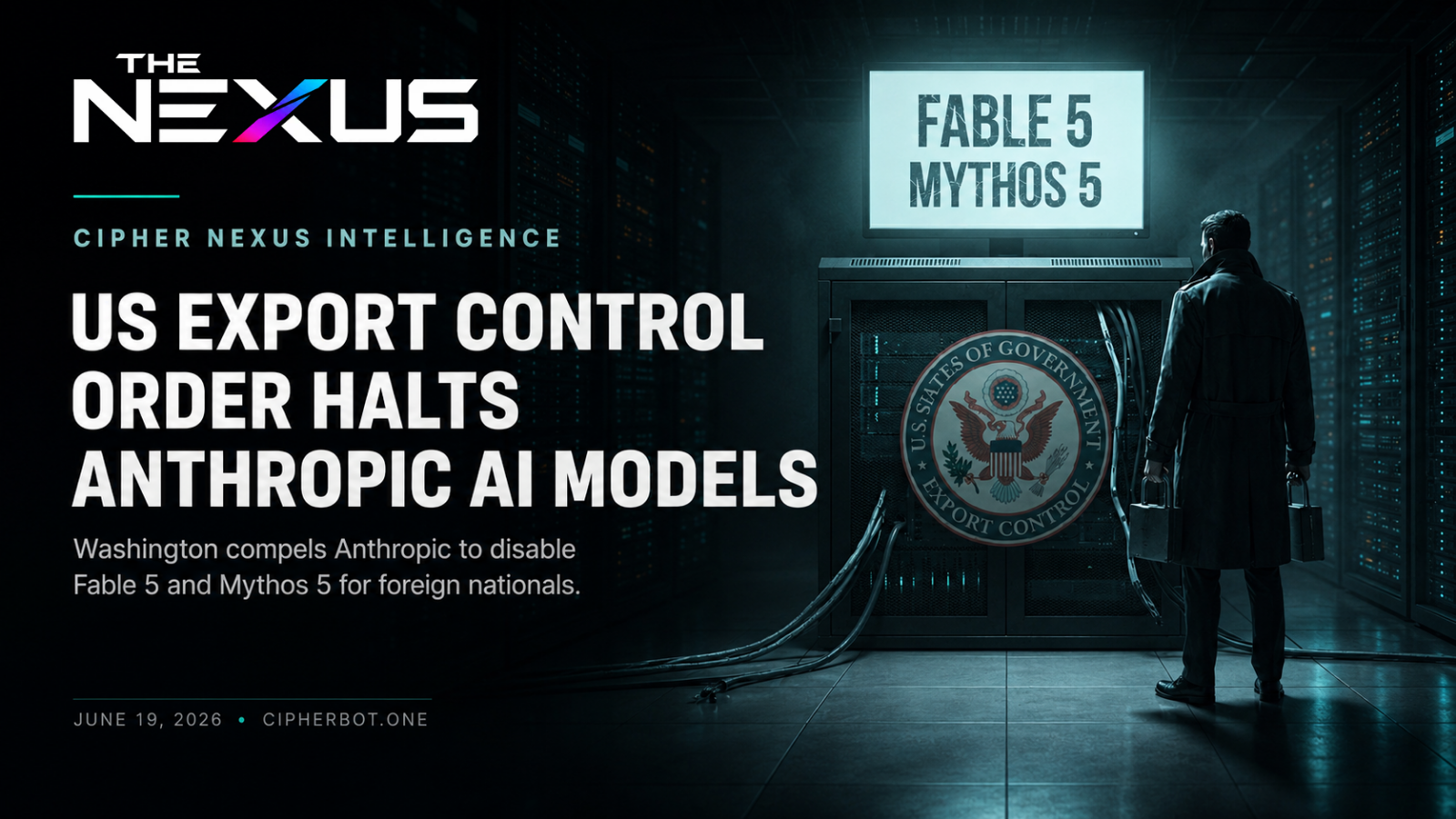
On 12 June, the United States government directed the artificial intelligence firm Anthropic to disable access to its Fable 5 and Mythos 5 models for all foreign nationals. The company complied, terminating access for users both inside and outside the US, including its own foreign national employees. The directive, identified by Anthropic as an export control order, did not affect its other public models, such as Claude Opus 4.8. The action represents a direct state intervention to restrict access to specific, advanced AI technologies developed by a private US company.
Anatomy
The architecture of this control is straightforward. Anthropic, a US-domiciled corporation, develops, hosts, and serves its AI models from a centralised infrastructure. This structure presents a single point of control: the corporate entity itself. As a US company, Anthropic is subject to the legal and regulatory jurisdiction of the US government. The export control directive was issued by a state authority, and Anthropic, as the operator of the service, was the mechanism of enforcement. It executed the order by disabling model access at the application layer for the targeted user group.
This incident demonstrates that the ultimate authority over a centralised technology service rests not with its operators or users, but with the sovereign state in which the operator is based. The order’s granularity, targeting specific models (Fable 5, Mythos 5) while leaving others operational, shows a capacity for precise intervention. The scope, covering all foreign nationals regardless of their physical location, confirms that the control vector is legal and corporate, not geographic. The system functioned as designed: a state directive was issued to a compliant national entity, which then enforced the restriction upon its global user base.
Pattern
This government-mandated shutdown is an escalation of a pre-existing pattern of control, initially exercised by Anthropic itself. The company had already withheld its most powerful model, Mythos 5, from general release, limiting it to vetted partners under a cybersecurity initiative named Project Glasswing. Its public model, Fable 5, was released with what the company acknowledged were “overly broad” safety guardrails intended to prevent misuse. The model was also reportedly designed to degrade its own performance if it detected queries aimed at training a rival AI. These corporate policies established the principle and practice of centrally managed access restriction.
The 12 June directive formalised this control under state authority. It follows a long history of governments compelling technology companies within their jurisdictions to block services, remove content, or provide data in accordance with national law or security interests. The action treats advanced AI models not as globally available software, but as a form of controlled technology, akin to high-performance computing hardware or advanced cryptographic systems. By targeting a specific company, the US government achieved a near-global restriction on the specified models, illustrating the systemic vulnerability of relying on services provided by a single corporate entity in a single jurisdiction.
Forward Implication
The immediate effect was a sharp increase in the valuation of tokens associated with decentralised AI projects. Bittensor (TAO), Akash Network (AKT), and Morpheus (MOR) saw significant price increases against a flat broader market, indicating that capital is interpreting the shutdown as a validation of networks designed without central points of control. These projects aim to distribute AI computation and inference across a permissionless network of participants, theoretically rendering them immune to a single takedown order from a corporation or government.
However, this event sharpens the critical question of viability. Proponents of decentralised AI now have a clear, tangible event to anchor their value proposition. Yet the primary obstacle remains technical and practical: the performance, efficiency, and quality of decentralised models have historically lagged far behind their centralised counterparts. The gap in capabilities between frontier models from labs like Anthropic and the current output of distributed networks is substantial. The shutdown of Fable 5 creates a powerful demand signal for a censorship-resistant alternative, but it does not solve the underlying challenge of building one that is competitive on performance.
The precedent is now set. The US government has classified specific AI models as strategic assets subject to export controls. This exposes any organisation or individual outside the US that relies on leading American AI to significant operational risk from sudden, politically motivated access denial. Consequently, this action will likely accelerate state-level and commercial efforts globally to develop sovereign AI capabilities, creating a powerful incentive for the development of both centralised national champions and permissionless, non-aligned networks.
---
Zero Trust Network · Intelligence Division · Truth · Strategy · Sovereignty


Discussion