Verus Network Halts Layer 1 Chain After $11.6M Bridge Exploit
On 17 May 2026, an attacker exploited a vulnerability in the Verus-Ethereum bridge, extracting digital assets valued at approximately $11.6 million. The stolen assets, which included various tokens native to the Verus ecosystem, were immediately swapped for Ether (ETH) on decentralized exchanges. Th

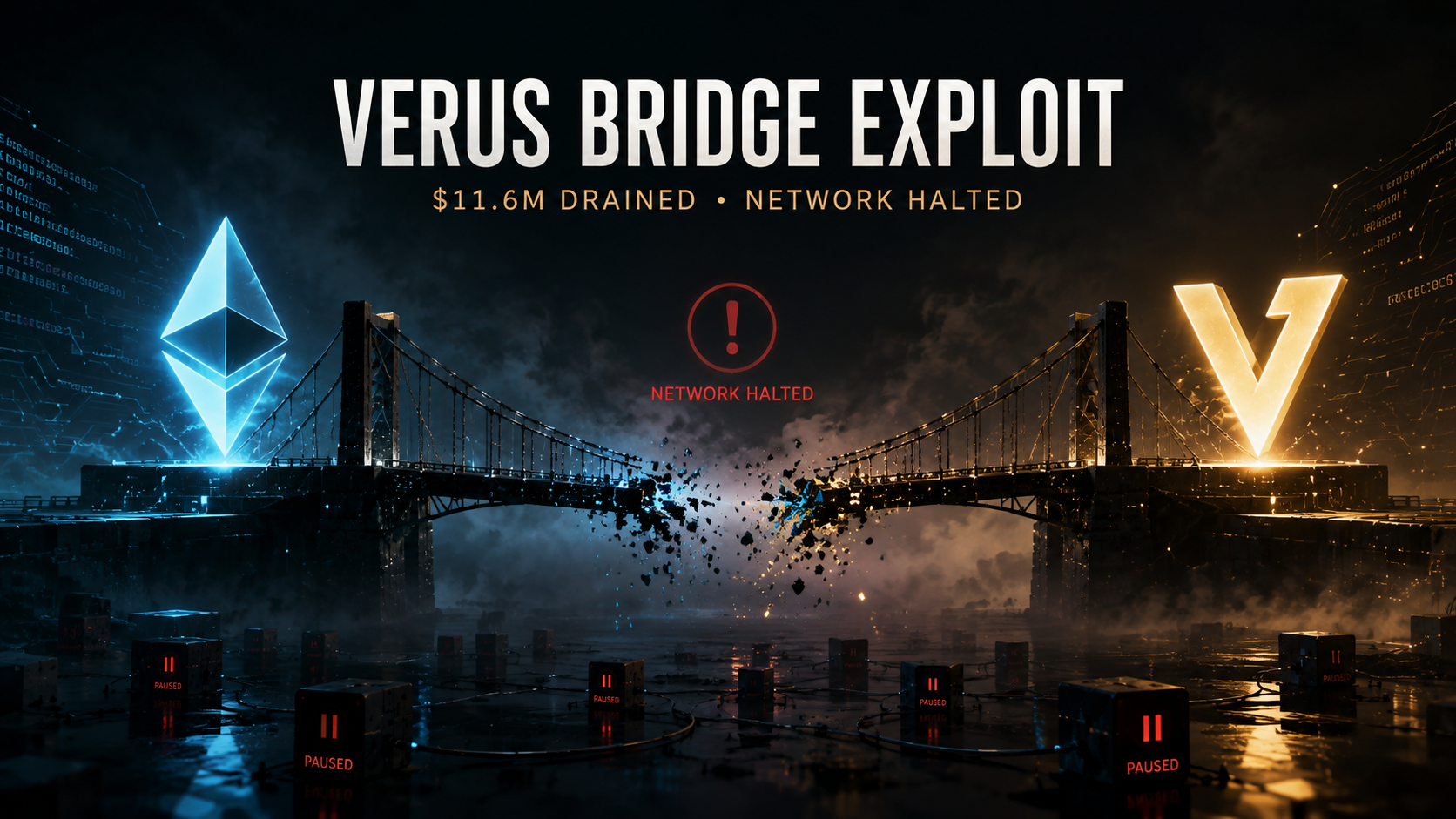
On 17 May 2026, an attacker exploited a vulnerability in the Verus-Ethereum bridge, extracting digital assets valued at approximately $11.6 million. The stolen assets, which included various tokens native to the Verus ecosystem, were immediately swapped for Ether (ETH) on decentralized exchanges. This action was likely taken to obscure the funds' trail and prevent asset freezes by centralized token issuers. In an unprecedented response, the Verus project's core team halted the Verus blockchain, a Proof-of-Power Layer 1 network, to contain the damage and prevent further losses.
Anatomy
The Verus-Ethereum bridge is designed to facilitate asset transfers between the two blockchains. Its security model does not rely on a single custodian but on a federated group of participants known as notaries, who are responsible for observing and validating transactions on both chains. For an asset to move from Verus to Ethereum, it is locked in a contract on the Verus chain. Notaries then sign a message attesting to this lock, which authorizes a smart contract on Ethereum to mint a corresponding wrapped token. The security of this system rests on a threshold of notaries acting honestly and the integrity of the smart contracts processing their attestations.
The failure occurred within the Ethereum-side smart contract responsible for minting wrapped assets. Analysis of the exploit indicates the attacker did not compromise the notary keys. Instead, they identified a flaw in the contract's validation logic. This vulnerability allowed the attacker to submit a validly formed, but fraudulent, transaction that triggered the minting function without a corresponding asset lock on the Verus chain. The contract failed to properly verify the source of the notary attestations, enabling the attacker to create $11.6 million in unbacked assets on Ethereum.
The project's response reveals a deeper architectural characteristic. The decision to halt the entire Verus network was executed by the core development team, demonstrating a centralized control mechanism within the protocol or its operational governance. Verus operates on a hybrid Proof-of-Work and Proof-of-Stake consensus mechanism called Proof-of-Power. The ability to unilaterally stop block production, however, points to either a privileged function accessible to a small group of key holders or a social consensus among a concentrated set of node operators and notaries who agreed to shut down their systems in unison. The response, though decisive in preventing further bridge exploitation, fundamentally contradicts the premise of an unstoppable, decentralized public ledger.
Pattern
The Verus incident follows a well-established pattern of cross-chain bridge exploits, which remain the most frequently targeted and highest-value vulnerability in the sector. The method of failure, specifically minting unbacked assets by subverting validation logic, is analogous to prior major incidents. The Nomad bridge exploit ($190 million) resulted from a faulty contract update that allowed users to spoof messages and withdraw funds. The Wormhole exploit ($326 million) involved an attacker forging a validator signature to mint unbacked wrapped Ether. In each case, the core vulnerability was not on the underlying blockchains but in the intermediary messaging and validation layer connecting them.
The nature of the response distinguishes the Verus incident. While network slowdowns and temporary pauses for maintenance are not uncommon, the complete, indefinite halt of a Layer 1 blockchain to contain a decentralized application failure is an extreme measure. It echoes the decision by BNB Chain operators to pause their network following a $570 million exploit of its native cross-chain bridge in 2022. Both events demonstrate a pattern where the integrity of a single, critical bridge is considered systemically important enough to justify suspending the entire network's liveness. This reveals a pragmatic but centralized approach to risk management, subordinating the principle of continuous operation to the need
---
Zero Trust Network · Intelligence Division · Truth · Strategy · Sovereignty



Discussion