Zcash Has a Privacy Problem. And a Trust Problem.
Zcash built its reputation on privacy. Now that privacy is creating a problem no one can fully measure. Ironwood is designed to contain a critical inflation risk, but the network must first navigate a major infrastructure migration. The real challenge isn't the bug. It's confidence.

The Zcash network is facing the brutal side of privacy: when the ledger is hidden, confidence has to come from design, coordination, and trust in the people managing the upgrade.
That is exactly where the problem begins.
Ironwood is meant to contain a serious flaw in the Orchard shielded pool, a vulnerability that could theoretically allow undetectable inflation of ZEC. Developers say there is no evidence it has been exploited, but in a shielded system that assurance can only go so far. The whole point of the pool is that balances and flows are not publicly auditable in the same way they are on a transparent ledger. Privacy protects the user, but it also creates a blind spot when the question becomes: can we prove the money supply is clean?
That is not a minor technical concern. It cuts straight into monetary credibility. A private transaction system can survive bugs, delays, and difficult upgrades. It cannot survive lasting uncertainty over whether the supply itself is real.
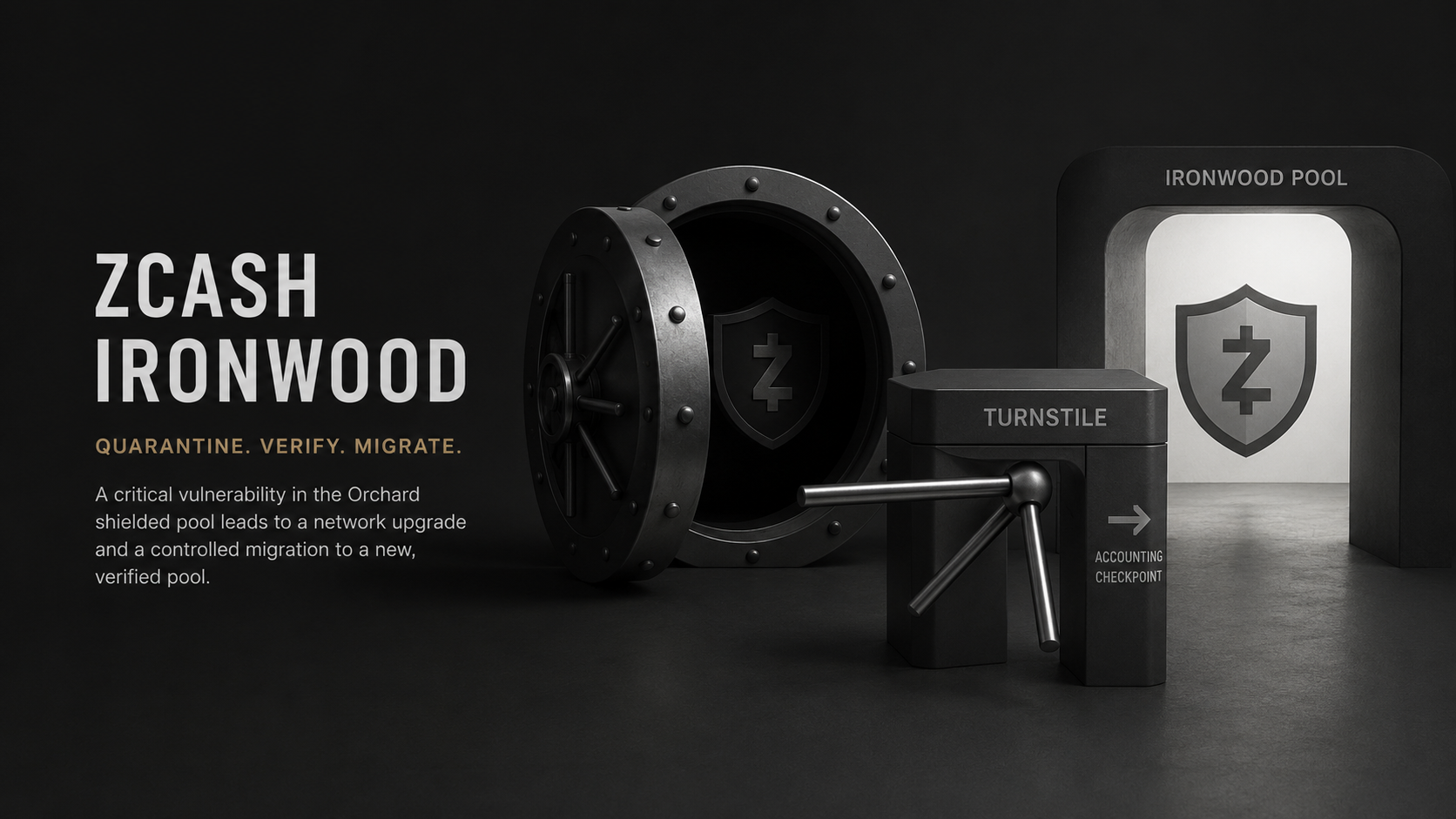
Ironwood is the attempt to contain that uncertainty. The vulnerable Orchard pool would stop accepting new funds, a replacement shielded pool would take over future private activity, and funds leaving the old pool would pass through an accounting boundary designed to stop more ZEC exiting than legitimately entered. In other words, Zcash is not proving nothing happened. It is trying to build a wall around what might have happened.
That may be the only realistic option. It is also the part that should make people uncomfortable.
Because at the same time, the network is trying to force through the retirement of zcashd, the old client that much of the ecosystem still depends on, and move operators onto the newer Z3 stack. That may be the correct long-term architecture, but it turns an already sensitive security response into a live migration of critical infrastructure.
Exchanges, wallets, mining pools, and custodians are not being asked to click update. They are being asked to rework the systems through which most users actually touch Zcash, while parts of the replacement stack are still not considered fully production-ready by the people closest to it.
That is the real risk.
Not that Zcash has a bug. Serious protocols find serious bugs.
The risk is that the network is asking users to trust the cryptography, trust the containment plan, trust the migration path, trust the readiness of the new software, and trust the coordination of everyone involved, all at the same time.
For a privacy coin, that is a dangerous amount of trust.
This is where Zero Trust thinking cuts through the softer language. Privacy is not the same as verification. Shielding transactions may protect users from surveillance, but it also makes supply integrity harder to independently confirm when the cryptography is questioned. The stronger the privacy layer, the more brutal the consequences when confidence in that layer breaks.
That does not mean Zcash is finished. It means Ironwood has to be treated as more than an upgrade. It is a credibility event.
If Zcash handles it cleanly, the network can close off Orchard, move future private activity into safer architecture, and show that privacy protocols can respond under pressure without losing control of the system around them.
If it mishandles it, the damage will not just be technical. It will become a governance problem, an infrastructure problem, and a confidence problem all at once.
Zcash’s promise has always been private money.
Ironwood is the test of whether that money is still verifiable enough to trust.
---
Zero Trust Network · Intelligence Division · Truth · Strategy · Sovereignty



Discussion