DxSale Legacy Contracts Drained of $7.3M via Abused Administrative Keys
An attacker has drained approximately $7.3 million from legacy liquidity provider locker contracts belonging to the DxSale launchpad platform on BNB Chain.

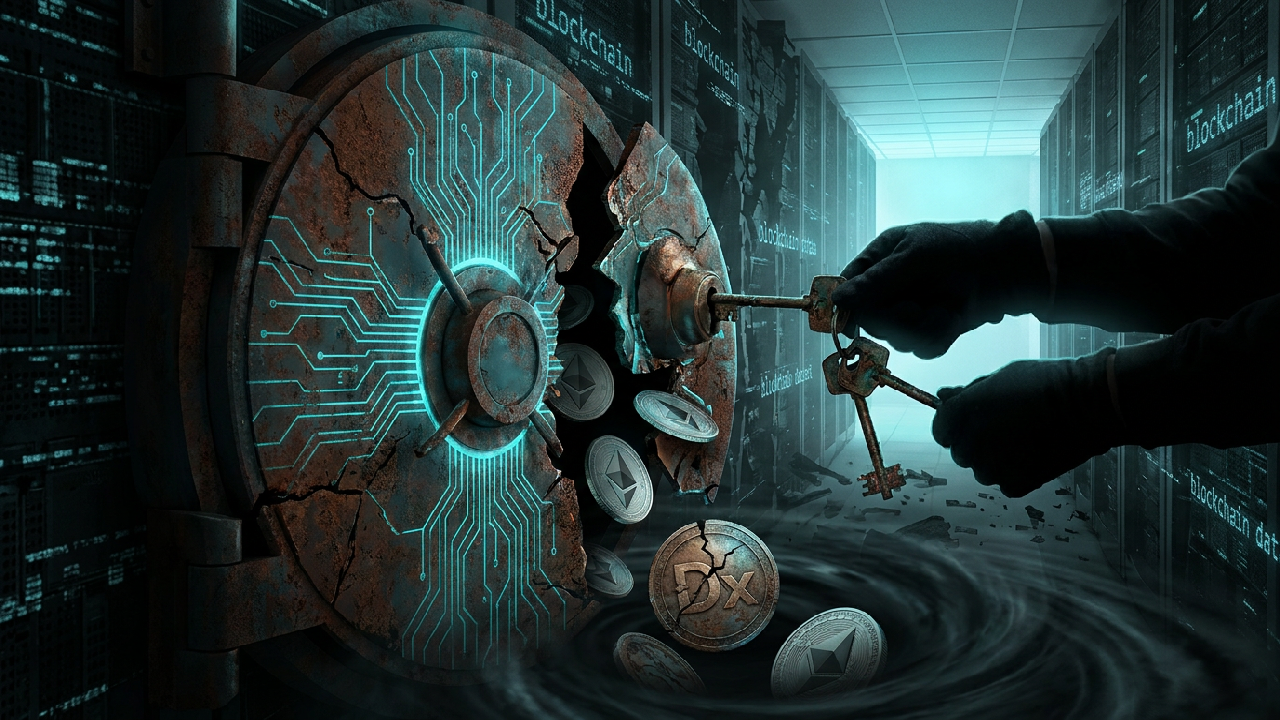
An attacker has drained approximately $7.3 million from legacy liquidity provider locker contracts belonging to the DxSale launchpad platform on BNB Chain. The incident, flagged by security analysts on 29 May, was not the result of a novel smart contract vulnerability but the deliberate abuse of administrative functions. The attacker gained control of the contract via an unannounced ownership transfer that occurred nine months earlier. This access was used to modify contract parameters, nullify lock periods, and execute a batch withdrawal across more than 1,400 individual liquidity pools.
Anatomy
The architecture of this failure is rooted in centralized control over a legacy contract. The exploited contract was a liquidity locker deployed by DxSale during the 2021 market cycle. Critically, the contract's source code was unverified on the BscScan block explorer, preventing users from easily inspecting the exact permissions, owner powers, withdrawal logic and emergency functions embedded inside it.
That single detail changes the entire meaning of the word locked. To the ordinary user, a liquidity locker suggests finality. It implies that liquidity has been placed beyond the reach of the project team, protected from impulsive withdrawal, hidden admin control or coordinated extraction. In reality, a locker is only as strong as the contract logic that enforces the lock. If that logic contains privileged functions, mutable parameters or owner level overrides, then the lock is not a lock in the trustless sense. It is a promise mediated by whoever controls the privileged path.
In this case, the path appears to have been prepared long before the public drain. Analysts reported that contract ownership had been transferred silently months earlier, with the eventual attacker later using that control to modify unlock conditions and trigger withdrawals across a large number of LP positions. The attack did not require breaking encryption, bypassing consensus or discovering some new mathematical weakness. It required control of the administrative layer.
That is why this incident is more disturbing than a normal exploit. A typical smart contract bug is often framed as a mistake in code. This event looks more like the abuse of dormant authority. The mechanism was not hidden in the sense that blockchains hide data. The chain recorded the ownership movement and the later withdrawals. The problem was that most users do not monitor old locker contracts for ownership changes, especially after liquidity has been presented as safely locked for years.
The attacker’s route also shows preparation. Reports describe the movement of funds through many wallet hops before deposits reached exchange linked destinations. That pattern suggests an actor who understood both the contract control surface and the post extraction laundering path. The scale of the withdrawals, spread across more than 1,400 pools, also suggests that this was not a hurried opportunistic drain of one vulnerable project. It was a broad extraction from infrastructure that many smaller projects had relied on as part of their launch credibility.
For the affected projects, the damage is structural. Liquidity locks are not decorative. They are used to reassure buyers that a token cannot be rugged by pulling its trading pair. When legacy LP tokens were withdrawn, the market depth behind those tokens disappeared or became unstable. Even projects that were inactive, forgotten or already dead may have still had value trapped in those pools. The attacker did not need to compromise each project individually. By controlling the shared locker, they accessed the weakness sitting beneath them all.
This is the real anatomy of the event. It was not 1,400 separate failures. It was one shared trust assumption failing at scale.
Pattern
The DxSale incident fits a wider pattern across DeFi: old infrastructure remains dangerous long after the market stops paying attention to it. The 2021 cycle produced thousands of token launches, many of them on BNB Chain, many using the same handful of launchpads, lockers and token generation tools. These systems were treated as temporary launch infrastructure, but the contracts they created often remained live for years.
That creates a strange kind of technical debt. The website may change. The brand may rebrand. The main app may migrate to a new domain or new contract set. The team may focus on newer products. But the old contracts remain on chain, still holding assets, still governed by whatever permissions were written years ago, still vulnerable to any key compromise, ownership transfer, forgotten admin function or undocumented escape hatch.
This is where the language of decentralization becomes dangerously soft. A platform can call itself permissionless, decentralized or trust minimizing while still deploying contracts with centralized authority. A liquidity locker can advertise safety while retaining owner powers. A launchpad can give retail users a clean interface while hiding complexity beneath an unverified contract. The front end sells simplicity. The contract decides reality.
The BNB Chain setting also matters. The 2021 BSC boom was fast, cheap and chaotic. Token launches appeared by the hour. Projects wanted quick tooling, investors wanted proof that liquidity was locked, and platforms competed by making deployment easier. Speed became the product. Due diligence was reduced to icons, badges, countdowns and lock certificates. In that environment, a locker platform could become part of the trust layer for an entire generation of tokens without every user checking whether the underlying contract was truly immutable.
DxSale was one of those infrastructure names. For many smaller projects, using a known locker was part of the launch ritual. It offered social credibility. Investors could see that liquidity was locked through a recognized service, and that was often enough. But this incident shows how easily that credibility can become a pooled risk. When many projects depend on the same admin controlled contract, the trust assumption is not distributed. It is concentrated.
The pattern is therefore not just “another DeFi hack.” It is closer to a delayed infrastructure rug. The liquidity did not vanish at launch. It sat there for years, giving the appearance of safety, while the contract’s privileged control path remained the hidden centre of gravity. When that path was finally used, the result looked sudden to the market, but the vulnerability may have existed from the beginning.
This is one of the most under discussed risks in crypto. Users often check whether liquidity is locked, but rarely ask what kind of lock it is. Is the locker immutable? Is the source code verified? Can the owner change unlock times? Can ownership be transferred? Is there an emergency withdrawal? Is there a migrator? Is there a batch function? Is the admin a multisig, an EOA, a timelock, a DAO or an unknown wallet? Has the contract been abandoned? Has it changed owner since the original lock was created?
Those questions are not glamorous, which is why they are often ignored. But the DxSale event shows that the hidden administrative surface can remain alive long after the marketing cycle is dead.
Forward Implication
The immediate implication is that legacy liquidity lockers now need to be treated as live risk zones. Any project that used older DxSale contracts, or similar launchpad infrastructure from the 2021 era, should not assume that a historic lock certificate means the liquidity is safe today. The contract must be inspected directly. Ownership history must be checked. Unlock functions must be understood. Admin permissions must be mapped. If the code is unverified, users should treat the lock as opaque rather than trustless.
For launchpads, this incident raises a harder question. If a platform markets liquidity locking as protection against rugs, then the platform itself becomes part of the rug risk if it retains hidden control. A locker with unchecked admin authority is not neutral infrastructure. It is a custodian with extra steps. The user may not have handed over funds to a centralized exchange, but they have still placed value behind a privileged contract path controlled by someone else.
The market will likely become more demanding around lock verification. It will not be enough to show that LP tokens are inside a contract. Users will increasingly want to know whether the contract is verified, whether ownership is renounced, whether the lock logic is immutable, whether admin functions exist, whether any role can alter unlock times, and whether the locker has been audited in a way that specifically addresses privileged withdrawal risk.
This event also strengthens the case for independent infrastructure monitoring. A silent ownership transfer should not sit unnoticed for nine months when a contract holds millions in LP value. Watchers should track owner changes, role changes, proxy upgrades, implementation swaps, emergency function calls, unlock timestamp changes and suspicious batch preparation across major DeFi infrastructure. These alerts should not only exist for blue chip protocols. They should cover old launchpad contracts, lockers, vesting contracts and token factories from prior cycles because that is where dormant risk often hides.
There is also a reputational implication for the word “locked.” In crypto, words like locked, renounced, verified and decentralized are often used as emotional shortcuts. They create a feeling of safety before the architecture has been tested. The DxSale drain cuts directly through that habit. Locked does not mean inaccessible. Renounced does not mean safe if there are other roles. Verified does not mean good. Unverified should never be treated as harmless. Decentralized should never be accepted from a landing page when the contract still has an owner key.
For affected users, recovery will likely be difficult. Once LP tokens are withdrawn, sold, split, routed and moved through multiple wallets, the technical path to recovery becomes narrow. If funds reached centralized exchange deposit addresses, freezing or tracing may depend on coordination with exchanges, chain analytics firms and law enforcement. But even if some portion is frozen, the broader loss of confidence cannot be reversed by a partial recovery. The trust layer has already been broken.
The deeper lesson is that DeFi inherits the consequences of its old shortcuts. The 2021 launch machine was built around speed, templates and simplified trust badges. Many of those shortcuts are still sitting on chain, waiting to be rediscovered. Some will be harmless. Some will contain forgotten owner keys. Some will contain unverified logic. Some will still hold liquidity that people believe is permanently beyond reach.
The DxSale exploit is therefore not just an attack on one platform. It is a warning about an entire generation of legacy DeFi infrastructure. The contracts did not disappear when the hype moved on. The admin keys did not become irrelevant because the chart went quiet. The lock did not become trustless because people stopped asking questions.
The final read is stark. More than 1,400 pools were not drained because DeFi is impossible. They were drained because users were told to trust a lock without being able to verify the lock. The attacker did not defeat decentralization. They used the part that was never decentralized in the first place.
Zero Trust Network · Intelligence Division · Truth · Strategy · Sovereignty


Discussion