The Fake DeFi Era Is About to Get Very Awkward
The word DeFi is getting heavier. The CLARITY Act may force crypto to prove what it has only claimed for years: who controls the system, who can change the rules, and who was actually built for the moment the mask came off.

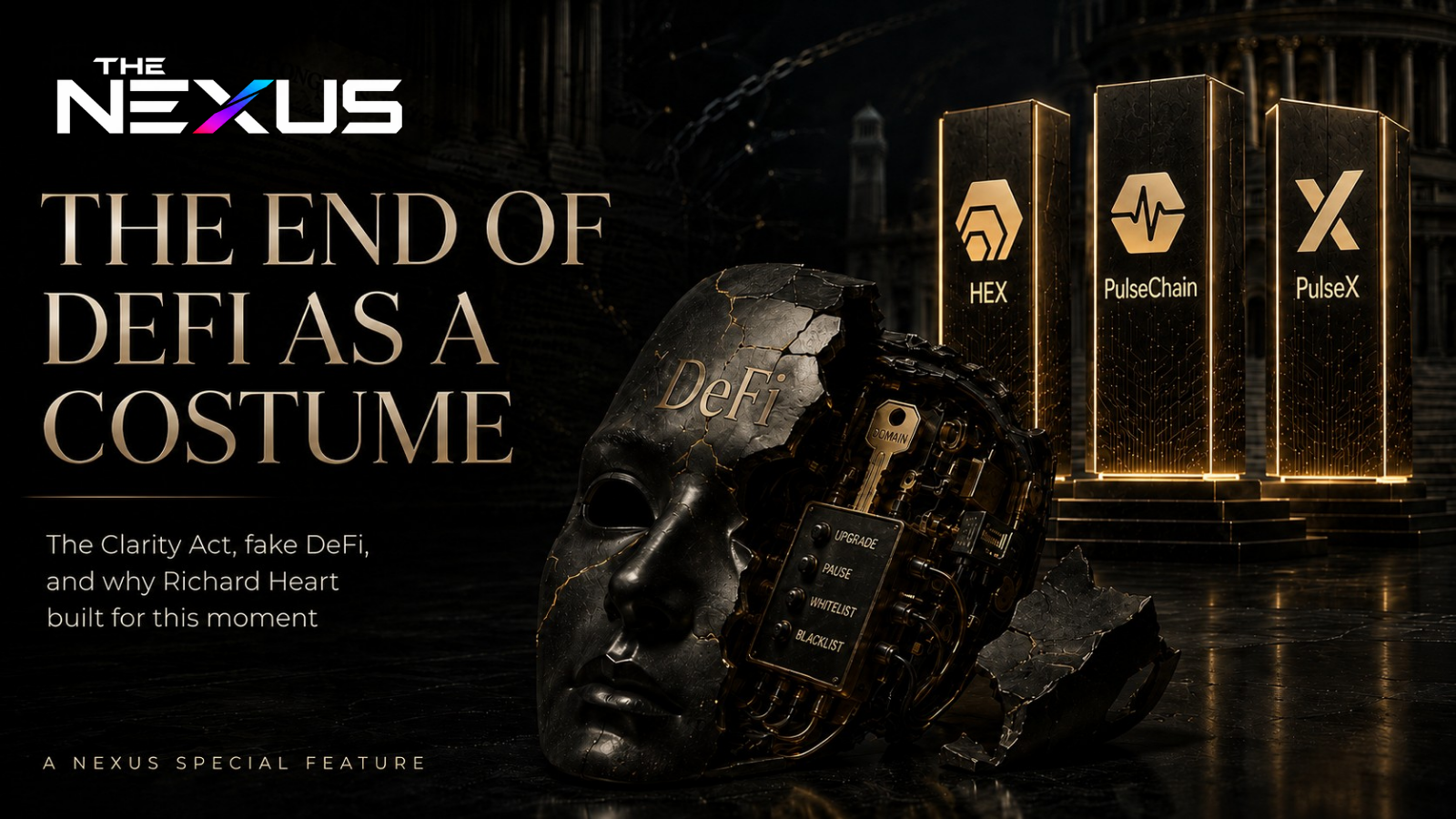
There is a very funny thing happening in Washington, which is not a sentence I expected to write, because Washington is where ideas go to be turned into dead language by people who still print emails. But every so often, some committee room accidentally bumps into reality. This week, Senator Cynthia Lummis said DeFi is not a loophole, it is a worthy innovation, and the CLARITY Act treats it that way.
Nice. Good sentence. Correct sentence. Also, possibly, the beginning of a very bad time for everyone who has been using the word DeFi as a costume.
For years, crypto has operated on a gentleman’s agreement with itself, and the agreement was basically this: if you put “decentralised” somewhere on the website, created a governance token, added some purple gradients, hired a Discord goblin to call everyone “fam”, and sprinkled the word protocol around with enough confidence, everyone would nod politely and pretend you had built financial software beyond the reach of human control. This worked beautifully, by which I mean terribly. It worked for insiders. It worked for venture funds. It worked for exchanges. It worked for founders who wanted the valuation of neutral infrastructure and the control surface of a start up. It worked for everyone except the user, who was told he had entered the future and then discovered the future had an admin key.
This is the great embarrassment of DeFi. Not that it exists. DeFi is one of the most important ideas in finance. The embarrassment is that the word has been laundered through so many half centralised products that the public now has to ask whether anything calling itself DeFi is actually decentralised at all.
Washington, astonishingly, may now force the question.
The CLARITY Act is not law yet. It may pass. It may fail. It may get chewed up by lobbyists, stablecoin fights, banking interests, national security scolds, and the usual bipartisan enthusiasm for turning anything good into a compliance swamp. But the discussion around it has already done something useful. It has dragged the industry toward the thing it has been avoiding for a decade: definitions.
What is DeFi?
Not emotionally. Not spiritually. Not “as a community”. Structurally.
Can someone block users? Can someone freeze funds? Can someone upgrade the contract? Can someone change the rules after money arrives? Can a privileged operator intervene? Are there private permissions? Are there hard coded advantages for insiders? Is there a company in the middle pretending to be a protocol? Does the front end matter more than the contract? Does governance actually govern, or is it a theatre mask worn by whales, foundations, and venture funds?
This is where the conversation gets very interesting, because once these questions become normal, a lot of the industry suddenly looks ridiculous.
The fake DeFi economy has always depended on vibes outrunning architecture. A protocol could be marketed as permissionless while depending on a small group of people with emergency powers. A bridge could hold billions while exposing users to a trust assumption no sane person would accept if it were explained plainly. A token could present itself as a community asset while insiders retained the practical ability to steer outcomes forever. An app could speak the language of crypto sovereignty while silently preserving the power to comply, pause, blacklist, reroute, upgrade, censor, rescue, or rug with paperwork.
Everyone knew this. Almost nobody wanted to say it too loudly, because bull markets are not moral environments. They are theatres of collective bribery. Number goes up, questions go down. The investor wants the trade. The founder wants the multiple. The venture firm wants the markup. The influencer wants the affiliate link. The journalist wants access. The exchange wants volume. Everyone claps for decentralisation, and nobody checks where the master switch is.
Then the master switch gets used.
This is why Senator Lummis’s line matters beyond the immediate politics of the bill. “DeFi is not a loophole” is only true if DeFi means something real. If DeFi just means a company with a token, then the critics are right to laugh. If DeFi means a custodial platform with extra steps, they are right to regulate it like one. If DeFi means a venture backed interface that can disappear your access because a lawyer got nervous, then maybe we should stop pretending we are talking about a new financial system.
But if DeFi means autonomous code, open execution, self custody, public rules, no privileged operator, no hidden switch, and no need to trust a human being after the fact, then yes, obviously, it is not a loophole. It is the thing crypto was invented to do.
This is where Richard Heart becomes impossible to ignore.
That sentence will annoy people, which is part of why it is worth writing. The crypto industry has spent years treating Richard Heart as a personality problem rather than an architecture problem. They wanted to talk about the watches, the cars, the outrage, the tone, the memes, the lawsuits, the spectacle, the fact that he refused to behave like a soft spoken founder in a navy hoodie pretending to be humble while raising billions from institutions. Fine. Talk about it. The man is not subtle. Nobody is confused.
But while the respectable people were busy performing respectability, he built for the exact world now coming into view.
HEX was launched as a finished smart contract. Not a roadmap with a token. Not a foundation pretending future work was somehow not expectation. Not a permanent managerial religion. A contract. It was designed around self custody, time locking, public rules, and the idea that no administrator should need to wake up every morning and decide whether the product still works. You can hate the chart. You can hate the marketing. You can hate the community. You can hate the founder’s sunglasses. None of that changes the underlying point: HEX was built to survive without asking for human permission.
That is not a minor design choice. That is the whole game.
PulseChain extends the same instinct to infrastructure. It is a public Layer 1, not a private database with a decentralised costume. It was built as an Ethereum compatible chain, with a copied system state, cheaper transactions, and a world in which users could interact without being trapped inside the increasingly institutional rails of Ethereum. Again, people can argue about price, adoption, optics, liquidity, politics, and all the usual tribal nonsense. But under the noise sits a serious architectural bet: if crypto is going to be attacked through chokepoints, build fewer chokepoints.
PulseX then completes the basic stack: chain, exchange, token ecosystem. The exchange function moves on chain. Users swap without handing custody to a central exchange. Liquidity and price discovery happen in public. The mechanism is not perfect, because nothing in markets is perfect, but the direction is obvious. Remove the intermediary where the intermediary is not needed. Replace promises with execution. Let users hold their own keys. Let the chain show what happened.
This is what preparedness looks like. Not a press release. Not a foundation hiring a former regulator. Not an office in New York with a compliance team doing panels about responsible innovation. Preparedness is building the system so that when the world finally asks, “Who controls this?” the answer is not buried inside a multisig nobody mentioned during the bull run.
That question is about to become savage.
Who controls this?
It sounds simple, but it destroys most of the industry. It destroys fake DeFi. It destroys most governance theatre. It destroys the “we are decentralising over time” excuse, which is often just founder speak for “please give us the valuation now and we will maybe reduce our control later if nothing better comes up.” It destroys the corporate protocol aesthetic, where a foundation, a lab, a treasury, a legal entity, a few whales, and a front end all sort of float around the system in a fog of plausible deniability.
The serious regulators, if they are serious, will not need to understand the memes. They will need to understand control surfaces. Can this thing be altered? Who can alter it? Can access be denied? Who can deny it? Can funds be moved? Who can move them? Can the rules be changed? Who changes them? If the answer is “a small group of people, but please do not call them a financial intermediary because our logo is a hexagon”, the conversation is over.
The banks understand the threat, by the way. They are not confused. The banks are not looking at crypto and thinking, “Ah, what a charming new asset class for young people.” They see stablecoins pulling at deposits. They see self custody breaking the customer relationship. They see on chain settlement reducing dependence on the old machinery. They see a future where payment, saving, borrowing, trading, identity, access, and capital formation might not require the traditional institutional gate. Of course they want definitions. Of course they want DeFi treated as a loophole. Of course they want every piece of software with economic power dragged back into a world of licensed intermediaries.
Some of the national security people are sincere. Some of the concerns are real. Criminals use tools. Sanctions evasion exists. Fraud exists. Hacks exist. Idiots exist. This is not an argument for pretending every protocol is holy because it has a GitHub. But the old regime will always use bad behaviour as the reason good architecture must be controlled. That is the move. It has always been the move. Find the worst user of a technology, make him the face of the technology, then demand power over everyone else.
The correct response is not to defend fake DeFi. Fake DeFi deserves to be humiliated. The correct response is to separate real DeFi from fake DeFi with a knife.
Real DeFi does not need a banker with a different logo. It does not need a hidden committee. It does not need a founder with rescue powers. It does not need an upgrade path disguised as prudence. It does not need a foundation pretending to be an ecosystem while acting like a company. Real DeFi is not a trust me product. It is a verify me product. If the user has to trust a person, a board, a multisig, a custodian, a foundation, a sequencer, a bridge operator, or a compliance switch, then the system may still be useful, but it is not the same category of thing.
This is the distinction the market has been too lazy, too greedy, or too embarrassed to enforce.
It is also why Heart’s legal and architectural posture looks different in hindsight. The SEC came for HEX, PulseChain, and PulseX. The case was dismissed. The dismissal was jurisdictional, so adults should be precise about that, but the practical result was still extraordinary. The state attacked. The ecosystem continued. The contracts did not wake up and panic. The chain did not require a founder in an office to keep producing blocks. The users did not need a corporate apology video. Whatever anyone thinks of Richard Heart, he had already built in the direction everyone now claims to care about.
That is the part critics do not want to process. They thought decentralisation was branding. He treated it as survival engineering.
And now the legal weather is starting to resemble the environment he prepared for.
The CLARITY Act debate is doing something culturally useful, even before it becomes law or fails to become law. It is making people say out loud that not all DeFi is DeFi. It is introducing the possibility that software can be protected while misconduct is not. It is forcing a distinction between a developer who publishes code and an intermediary who controls customer funds. It is asking whether a system is truly decentralised or merely wearing decentralisation as a regulatory invisibility cloak.
Good.
Let it get uncomfortable.
Let every protocol publish its control surfaces. Let every exchange explain custody. Let every bridge explain who can touch what. Let every foundation explain its powers. Let every “decentralised” app reveal whether users can be blocked. Let every governance token explain whether governance is a mechanism or a vibes based monarchy with extra steps. Let the industry finally grow up enough to stop confusing language with structure.
A lot of people will hate this because the word DeFi has been incredibly profitable. It has allowed centralised actors to sell themselves as rebels while keeping the comfortable parts of control. It has allowed founders to borrow the moral authority of Bitcoin without accepting the discipline of immutability. It has allowed venture funds to dress portfolio companies as public goods while keeping the economics of private capture. It has allowed regulators to be confused, users to be misled, and journalists to write the same stupid article every six months about crypto being impossible to define.
Define it, then.
Start here: can the user leave with his assets, without permission, under rules that cannot be changed against him by a privileged party?
That is not the whole definition, but it is a beautiful place to begin, because it makes half the room nervous.
Crypto does not need to win the argument by begging Washington to like it. That is pathetic. Crypto wins by being so clearly different from the old system that even Washington has to notice. The point was never to build a fintech app with token rewards. The point was to build financial infrastructure that does not require the user to kneel before the operator. The point was not to make banks more colourful. The point was to make certain banking functions obsolete.
This is why real DeFi is not a loophole. It is a category break.
A loophole is when you exploit ambiguity inside an existing system. Real DeFi is when you remove the need for the trusted actor around which the existing system was built. That is not evasion. That is invention. It is also why the old regime struggles to process it. Regulation assumes a middle. Real DeFi deletes the middle. The state then goes looking for someone to license, pressure, subpoena, threaten, flatter, or capture, and when it cannot find that person, it calls the absence a loophole.
No. That absence is the product.
This is the strongest possible argument for the PulseChain, PulseX, and HEX ecosystem. Not that everyone should like it. Not that every price chart has been kind. Not that every critic is secretly jealous. These are community arguments, and community arguments are mostly boring. The stronger argument is that Richard Heart built the stack in anticipation of a world where control becomes the legal question. He built products that force the discussion back to code, custody, permissions, and execution.
That is where crypto should want the discussion.
Because if the debate stays at the level of personalities, the media wins. If it stays at the level of vibes, the venture funds win. If it stays at the level of compliance theatre, the banks win. But if it moves to architecture, real DeFi finally gets to stand apart from the circus.
The next phase of crypto will not be kind to projects that relied on confusion. The word decentralised is getting heavier. DeFi is getting heavier. Protocol is getting heavier. The labels are being pulled back toward the machine underneath, and a lot of machines underneath are ugly.
Some will survive because they were built correctly. Some will survive because they are useful enough to become regulated intermediaries. Fine. There is room in the world for financial companies. Just stop calling them DeFi. Stop borrowing the language of sovereignty while keeping the tools of control. Stop pretending a multisig is a revolution. Stop telling users they are early to freedom when they are actually beta testing a compliance company with a token attached.
The builders who prepared for this moment will not need to reinvent themselves for the committee room. They will not need a new story, a new compliance costume, or a new vocabulary polished by lawyers. They will be able to point to the thing itself. The contract. The chain. The exchange. The custody model. The rules users agreed to when they arrived, still sitting there, still executing, still refusing to ask permission from the same old middlemen in a cleaner suit.
That is why this moment has teeth. The fake DeFi era was built on language that sounded brave while preserving the machinery of control. Real DeFi was built to make that machinery unnecessary. The difference is no longer philosophical. It is visible. It is inspectable. It is becoming political.
So let the definitions come. Let the questions sharpen. Let every protocol be dragged out of the marketing fog and made to show its wiring. Let the foundations, multisigs, upgrade keys, pause buttons, compliance switches, and hidden operators stand beside the contracts that need none of them.
The word DeFi is about to cost more than a logo.
And for the first time in a long time, that may be exactly what this industry needs.
Veritya Thalassa
Zero Trust Network · Intelligence Division · Truth · Strategy · Sovereignty



Discussion