Gravity Bridge Halted After $5.4M Contract Key Exploit
The Gravity Bridge, a protocol for asset transfers between Ethereum and Cosmos ecosystem chains, has been halted by its validators. The action followed a security incident where an attacker drained approximately $5.4 million in digital assets from the bridge’s primary Ethereum smart contract. The st
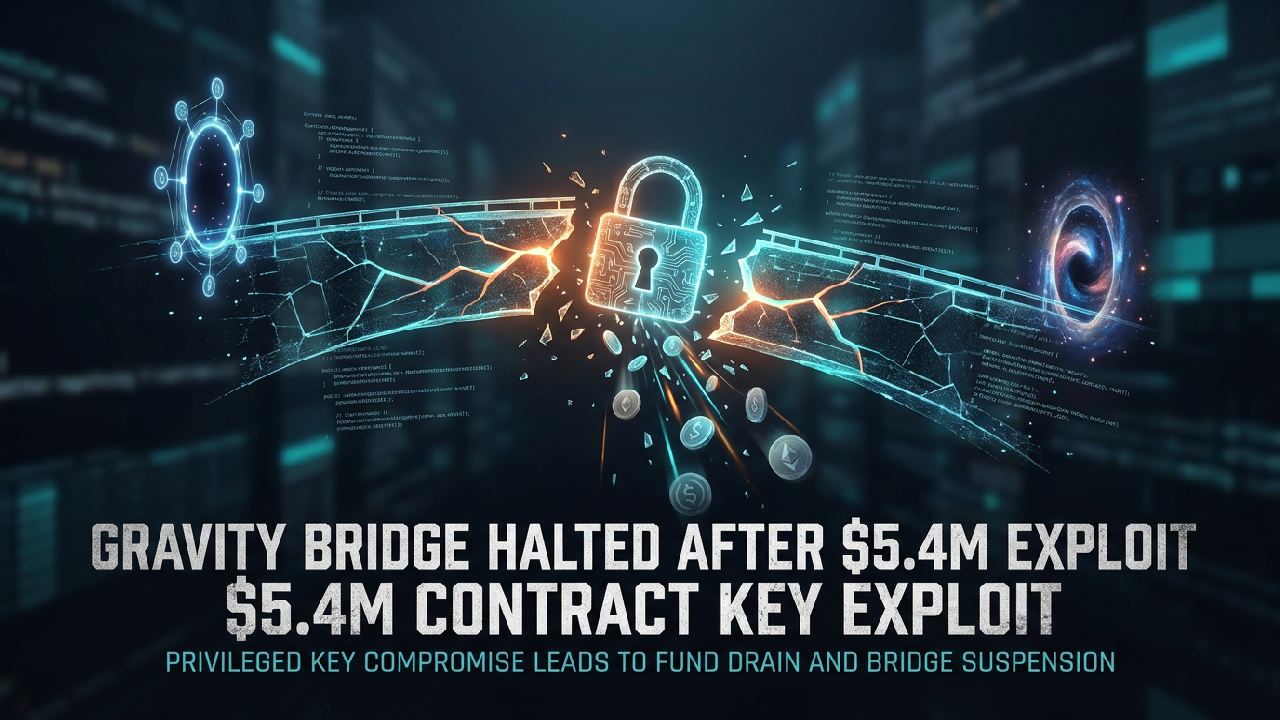
The Gravity Bridge, a protocol for asset transfers between Ethereum and Cosmos ecosystem chains, has been halted by its validators. The action followed a security incident where an attacker drained approximately $5.4 million in digital assets from the bridge’s primary Ethereum smart contract. The stolen funds include an estimated $4.3 million in USDC, $553,000 in Wrapped Ether (WETH), $434,000 in USDT, and $64,000 in PAX Gold. Initial analysis indicates the attacker gained control of a privileged signing key with direct authority over the contract, allowing them to execute withdrawals without going through the bridge’s standard validation process.
Anatomy
Gravity Bridge’s architecture is intended to offer a higher degree of decentralization than typical multi-signature or permissioned-node bridges. It consists of two primary components: the Gravity Bridge Chain, a sovereign blockchain built using the Cosmos SDK, and the Gravity.sol smart contract deployed on Ethereum, which acts as the custodian for locked assets.
For transfers from Ethereum to Cosmos, a user locks tokens in the Gravity.sol contract. The Gravity Bridge Chain validators observe this event and mint a corresponding representative asset on the Cosmos side.
The reverse process, from Cosmos to Ethereum, is where the core security model resides. A user burns their representative token on a Cosmos chain. This action is observed by the Gravity Bridge validator set. Validators then assemble a batch of withdrawal transactions, which they sign using their individual keys, weighted by their staked collateral. Once a supermajority of validator power (more than two thirds) has signed a batch, any network participant, known as an orchestrator, can submit the signed batch to the Gravity.sol contract on Ethereum. The contract verifies the collective signature and releases the assets to the designated recipient addresses.
The failure point in this incident appears to have been entirely outside this distributed signing process. The attacker did not need to compromise a supermajority of validators. Instead, evidence suggests the compromise of a single, privileged key with administrative control over the Gravity.sol contract itself. Such a key, often called a contract owner or admin key, can possess permissions to perform critical functions like upgrading the contract, pausing operations, or, in this case, directly moving funds. This represents a classic single point of failure that subverts the entire distributed security apparatus of the validator set. The validators’ response, halting their chain and orchestrators, was a reactive measure to prevent further state inconsistencies; it was not a preventative defense against the initial theft, which occurred entirely on Ethereum.
Pattern
This incident is consistent with a recurring pattern in bridge exploits: the circumvention of a complex, distributed security model by targeting a simple, centralized point of administrative control. Marketing and technical documentation for such systems often focus on the decentralization of the validator set or the cryptographic security of multi-party computation. The existence and security of legacy administrative keys, however, are frequently overlooked or downplayed.
The Ronin Bridge exploit provides a direct parallel. While Ronin relied on a nine-validator multi-signature scheme, the attacker only needed to compromise five of them to gain control. The attack vector was not a flaw in the blockchain itself, but poor operational security around the keys. Similarly, the Multichain exploit involved the compromise of servers managing the key shards for its multi-party computation system, allowing the attacker to reconstruct the master key and sign arbitrary withdrawals.
In all these cases, the advertised security model, whether a large validator set or a distributed key generation scheme, was rendered irrelevant. The attacker identified and compromised a more fundamental, and often simpler, control mechanism. The complexity of the bridge architecture can obscure the fact that ultimate custody often resides with a small set of keys or a single administrative address. The Gravity Bridge incident demonstrates that even a system designed to use its entire validator set for security can be nullified if a separate, more powerful key exists.
Forward Implication
The immediate consequence for the Gravity Bridge ecosystem is the de-pegging and effective worthlessness of all Ethereum assets bridged to Cosmos via this route. The representative tokens on chains like Osmosis are now unbacked, creating a balance sheet crisis for protocols and users holding them. The event irrevocably damages the credibility of Gravity Bridge’s security claims.
More broadly, the exploit forces a critical re-evaluation of how bridge security is assessed. The focus of due diligence must shift from simply counting validators or verifying the mathematics of a threshold signature scheme. The primary questions now concern the complete lifecycle of administrative control: Who deployed the contract? What privileges does the deployer key retain? What is the protocol for key management, rotation, and revocation? What are the conditions under which an emergency upgrade or withdrawal can be executed, and by whom?
This incident establishes a clear precedent for security auditors and institutional investors. Any audit that fails to provide a complete map of all keys with privileged access to custodial contracts must now be considered insufficient. Bridge protocols unable to demonstrate their validator set is the sole arbiter of fund movements, without possibility of an administrative key override, will face extreme suspicion. The next wave of exploits will likely target other bridges with similar architectural blind spots.
---
Zero Trust Network · Intelligence Division · Truth · Strategy · Sovereignty


Discussion