Law Enforcement and Exchanges Freeze 41 Million Dollars in BG Wealth Sharing Collapse
Law enforcement agencies, in coordination with several centralised exchanges and stablecoin issuers, have frozen approximately 41 million dollars in digital assets connected to BG Wealth Sharing. The move follows the collapse of the purported investment group, which is estimated to have defrauded us

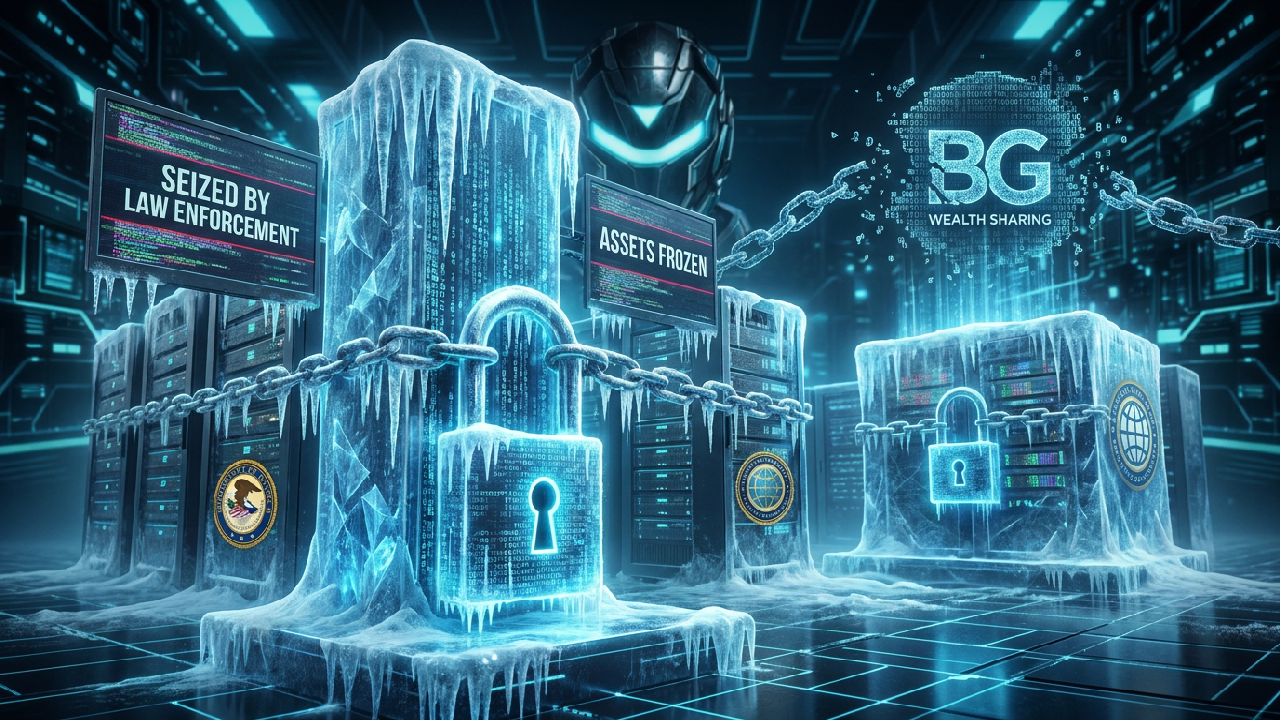
Law enforcement agencies, in coordination with several centralised exchanges and stablecoin issuers, have frozen approximately 41 million dollars in digital assets connected to BG Wealth Sharing. The move follows the collapse of the purported investment group, which is estimated to have defrauded users of more than 150 million dollars since 2025. The intervention occurred after the group attempted to launder 92 million dollars across various platforms, leading to the seizure of the entity's web domain by United States authorities.
BG Wealth Sharing operated by promising daily yields between 1.3 and 2.6 per cent, a classic hallmark of unsustainable return structures. Before the platform went offline, the group attempted a final extraction by informing users that a 12 per cent tax on account balances was required to facilitate an initial public offering. This tactic, known as an advance fee scam, served as the final signal of a liquidity exit before the website was replaced by a seizure notice from the Federal Bureau of Investigation and the Scam Center Strike Force.
The event exposes the inherent risks of custodial reliance and the illusion of sovereignty in centralised crypto-asset environments. While the freezing of funds is framed as a victory for victim recovery, it serves as a reminder that assets held on exchanges like Binance and OKX, or within centralised contracts like Tether, are subject to external control. The ability of third parties to blackhole addresses and halt transactions confirms that users in these ecosystems do not hold the keys to their own wealth. They are instead participants in a permissioned system where the state and private corporations maintain the ultimate power to freeze or seize at will.
Furthermore, the success of the scheme relied on the trust assumption that a centralised entity could consistently outperform the market. Investors surrendered their capital to a black box, blinded by social media marketing and the promise of automated profits. When the entity failed, the only recourse was to appeal to the same centralised authorities that the broader decentralisation movement originally sought to bypass.
True sovereignty is found only in non-custodial environments where no single party possesses the kill switch. If an external entity can freeze your funds to protect you, they can also freeze them to control you. Zero trust requires the elimination of the middleman, ensuring that the user remains the sole arbiter of their financial state.
---
Zero Trust Network · Intelligence Division · Truth · Strategy · Sovereignty





Discussion