LayerZero Clients Migrate to Chainlink CCIP After Exploit
Three protocols, Virtuals Protocol, Pleasing Market, and Zest Protocol, have announced the migration of their cross-chain infrastructure from LayerZero to Chainlink's Cross-Chain Interoperability Protocol (CCIP). The announced value of the assets and infrastructure covered by these moves exceeds $1.

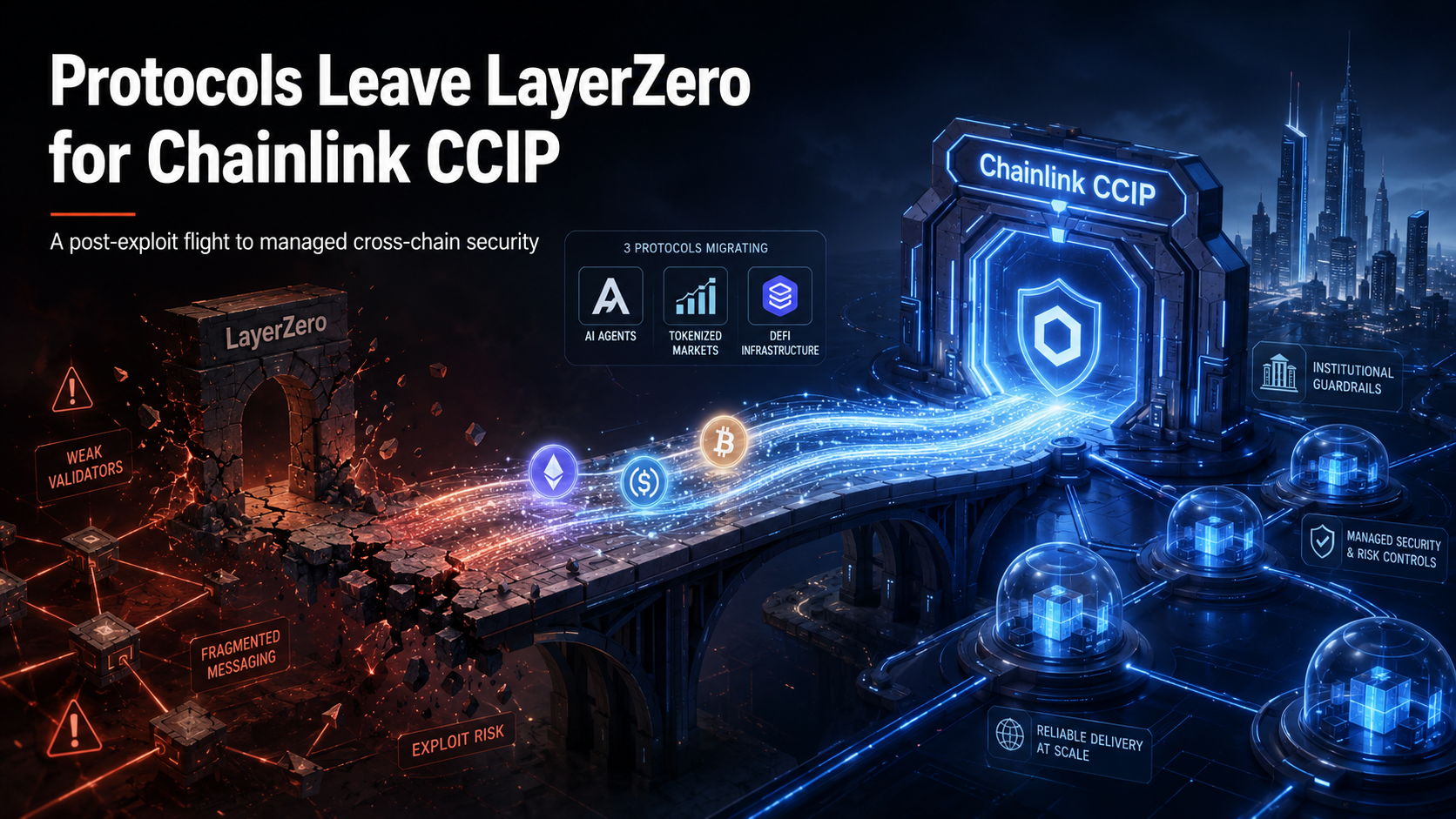
Three protocols, Virtuals Protocol, Pleasing Market, and Zest Protocol, have announced the migration of their cross-chain infrastructure from LayerZero to Chainlink's Cross-Chain Interoperability Protocol (CCIP). The announced value of the assets and infrastructure covered by these moves exceeds $1.1 billion. The largest single component is from Virtuals Protocol, an AI agent platform, which is shifting infrastructure supporting over $700 million in its VIRTUAL token. This series of migrations follows a critical security incident in April, when a misconfigured LayerZero bridge used by Kelp DAO was exploited for $292 million. According to Chainlink, the total value migrated to CCIP from former LayerZero clients since the April exploit now approaches $5 billion, though these figures represent announced commitments rather than independently audited on-chain flows.
Anatomy
The migrations respond to a specific architectural vulnerability. The Kelp DAO exploit was not a failure of LayerZero's core smart contracts, but of its flexible security model. LayerZero allows applications to select their own Decentralised Verifier Networks (DVNs). These off-chain actors are responsible for validating an event on a source chain before triggering an action on a destination chain. In the Kelp DAO case, the DVN was configured as a 1-of-1 set. This meant a single, compromised verifier was sufficient to authorize fraudulent transfers, creating a centralized point of failure. LayerZero acknowledged this as a critical misconfiguration in its post-mortem analysis.
Chainlink's CCIP operates on a different, less flexible model. Each cross-chain lane is secured by a set of at least 16 independent, Chainlink-operated node operators, creating a high threshold for collusion or compromise. CCIP also integrates a separate Risk Management Network that monitors for anomalous activity and enforces value-based rate limits on each lane, acting as a circuit breaker to cap potential losses. The protocol's SOC 2 Type 2 and ISO 27001 certifications, while procedural, are cited by institutional partners as a key differentiator. The choice for protocols is between LayerZero's permissive, customizable framework and CCIP's more rigid, managed security architecture. The former allows for potentially lower operational costs but delegates security configuration risk to the application developer; the latter enforces a higher baseline security standard at the infrastructure level.
Pattern
This is a flight to security in the interoperability sector, catalyzed by a specific loss event. The exploit on Kelp DAO transformed an abstract architectural risk into a concrete financial liability, forcing protocols built on LayerZero to re-evaluate their own configurations. The protocols leading the migration are not a random sample; they represent sectors with a particularly low tolerance for security failures. Virtuals Protocol, which facilitates transactions for autonomous AI agents, stated that infrastructure for non-human actors requires a higher security guarantee than typical user-driven DeFi. Similarly, Pleasing Market, a tokenized commodities platform, deals with assets whose value is pegged to external markets, making exploit recovery uniquely complex. The pattern is one of risk recalculation. Before the exploit, the market appeared to favor the flexibility and potential cost advantages of LayerZero's model. Post-exploit, the market is pricing in the cost of misconfiguration, and a significant segment is now willing to trade flexibility for the managed security offered by CCIP. This is a market consolidation event, where one provider's perceived weakness is directly converted into a competitor's market share.
Forward Implication
The immediate pressure now falls on LayerZero and its remaining client base. The Kelp DAO incident demonstrated the security of the entire LayerZero ecosystem is bottlenecked by its least secure implementation. Any application using a low-number DVN configuration represents a systemic risk, as another major exploit would damage the protocol's reputation. LayerZero's challenge is to enforce or heavily incentivize more secure default configurations without alienating developers who chose the platform for its flexibility. A public audit of all client DVN configurations would be a necessary step to restore confidence, but it would also expose the full extent of the platform's residual risk.
For the broader interoperability market, this establishes a new precedent. Infrastructure providers may no longer be able to simply offer a set of tools and delegate security responsibility. The market has shown it will hold infrastructure providers accountable for the failures of their users, especially when a framework permits insecure setups. This will likely force a convergence towards more opinionated architectures with higher security baselines, even at the cost of user flexibility. The key question is how many other protocols are currently operating with a 1-of-N verifier set, and what catalyst will expose them next.
---
Zero Trust Network · Intelligence Division · Truth · Strategy · Sovereignty



Discussion