Revolut Delists USDT, Citing EU Regulatory Compliance
Revolut isn’t killing USDT. It’s showing users what they actually bought: not sovereign dollars, not borderless money, but exposure inside a regulated app that can set a deadline and cash you out. MiCA drew the line. Custodians will enforce it.

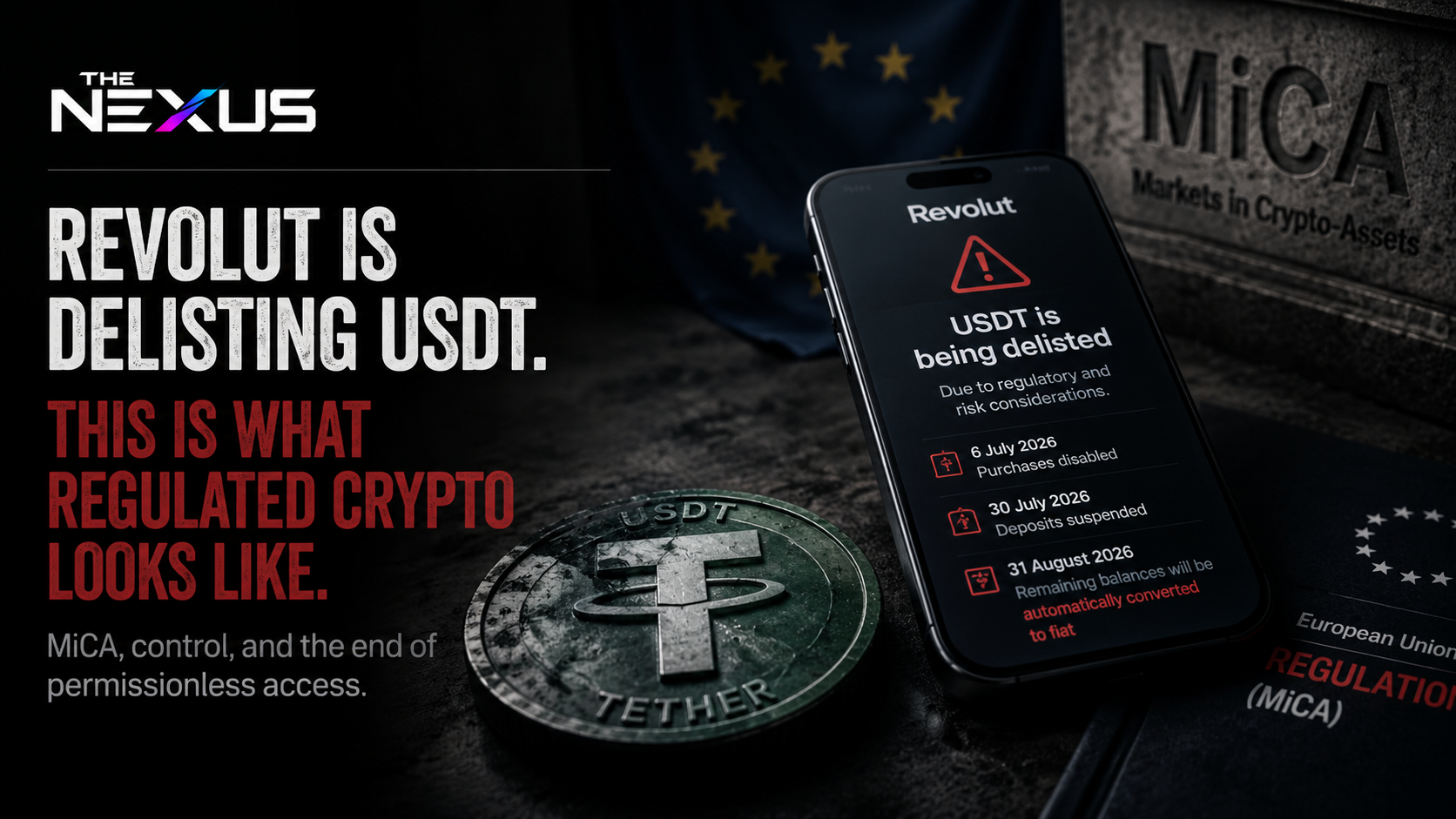
Revolut Is Delisting USDT. This Is What Regulated Crypto Looks Like.
Revolut is removing USDT from its platform, and the polite explanation is “regulatory and risk considerations.” That is the language institutions use when the decision has already been made and nobody wants to say the obvious part too loudly. MiCA has drawn a line through the European market. Tether has refused to step over it. Revolut has chosen the side it was always going to choose.
The interesting part is not that USDT is leaving Revolut. The interesting part is what happens to users who do nothing. After the deadline, remaining USDT balances will be automatically converted into the customer’s base fiat currency. That is the whole story in miniature. A user thinks they hold a digital dollar. The platform reminds them they hold a position inside someone else’s system.
This is not crypto failing at the protocol level. It is crypto being domesticated at the access layer. The asset still exists. The liquidity still exists. The global market still exists. What disappears is the permission to touch it through a regulated European fintech app. That is how policy now enters the room. Not by rewriting a blockchain, but by controlling the companies most people use to reach it.
For years, the industry pretended this distinction was a detail. It was not. A self-custody wallet and a Revolut balance are not the same thing. They may expose the user to the same price, the same ticker, and the same illusion of ownership, but structurally they belong to different worlds. One is controlled by keys. The other is controlled by terms, licences, deadlines, regulators, and whatever the custodian is required to do next.
Revolut is not behaving strangely. It is behaving exactly like a regulated institution. That is the problem for anyone who thought mass adoption meant crypto would somehow smuggle sovereignty into the banking system. It does not work that way. The moment crypto enters the regulated container, the container wins. The app may look modern. The branding may say digital assets. The outcome is still old finance with a cleaner interface.
MiCA is not killing USDT globally. It is deciding which assets get to live inside the European permission layer. Circle adapts, Tether refuses, platforms comply, and users are quietly sorted into two categories: those who accept the approved rails, and those who leave the rails entirely. That is the split now forming across the market. Not crypto versus banks, but compliant crypto versus crypto that still behaves like crypto.
This is the part nobody in the polite industry wants to say because it sounds too harsh, too ideological, too inconvenient for the next institutional panel. But the direction is obvious. Regulated platforms will become policy machines. They will list what they are allowed to list, remove what they are told to remove, freeze what they are required to freeze, and convert what they are forced to convert. The customer will call it convenience until the day convenience makes a decision for them.
USDT leaving Revolut is not the end of anything. It is a preview. The future being built in Europe is not a borderless financial system. It is a licensed digital asset market with approved issuers, approved custodians, approved access points, and an increasingly narrow definition of acceptable money.
That may be good for regulators. It may be good for banks. It may even be good for the kind of user who wants crypto exposure without ever touching a private key.
But it is not sovereignty.
It is permission with a better app.
---
Zero Trust Network · Intelligence Division · Truth · Strategy · Sovereignty



Discussion