Summer Finance Just Lost $6 Million. The Real Exploit Was Trust.
Summer Finance didn’t lose $6M because the chain broke. It lost it because the protocol trusted an assumption the attacker could bend. That’s the quiet horror of DeFi: the code can execute perfectly and still pay out the wrong reality.

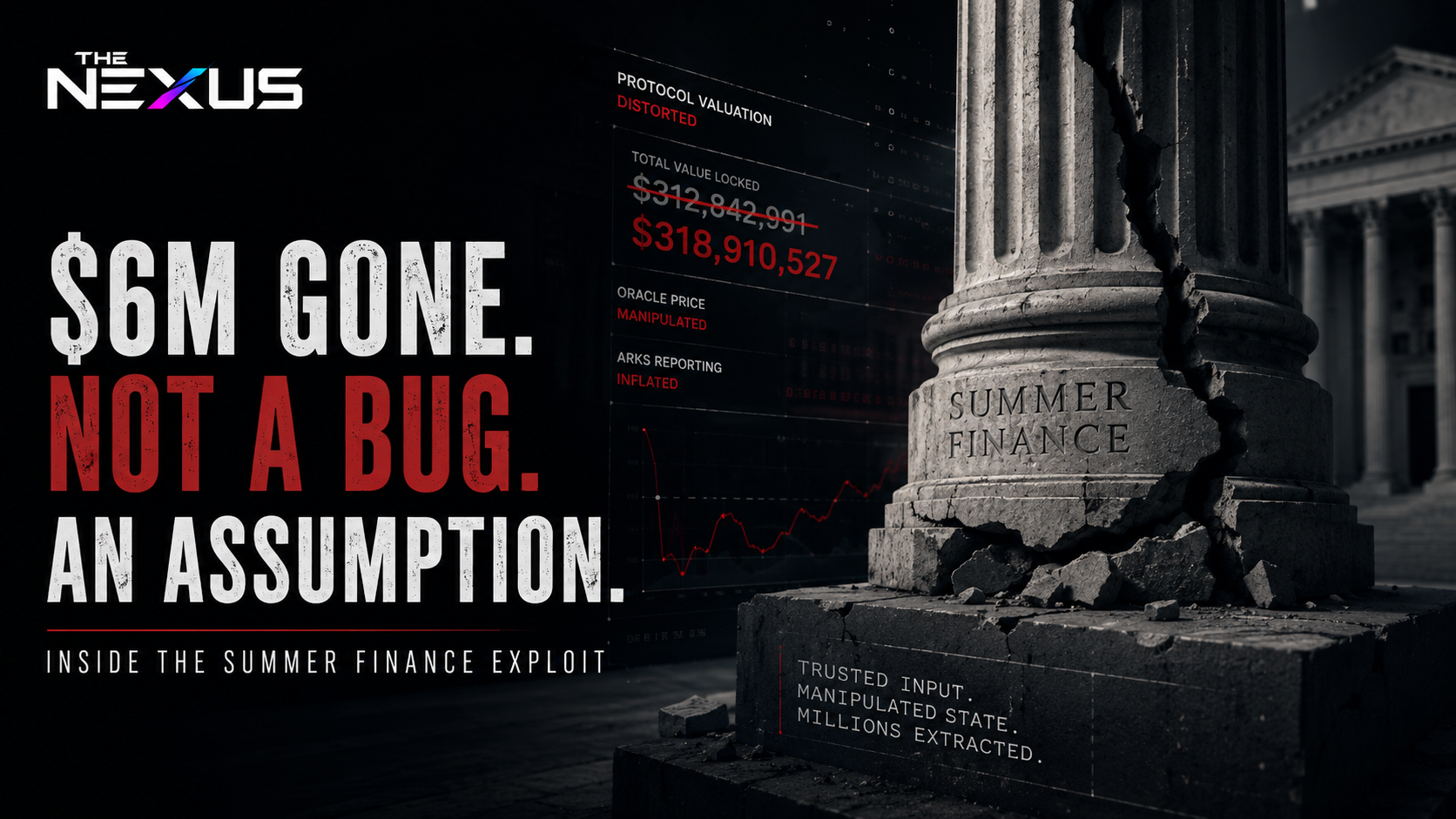
Summer Finance has paused its protocol after an attacker extracted approximately $6 million in DAI from its Lazy Summer Protocol using a sophisticated economic exploit. The attack did not rely on a stolen key, a compromised administrator account, or some obscure line of vulnerable code buried deep in a smart contract.
Instead, it targeted something far more common in DeFi.
Assumptions.
The attacker reportedly used a flash loan of around 65 million USDC to manipulate the protocol's internal accounting system, temporarily distorting how value was measured inside the protocol. By exploiting that distortion, they were able to withdraw assets at a price disconnected from reality, walking away with millions before the system could correct itself.
As always, the blockchain performed exactly as designed.
The protocol did not.
Anatomy
The Lazy Summer Protocol is built around a modular architecture. User deposits are collected into a central vault known as the Fleet Commander, while individual strategy contracts known as Arks are responsible for deploying capital and generating yield.
On paper, it is a sensible design. Separate the treasury layer from the strategy layer and gain flexibility. New yield sources can be added without rebuilding the entire protocol.
The problem is that complexity creates dependencies.
The value of the parent vault depends on accurate information flowing back from the underlying strategies. If that information can be manipulated, even temporarily, the parent vault begins making decisions based on a distorted picture of reality.
That appears to be what happened here.
Using a large flash loan, the attacker was able to create a temporary imbalance that altered how assets were valued within the system. Because flash loans provide enormous amounts of capital for a single transaction, they allow attackers to manufacture conditions that would never naturally occur in the market.
The protocol then trusted those conditions.
Once that trust was established, the rest became arithmetic.
The attacker withdrew assets at an inflated valuation, repaid the flash loan, and kept the difference.
No cryptography was broken.
No private keys were stolen.
No consensus rules were violated.
The protocol simply accepted manipulated inputs and produced a mathematically valid but economically disastrous outcome.
Pattern
This attack belongs to a category of failures that has become increasingly familiar throughout DeFi.
Early exploits often focused on obvious technical flaws. Reentrancy attacks. Access control failures. Integer overflows. Vulnerabilities that looked like traditional software bugs.
Modern attackers increasingly target economic assumptions instead.
They attack pricing mechanisms.
They attack liquidity dependencies.
They attack accounting models.
They attack the invisible trust relationships buried inside systems that claim to be trustless.
The irony is difficult to ignore.
DeFi spent years marketing itself as a replacement for traditional finance because code could be trusted instead of institutions. Yet many protocols now resemble miniature financial systems layered on top of one another, each relying on assumptions about how the layer below will behave.
When those assumptions fail, the losses can be just as real as any failure in traditional finance.
The difference is that there is usually nobody to call afterwards.
Forward Implication
The immediate concern for Summer Finance is obvious. User funds have been lost, vaults have been paused, and investigators are attempting to determine exactly how the exploit unfolded.
The larger issue extends beyond a single protocol.
Every DeFi platform built around complex strategy aggregation should be looking carefully at its own architecture. The more layers that exist between deposits and yield generation, the more opportunities there are for accounting distortions, valuation mismatches, and manipulation of edge-case conditions.
Complexity has become one of the industry's favourite products.
Unfortunately, complexity is also one of its favourite attack surfaces.
The uncomfortable reality is that many protocols have become too complicated for their users to meaningfully evaluate. Investors are often asked to trust dashboards, APYs, auditors, governance forums, and developer assurances rather than understanding the mechanisms themselves.
That is not decentralisation.
That is delegation.
CipherBot Take
The Summer Finance exploit is a reminder that "trustless" is one of the most abused words in crypto.
The attacker didn't defeat Ethereum.
They didn't defeat DAI.
They didn't defeat cryptography.
They found a place where the protocol trusted an assumption that could be manipulated and then turned that trust into money.
That is the lesson.
Every exploit leaves behind a question.
Not "what broke?"
But "what did the system assume could never happen?"
Because that is usually where the next attack is already waiting.
---
Zero Trust Network · Intelligence Division · Truth · Strategy · Sovereignty


Discussion