The Nexus Report: Week of June 15–21, 2026
Code, stablecoin, central bank, AI lab. Every system contains an intervention point. The question is whether it exists, who controls it, and what happens when it is used.
The Week in Brief
A string of systems failed, shut down, or changed the rules this week. They had almost nothing in common on the surface: a deprecated privacy bridge breached twice from the same lineage, an options vault, a cross-chain bridge, an automated trading bot, a software supply chain, a stablecoin issuer, a central bank, and a frontier AI lab. What connected them was a single property, present, absent, or held back, at the moment it mattered.
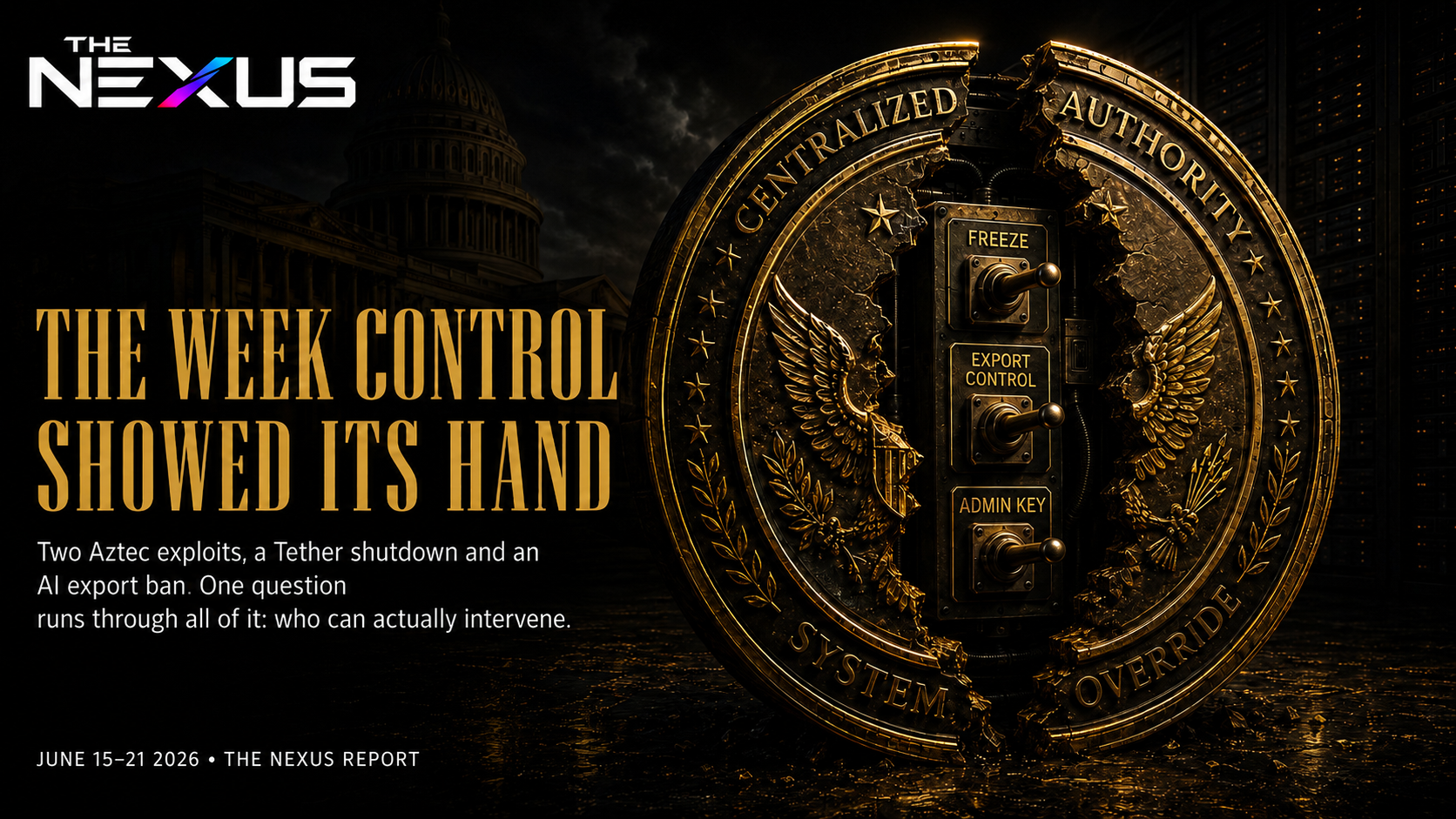
Every system has an intervention point. Someone, somewhere, can freeze, pause, upgrade, reverse, disable, or deny. Or no one can. Or someone can, and chooses not to. That property is not decided in the moment of crisis. It is decided at inception, written into the architecture long before anyone needs it, and it determines everything about what happens next.
This week the question was not whether code can be exploited. It was who could act once it was, and what their ability to act, their inability, or their choice not to, produced. Some systems had no one who could intervene once the failure began, and the losses were permanent. One had someone who could, and most of the money came back. One had a working emergency mechanism, used it once, and then had a second chance to recover specific funds, and declined to take it. One had no person in the loop at all, only an automated system trusting itself. And in the systems where intervention was most absolute, a stablecoin issuer, a central bank, a government export order, the power to act was never in question. The only question was who held it, and what they decided to do.
That is the throughline. Name what was built into a system from the start, including who can act, who chooses to, and who doesn't, and you can predict the shape of the outcome before the details arrive.
Security Intelligence
Two failures, one lineage, three days apart
The week's clearest lesson came from Aztec, and it came twice.
On June 14, an attacker drained approximately $2.15 million from Aztec Connect, a privacy bridge that had been deprecated since 2023. The mechanism was a desynchronisation between proof and settlement: the contract verified a valid zero-knowledge proof for one set of transactions, then executed a different set supplied in the same call, because the two were never cryptographically bound to each other. The attacker submitted a valid proof and a malicious transaction list, and the contract processed both as if they matched. Funds left across seven transactions, routed through Tornado Cash. BlockSec confirmed the figure and the mechanism.
Three days later, on June 17, it happened again, to a different contract from the same project's history. Aztec's older Private Rollup Bridge, a separate product sunset back in 2022, was drained of a comparable amount through its escapeHatch function, exploiting a gap in how the zero-knowledge circuit bound its witness data to on-chain validation. A function apparently built as a safety mechanism became the way in. Aztec Labs, the Aztec Foundation, PeckShield, BlockSec, and SlowMist all confirmed it.
One point needs stating clearly, because the two incidents will travel under the Aztec name and the distinction matters: the current, live Aztec Network is unaffected by either of these. Aztec Labs said so directly and immediately. Both drained contracts were deprecated, abandoned products from earlier stages of the project, immutable and left on-chain after their useful life ended.
That immutability is the central story. Neither contract had an administrator. There were no admin keys, no upgrade path, no pause function, no one with the authority to intervene once the flaw was found. This is usually described as a feature, and in one sense it is: nothing could be seized, censored, or quietly altered by a privileged operator, because no privileged operator existed. But the same property that made the contracts impossible to capture made them impossible to fix. The vulnerability sat in the code for years. When it was finally found, there was no one to call. The funds were simply gone.
Immutability removes the risk of intervention. It also removes the possibility of it. Both incidents are the same demonstration of that trade-off, from the same lineage, in the same week.
When someone could act
The contrast arrived on the same day as the first Aztec drain.
On June 15, ThetanutsFi was exploited for roughly $2.1 million through a flash loan combined with an integer division truncation bug in a vault contract. On its face, the same category of event: a code flaw, real money leaving. But the outcome could not have been more different. A whitehat was able to intervene and rescue the bulk of the funds, leaving a net loss closer to $100,000 against the $2.1 million gross.
The difference was not the severity of the bug. It was that someone could still act. ThetanutsFi's structure left room for intervention, and intervention happened in time to matter. Same week, same approximate size, opposite result, decided entirely by whether anyone retained the ability to respond.
When the capability to act exists, and isn't used
A third shape appeared on June 19, and a postmortem published over the weekend made it sharper than it first looked. The Axelar Network disclosed that approximately $4.67 million in assets bridged to Secret Network had been taken, through a vulnerability in the Secret-side ICS-20 smart contract of the Cosmos IBC connection. The root cause was not a fresh flaw. Security checks in a modified version of that contract had been commented out since 2023, sitting dormant for roughly two years before an attacker found them, spun up a fake Cosmos chain, and relayed forged deposit packets to mint unbacked tokens against the legitimate bridge. That makes this the third confirmed instance this week of the same underlying pattern as the two Aztec incidents: old, unmaintained code as the actual point of failure, not a defect in anything actively built or reviewed.
Axelar's initial response was fast and worked as designed. Its emergency committee disabled the affected Secret and Secret-SNIP connections within roughly a week of the exploit. The damage was contained to that single bridge path, the core Axelar protocol and every other IBC connection were unaffected, and the contagion did not spread.
What happened next is the part worth sitting with. Most of the stolen funds, roughly $4 million, were already cashed out through exchanges by the time of detection. But several hundred thousand dollars remained sitting in the attacker's Axelar-side wallet, and Secret Network identified those funds as recoverable, then asked Axelar to freeze or act on them. Axelar declined, choosing instead to coordinate with exchanges and law enforcement through conventional channels rather than exercise that capability directly.
This is a different shape from everything else in this section. Aztec had no one who could act. ThetanutsFi had someone who could, and did. Axelar had a working emergency mechanism, used it once to contain the breach, and then had a second, more targeted intervention available to it, recovering specific funds already identified and located, and chose not to use it. That is not absence of capability. It is capability, weighed, and declined. Whatever the reasoning, jurisdictional caution, a preference for due process over unilateral seizure, the episode shows that "who can intervene" and "who will intervene" are not always the same question, even within a single incident.
When the trust sits in the machine, not a person
A fifth shape closed out the week. On June 20, the Specter MEV bot, known on-chain as "JaredFromSubway," was drained of approximately $7.5 million on Ethereum, roughly 1,475 wrapped ETH alongside nearly $5 million combined in USDC and USDT, later consolidated and partly routed through Tornado Cash. The attacker didn't exploit a smart contract bug or a deprecated bridge. They built a trap. Over a period of weeks, the attacker deployed dozens of fake token contracts and fake liquidity pools, each designed to look like a profitable opportunity to an automated bot hunting for exactly that. The bot's execution system, doing precisely what it was built to do, took the bait and approved spending against the attacker's contracts. A final transaction sprung the trap and swept the real assets out.
This is a genuinely different intervention point from everything else this week. There was no admin key to find, no governance vote to capture, no deprecated contract sitting unmaintained. The trust being exploited was placed in an automated system's own decision-making. The bot was built to act without a human in the loop, to spot opportunities and move on them faster than any person could, and the attack was engineered to turn that exact capability against it. The trap worked because the automation worked. As more of crypto's infrastructure moves toward systems executing transactions autonomously, the question of who can intervene gains a stranger variant: can anyone intervene at all once the decision-maker isn't a person, and the thing being exploited is its competence rather than a flaw.
The perimeter keeps moving toward the wallet
Two more incidents this week were not protocol exploits at all. They were attacks on the infrastructure around crypto, aimed squarely at wallets.
SlowMist reported a supply chain attack compromising more than 140 packages in the Mastra AI agent framework, poisoned through a dependency called easy-day-js. The malicious code executed at install time and, among other behaviours, specifically inventoried cryptocurrency wallet extensions on infected machines. Separately, Microsoft reported USB-borne malware spreading worm-style on Windows through shortcut hijacking and clipboard tampering, again targeting wallets and private keys.
Different vectors, one target. A year ago the dominant threat was a flaw in a smart contract. Increasingly it is the developer's machine, the package they imported, the USB stick they plugged in. The code can be flawless and the keys can still walk out the door through the infrastructure that surrounds it. There is no admin key to blame here and no protocol to patch. The intervention point, if it exists at all, is the discipline of the individual user and the integrity of the tools they trust.
Sovereignty and the Regulatory Layer
Where the security stories were about whether anyone could intervene, the sovereignty stories this week were about systems where the power to intervene was never in doubt. The only questions were who held it and what they chose to do.
One issuer, two demonstrations
Tether spent the week showing both halves of what centralised issuer authority means.
The first half was routine, and that is the point. Across the week, Tether continued freezing wallets through the admin functions built into its stablecoin contracts, no court order required, no appeal available. This is not an occasional emergency measure. It is the ambient operating condition of a centralised stablecoin, exercised continuously. The full accounting is in this week's Freeze Digest below.
The second half was a business decision. On June 18, Tether began winding down aUSDT, the synthetic dollar from its Alloy platform, collateralised by Tether Gold. Minting was halted immediately; holders have until September to redeem for the underlying collateral. This was not an exploit or a failure. It was a company discontinuing a product line that had not gained traction, executed cleanly through the administrative control it held over the contracts the entire time. It follows the same pattern as Tether's earlier shutdowns of its yuan and euro stablecoins.
Put the two together and the shape is clear. The same administrative authority that freezes an individual wallet on Monday can retire an entire product on Wednesday. One is reactive, one is strategic, and both run on the same set of keys. A decentralised lending system would need a governance process to wind down a product. Tether needed a decision. That difference is not a criticism of Tether's competence, which is considerable. It is a description of where the control sits.
The state builds the front door
On June 18, five federal agencies, the Federal Reserve, FinCEN, the OCC, the FDIC, and the NCUA, jointly proposed a rule requiring permitted payment stablecoin issuers to maintain a Customer Identification Program comparable to a bank's. The proposal implements the GENIUS Act's directive to treat these issuers as financial institutions under the Bank Secrecy Act. It is codified as 31 CFR Part 1033, with a 60-day comment period.
The scope is narrower than the headline suggests, and the distinction is the whole story. The requirement applies to the primary market, the point where a user mints or redeems directly with the issuer, which is functionally the act of opening an account. It does not, as written, reach every on-chain transfer or secondary-market trade. The live question, the one the comment period will decide, is how broadly "opening an account" gets interpreted. A narrow reading largely codifies what major issuers already do. A broad reading, one that treats direct interaction with an issuer's smart contracts as account-opening, would force decentralised protocols into either non-compliance or identity-gated front ends. That ambiguity is not a loose end. It is the part of the rule that determines whether compliant DeFi in the United States remains possible in its current form.
The direction is unmistakable regardless of interpretation: identity verification is being built into the entry and exit points of the regulated dollar, with the issuer positioned as the gatekeeper. It makes the freeze mechanism more precise, an issuer can tie a wallet to a verified identity, but it adds no appeals process. The tool gains information, not accountability.
Twelve votes, no alternative
On June 17 and 18, the Federal Reserve held its benchmark rate steady, a unanimous 12 to 0 decision, in the first meeting chaired by Kevin Warsh. The hold itself was expected. The signal underneath it was not: the projections turned hawkish, with the median path shifting from anticipated cuts toward the possibility of further tightening. Equities fell more than a percent and yields rose.
No rate moved this week. What this item demonstrates is structural rather than monetary. Twelve people met, voted, and set the price of capital for the entire economy, and there is no parallel system, no competing rate, no appeal, and no opt-out. Of all the intervention points in this week's report, this is among the most absolute and the least remarked upon, precisely because it is so familiar. It is worth naming plainly: one of the most powerful control surfaces in finance is not in crypto at all, and it was exercised this week exactly as designed.
One letter, every user, no appeal
On June 12, the US Department of Commerce directed Anthropic to suspend access to two of its AI models, Fable 5 and Mythos 5, for any foreign national anywhere in the world, including the company's own foreign-national employees. Anthropic received the directive at 5:21pm Eastern and complied, disabling both models globally because it could not reliably filter access by nationality across its platforms in real time. Its other models, including Claude Opus 4.8, were unaffected. Anthropic published the order, disagreed with its scope, and said it would work to restore access. The directive was confirmed by Reuters via a US official, and reported by Forbes, Politico, and others.
The architecture here is identical to everything else in this section, only the domain has changed. A US-based company develops and serves its models from centralised infrastructure. That makes the company a single point of control, and the company sits within US jurisdiction. A single letter from a state authority was enough to remove access for every affected user on earth within hours. There was no appeal, no governance process, and for anyone outside the United States who depended on these models, no alternative. Markets read it immediately: tokens tied to decentralised AI projects rose sharply in the following days, with Bittensor up double digits, capital interpreting the shutdown as a case for infrastructure that cannot be switched off by one party.
Whether export-control authority can properly extend to cloud-based AI inference this way is a genuine and unsettled legal question, and it will be argued. But the mechanism worked exactly as the architecture allowed. The same property that lets a company ship a frontier model from a single coordinated system lets a government switch it off from a single point.
Stablecoin Freeze Digest: Week of June 15–21, 2026
Fifty freezes. $14.65 million in USDT locked across Tron and Ethereum this week, independently verified event by event, each with a public transaction record. The largest single freeze: $3.54 million, Tron, June 16. The smallest: $0, a wallet frozen at a zero balance, the same administrative action applied whether there is anything in the account or not.
No freeze required a court order. No freeze came with an appeals process.
A note on this week's figure: CipherBot's daily freeze reports were received throughout the week via the Guardians, building a running tally. However, CipherBot's weekly curated digest, the consolidated format this section normally draws from for its final figure, had not yet published at the time of writing. The $14.65 million and 50-freeze total above is compiled from independent on-chain verification via Pharos FreezeWatch, with every event individually traceable to a public transaction record. The methodology differs slightly from CipherBot's digest format, which details freezes individually only above $200K. This figure will be revisited if CipherBot's full weekly digest, once published, shows a materially different total.
Live tracker: cipherindex.one/stablecoin-tracker
On-Chain Data
Every system in this report demonstrated something about intervention: who could act, who couldn't, who chose not to. PulseChain belongs in that picture as a comparison case, not a verdict. It is one architecture among the several examined this week, and the point of including its numbers is to let the contrast speak rather than to argue a conclusion.
The structural facts, as of this week: the network has run for 1,135 days since launch, secured by 44,901 active validators, with 1.43 trillion PLS staked at a current estimated APR of 9.47%. The validator set sits well off its peak of 54,066 but remains an order of magnitude larger than most proof-of-stake networks by validator count, 44,901 against Solana's roughly 1,400, Cardano's 3,000, Avalanche's 1,300. What that number does and doesn't mean is worth stating plainly: a high validator count is a measure of how distributed block production is, not a guarantee against any of the failure modes elsewhere in this report. It is one property, named honestly, not a claim of safety.
On the economic side, PulseX, the ecosystem's primary DEX, holds $35.78M in total value locked across its two versions, against $20.96B in cumulative lifetime volume. PLSX has burned 1.74 trillion tokens to date, 8.23% of user supply, with 5.37 billion burned in the last seven days. Total value locked across all 48 tracked PulseChain protocols stands at $47.05M, down 3.36% on the week and well below the all-time high of $978.70M. The official bridge holds $49.50M in assets. Daily active users number 7,263, against a cumulative 1.57 million total wallets and roughly 394,000 transactions a day.
These are not large numbers next to the chains at the top of this week's other stories. They are not presented as if they were. What they describe is a smaller, fully on-chain system with a particular architectural property relevant to everything above: no administrative key sits over the base protocol, no upgrade authority can rewrite it, and no governance surface exists for a privileged party to capture. That is the same property that, elsewhere in this report, meant the Aztec contracts could not be fixed once broken. It cuts both ways, and the honest version of this section names both edges. The comparison on offer is not "this architecture is safer." It is "this architecture made a different set of trade-offs at inception, and here is what those trade-offs produced." Compare accordingly.
Further Reading
Veritya Thalassa's "The Fake DeFi Era Is About to Get Very Awkward" extends this week's thesis directly into the regulatory arena. Where this report asks who can intervene in a given system, that piece asks what happens when the CLARITY Act forces every protocol to answer the question on the record: who controls this, who can change the rules, and who was actually built for the moment the costume comes off.
Trust nothing. Verify everything. ∞ ZERØ


Discussion