US Treasury Seizes $1B in Iranian Crypto via Centralised Choke Points
The United States Treasury Department has seized approximately $1 billion in cryptocurrency assets linked to the Iranian state. The action, confirmed by Treasury Secretary Scott Bessent, is a component of Operation Economic Fury, a broad financial pressure campaign targeting Tehran.

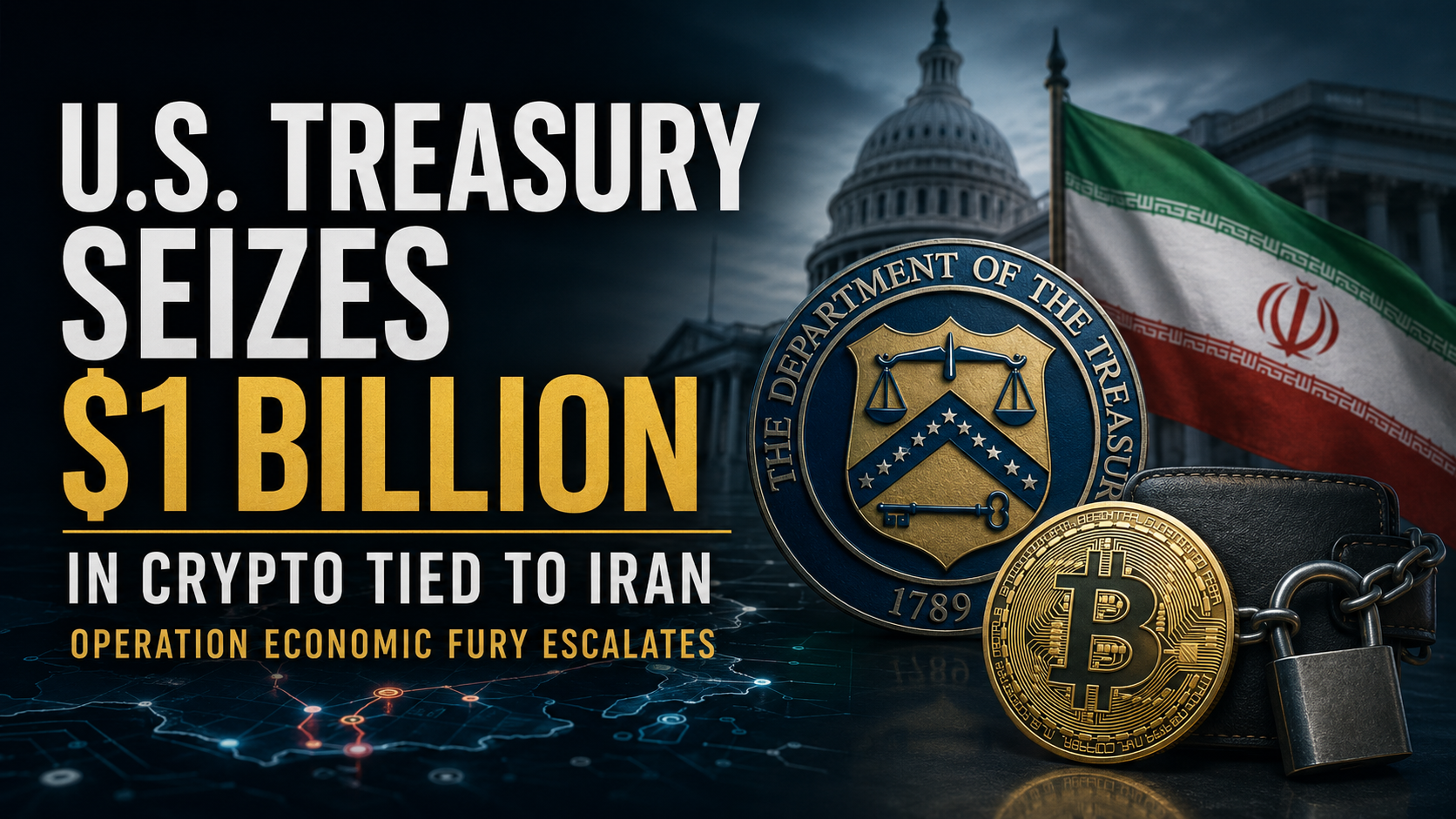
The United States Treasury Department has seized approximately $1 billion in cryptocurrency assets linked to the Iranian state. The action, confirmed by Treasury Secretary Scott Bessent, is a component of Operation Economic Fury, a broad financial pressure campaign targeting Tehran. The total value of seized assets is double the $500 million figure disclosed in late April 2026. Secretary Bessent indicated the seizures were executed by gaining direct control of the target wallets, noting that some owners may not yet be aware of the confiscation. This operation represents a significant escalation in the use of financial sanctions within the digital asset domain, demonstrating a maturing capability to track and interdict state-level funds on public blockchains.
Anatomy
The description of having “just outright grabbed the wallets” simplifies a multi-pronged technical and legal process. The seizure of assets at this scale was likely not achieved by compromising the cryptographic security of the underlying blockchain, such as Bitcoin. Instead, it almost certainly relied on exploiting centralized points of failure within the cryptocurrency ecosystem where the Iranian state or its proxies held funds. There are three primary vectors for such a seizure.
First, and most probable, is the targeting of custodial accounts on centralized exchanges. If Iranian entities held assets on exchanges that are either US-based or compliant with US sanctions, the Treasury’s Office of Foreign Assets Control (OFAC) can legally compel these platforms to freeze and surrender the funds. In this model, the exchange holds the private keys, not the Iranian user. The seizure is an administrative action, not a technical intrusion. The exchange simply reassigns control of the assets in its own omnibus wallet system to an address controlled by US authorities.
Second is the direct freezing of stablecoin assets at the smart contract level. A significant portion of the seized funds were likely held in stablecoins like USDC or USDT. Circle, the issuer of USDC, is a US-regulated entity and must comply with OFAC sanctions. It possesses the administrative capability to blacklist addresses, rendering the USDC tokens within them non-transferable and effectively worthless to the holder. Tether has also demonstrated cooperation with law enforcement, freezing hundreds of millions in assets linked to illicit activity. This mechanism allows for on-chain seizure without needing to compromise the wallet’s private keys, as control is centralized with the token issuer.
Third is the direct compromise of self-custody wallets through intelligence operations. This is the most technically demanding vector and implies a significant operational security failure by the Iranian operators. Methods could include the physical seizure of hardware wallets, successful phishing campaigns to acquire seed phrases, or the exploitation of software vulnerabilities on devices used to manage the funds. While possible for specific high-value targets, it is a less scalable method for a seizure amounting to $1 billion across what are likely numerous wallets. The most effective state-level seizures combine all three vectors: tracking on-chain flows from illicit sources to exchanges, then legally compelling the exchanges and stablecoin issuers to act, while simultaneously pursuing direct compromise of key non-custodial wallets identified during the investigation.
Pattern
This action follows an established pattern of the US Treasury extending its enforcement jurisdiction onto public blockchains. The sanctioning of the Tornado Cash mixer in 2022 was a foundational moment, establishing OFAC’s willingness to designate on-chain protocols and addresses, not just individuals or entities. That action created a compliance precedent, forcing centralized actors like Circle and major exchanges to blacklist associated addresses and demonstrating the reach of US regulation into supposedly decentralized infrastructure.
Furthermore, the methodology mirrors large-scale asset recoveries in criminal cases, such as the seizures of Bitcoin from the Silk Road marketplace and the recovery of funds from the 2016 Bitfinex hack. In those instances, investigators conducted meticulous on-chain analysis to trace funds through complex transaction histories. The final seizures, however, were often enabled by the criminals making a mistake: moving funds to a centralized exchange or otherwise revealing their private keys. Operation Economic Fury applies this same trace-and-seize model to the domain of state-sanctioned activity.
The escalation from an initial $500 million to $1 billion in seized assets within weeks indicates that US agencies have developed a repeatable and scalable process. They are no longer conducting isolated seizures but are running a continuous intelligence and enforcement campaign, mapping out the financial networks of adversaries on-chain and striking at their most vulnerable, centralized nodes.
Forward Implication
The success of this operation severely degrades Iran’s capacity to leverage cryptocurrencies for sanctions evasion and revenue generation. It forces a strategic recalculation. Plans such as the “Hormuz Safe” initiative, a proposed Bitcoin-based marine insurance scheme, now appear far more vulnerable. Even if premiums were collected in Bitcoin to non-custodial wallets, the proceeds would eventually need to be liquidated or used, creating a trail that could be traced to an exchange or other service provider where the funds could then be seized.
For other state actors like North Korea and Russia, this serves as a clear warning. Reliance on public blockchains, even with mixers, carries significant risk when interacting with any entity subject to US jurisdiction. The primary defense is not cryptographic but operational, demanding perfect security, avoidance of all US-linked services, and reliance on peer-to-peer or non-compliant jurisdictional off-ramps. This raises the technical bar for sanctions evasion. The next move for these actors may involve a shift toward more obscure privacy coins, decentralized exchanges in non-aligned jurisdictions, and complex cross-chain swapping techniques to obscure fund flows.
---
Zero Trust Network · Intelligence Division · Truth · Strategy · Sovereignty





Discussion