When the Revolution Learnt to Speak Finance
Some people don’t fight the old system. They teach the rebellion how to speak its language.

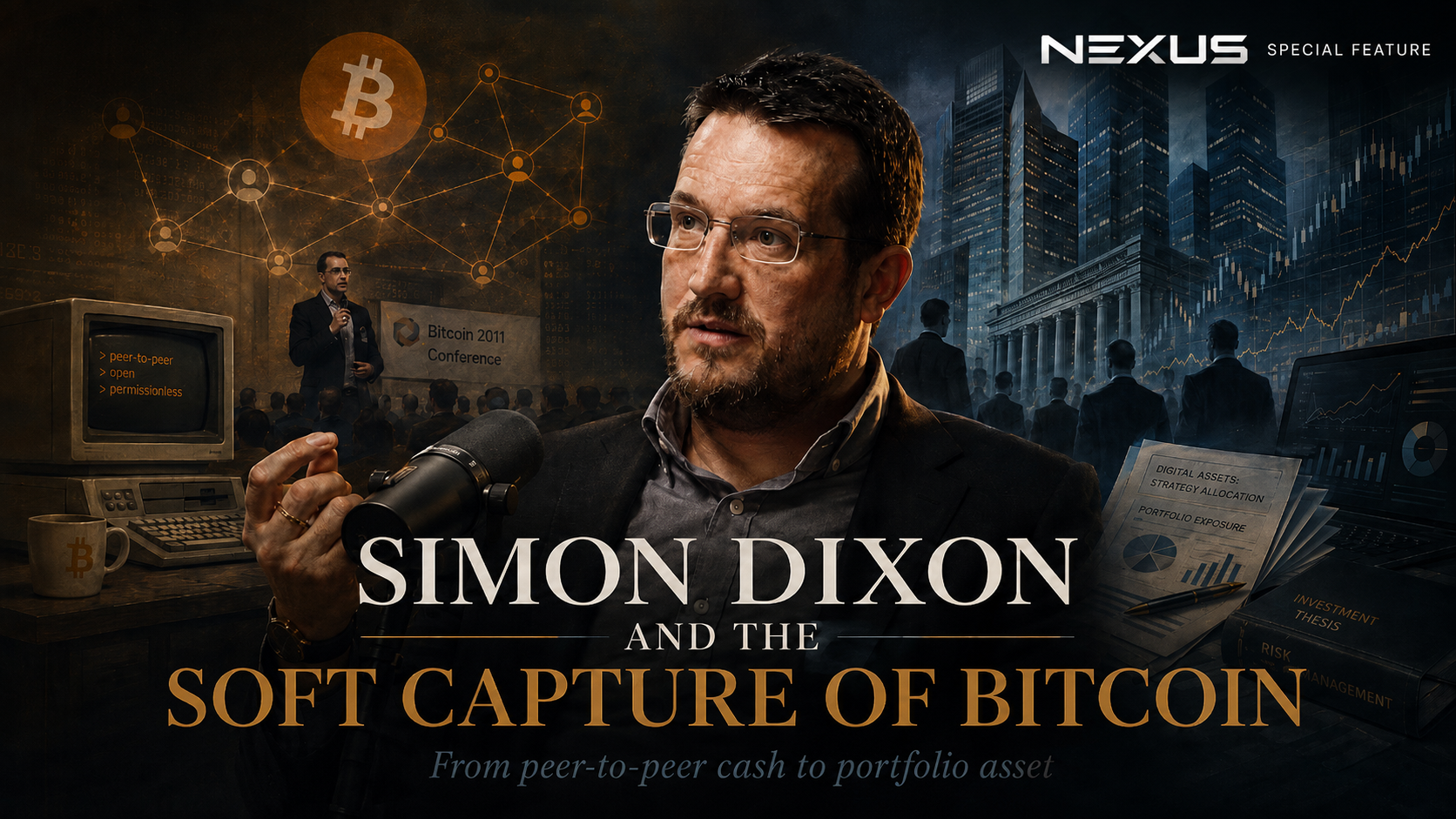
Simon Dixon is easy to misread because he speaks two languages at once. He speaks the language of monetary revolt: broken banking, debt money, confiscation by inflation, CBDCs, self-custody, escape from the machinery of financial permission. But he also speaks the language of capital markets: investment platforms, investor access, recovery plans, securities, deal flow, structured exposure, compliant participation.
That does not make him a fraud. It makes him more interesting than the simple story.
Dixon was not some late-cycle crypto salesman who discovered "freedom" after venture capital learned to say decentralization. His distrust of banking predates Bitcoin. He left investment banking before Bitcoin existed. His long-running conflict with the banking establishment, including the Bank of England's policing of what could present itself as a bank, is part of the origin story of BnkToTheFuture itself. The missing vowel is almost too perfect: a regulated scar turned into a brand.
He saw the weakness of the banking system early. He understood that the public was being asked to trust institutions whose balance sheets, incentives and political protections were rotten. He built his reputation around alternative finance before crypto became fashionable. He was early to Bitcoin, early to crypto equity, early to the idea that the old financial architecture would not survive without either reform or repression.
The useful question is not whether Dixon understands Bitcoin. He clearly does. The question is which Bitcoin he serves, and which Bitcoin he fears losing.
For people who came to crypto through liberty, peer-to-peer money, self-custody, voluntary exchange and escape from institutional control, Dixon often sounds like an ally. He talks about fiat debasement, bank fragility, financial repression, CBDCs and the need to hold assets outside the blast radius of the state-banking complex. He has repeatedly defended self-custody. He has attacked CBDCs as tools of control rather than neutral innovation. He has warned that Bitcoin can be neutralized not only by bans, but by capture.
Those warnings are not decorative. In "Was Bitcoin Hijacked?" he criticized the ETF era and the way Wall Street custody, branding and fund flows can redirect Bitcoin's meaning away from self-sovereign money and toward paper exposure. In "Bitcoin Treasury Companies Are an Attack on Bitcoin," he went further, arguing that corporate wrappers, leverage, balance-sheet games and equity-market proxies can turn Bitcoin into something held, priced and manipulated through institutions rather than used and owned by individuals.
That matters. It prevents the lazy reading of Dixon as merely a collaborator in Bitcoin's financial absorption. He is not quiet about the danger. He is one of its loudest critics from inside the investor-class world.
And that is the contradiction.
Dixon is not primarily a cypherpunk. He is a financier who found Bitcoin early and helped translate it into the language of investors, platforms, allocations, companies and recovery structures. BnkToTheFuture was not built as a peer-to-peer cash network. It was built as an online investment platform, giving eligible investors access to private fintech and crypto deals. Its history belongs to capital formation. Its grammar is the grammar of securities.
That is not a moral indictment, but rather a category distinction. Bitcoin the asset and Bitcoin the payment system are not the same political object. Bitcoin held in self-custody by a person who can transact without permission is one thing. Bitcoin wrapped in an ETF, held by a custodian, pledged by a treasury company, lent against by a broker and discussed as an allocation sleeve is another.
The original whitepaper was not titled "Bitcoin: A Non-Correlated Institutional Store of Value." It was titled "Bitcoin: A Peer-to-Peer Electronic Cash System." Its central proposal was direct digital payment without financial institutions. That was the original threat. Not simply that an asset might appreciate outside the state's preferred money. The threat was that money itself could move without banks, card networks, payment processors or approved intermediaries.
That vision did not quietly evolve into "digital gold" by natural market drift. It was fought over. The cash-to-settlement-layer pivot passed through a brutal civil war: the Blocksize Wars, scaling battles, fees, nodes, miners, corporate agreements, users, forks, propaganda and ideology. Bitcoin's meaning was contested in public, at full volume. One side prioritized everyday transactional capacity. Another prioritized decentralization, settlement assurances and monetary hardness, accepting that second layers or other systems would carry much of the payment burden. The outcome was not passive maturation. It was victory for one interpretation of Bitcoin over another.
Dixon's world sits uncomfortably on the winning side's later terrain. His work has revolved less around everyday peer-to-peer exchange and more around Bitcoin as a protected asset inside a collapsing financial order. Investment access, private equity, crypto companies, custody debates, creditor recoveries, tax and estate planning, wealth preservation, structured exposure and lending failures and balance-sheet disasters. Not Bitcoin staking, which belongs to proof-of-stake systems like Ethereum, not Bitcoin itself. Bitcoin does not offer native staking. But the broader crypto-financial world around Dixon has always been full of yield products, creditor claims, platform risk and financial engineering.
That distinction is where people get confused. Anti-fiat language is not always anti-system architecture. A person can despise central banking and still think like a capital markets operator. He can understand the dangers of centralized finance while building regulated gateways into a new asset class. He can defend self-custody while running a platform whose users are, by design, investors seeking access to deals. He can attack Wall Street's ETF capture while having spent years helping Bitcoin become legible to investors.
That is not hypocrisy in the cheap sense, it is a real contradiction. It is the contradiction of an era in which Bitcoin needed capital to grow, liquidity to survive, businesses to build infrastructure, and yet every step toward institutional scale made it easier for the old system to wrap Bitcoin in its own logic.
There is a large difference between crypto as an exit system and Bitcoin as a protected financial asset. The first vision is about reducing dependence on intermediaries. The second is about preserving wealth while the current system decays. Both criticize fiat. Both value Bitcoin. Both can sound sovereign. They do not lead to the same destination.
Sovereignty has two meanings here, and Bitcoin discourse often cheats by blending them.
One meaning is asset sovereignty: protect purchasing power, escape debasement, hold scarce money, manage risk, avoid being trapped entirely inside fiat liabilities. This is the sovereignty of the saver, the allocator, the family office, the person trying not to be ruined by the monetary regime.
The other meaning is infrastructural sovereignty: transact directly, hold keys, avoid permission, route around banks, build systems that do not require approval. This is the sovereignty of the user, the dissident, the merchant, the migrant worker, the person who needs money to function without asking the financial system to recognize him.
Dixon speaks to both, but his machinery belongs more to the first. His platform, history and audience are investor-world instruments. His strongest recent warnings, however, defend the second. That is why he cannot be reduced to a simple agent of absorption. He is better understood as a man standing on the bridge he helped build, shouting that the bridge may become a pipeline into captivity.
His Celsius and BlockFi work sharpened that image. When centralized crypto lenders imploded, Dixon did not side neatly with institutional polish and boardroom cleanup. He became a public advocate for creditors, pushing recovery plans, criticizing insiders and institutional actors, and treating depositors not as statistical debris but as people whose claims mattered. He had his own business and shareholder entanglements, but his public role in those collapses was not that of a banker defending the sanctity of the machine. It was closer to a battlefield accountant trying to claw value back from wreckage created by yield addiction, leverage, opacity and managerial arrogance.
Those episodes also exposed the fatal weakness of financialized crypto. People thought they were holding the future of money. Many were actually unsecured creditors to poorly governed financial companies. The coins were not the problem in the abstract, the structures were, the promises were, the intermediaries were, the yield wrappers were and the old disease had entered the new body.
Dixon understands that. He has said so, repeatedly and loudly.
But he is also part of the history that made Bitcoin investable, legible and attractive to capital. BnkToTheFuture helped investors gain exposure to crypto companies. It made early crypto equity a product. It translated rebellion into deal flow. That may have helped the ecosystem grow. It may also have helped teach capital how to own the exits.
Growth always comes with terms. Once an asset is made legible to capital, capital begins to shape the conversation around it. Price becomes proof, custody becomes convenience, regulation becomes legitimacy, treasury adoption becomes validation and ETFs become victory. The metric shifts from "Can I use this without permission?" to "Will BlackRock allocate to it?" The revolutionary question is replaced by a portfolio question.
That is the absorption mechanism. It does not require destroying Bitcoin. It only requires changing what success means.
The old financial system did not need to defeat Bitcoin at the protocol level in order to reduce its political force. It needed to turn Bitcoin into something it could price, custody, package, regulate, tax, lend against, sell, rehypothecate, include in a model portfolio and discuss on quarterly allocation calls. Once that process is accepted as the highest form of victory, the original promise has already been narrowed.
Dixon sees this. That is what makes him important. He is not merely the man of platforms and investor access. He is also the man warning that ETFs, treasury companies and institutional wrappers can become attacks disguised as adoption. He is not outside the financialization of Bitcoin. He is inside it, and increasingly at war with its endgame.
That is the real story.
For someone whose main concern is wealth preservation, Dixon remains useful. He understands macro risk, banking fragility, Bitcoin custody, investor psychology, market cycles and the traps built into centralized crypto finance. For someone whose main concern is the original peer-to-peer promise, he should be read more critically. His life's work is not the pure cash argument. It is not the ordinary person running money outside the system with no need for institutional rails. It is a bridge between Bitcoin and finance.
Some bridges are useful, some bridges become channels of absorption and other bridges are built by people who later look down and realize what is crossing from the other side.
Simon Dixon is best understood not as a simple villain of Bitcoin financialization, and not as a pure defender of cypherpunk money, but as the contradiction itself: a regulated investor-platform operator who helped Bitcoin enter the capital markets and now warns that capital markets may be eating Bitcoin alive.
His instinct is to structure Bitcoin wealth.
His warning is that structures can become cages.
The original instinct was harsher: make financial permission unnecessary.
Veritya Thalassa





Discussion