What Is a Stablecoin Freeze?
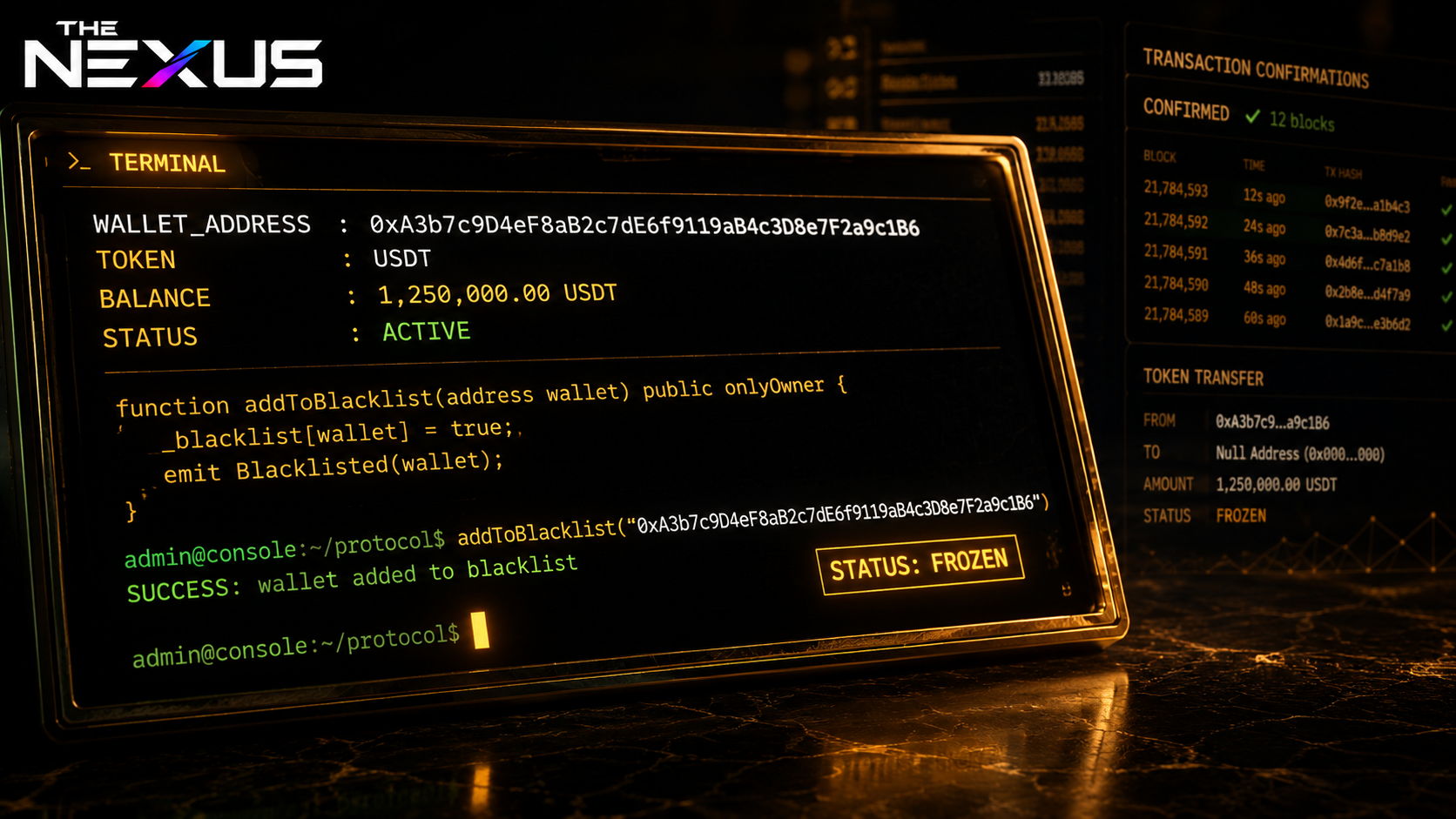
A stablecoin freeze is a unilateral action by a stablecoin issuer to make a specific wallet address unable to send or receive the issuer's token. The address is not emptied. The funds do not disappear. They remain in the wallet, visible on-chain, but immovable. The holder cannot transfer them, spend them, or exit the position until the issuer reverses the freeze.
A freeze can be executed immediately by the issuer once it decides to do so. In practice, freezes may follow sanctions designations, law enforcement requests, court orders, or the issuer's own compliance policies. The smart contract itself does not verify the legal basis. It simply executes the issuer's instruction.
How a Stablecoin Freeze Works
Although implementations differ between issuers and blockchains, every major centrally issued stablecoin includes privileged administrative functions controlled by the issuer. One of those functions is the ability to add any wallet address to a blacklist.
When an address is blacklisted, the contract rejects any transfer involving that address according to its programmed rules. The contract does not evaluate intent or circumstance. It only checks whether the address is permitted to transact. If not, the transaction fails.
Because the tokens remain recorded on the blockchain, anyone can still see the balance and verify that it exists. What changes is the contract's willingness to honour transfer requests from that address.
The issuer can remove an address from the blacklist just as easily. They can also destroy the tokens in a frozen wallet entirely, a function called destroyBlackFunds, which Tether has used in certain circumstances to permanently remove frozen assets from circulation.
Who Can Freeze a Stablecoin?
The ability to freeze is held exclusively by the issuer through a set of cryptographic keys, called admin keys, that control the smart contract's administrative functions. If those keys are compromised, anyone who holds them can freeze wallets. In practice, the issuers are the only entities who exercise this capability.
However, issuers respond to legal pressure. A government agency, a court order, or a law enforcement request can compel an issuer to freeze a wallet. Because the issuer is a company operating under national law, it cannot refuse a lawful order from the jurisdiction it operates within. The freeze mechanism therefore extends state-level enforcement power into on-chain assets, regardless of whether the wallet holding those assets is self-custodied.
This is the key distinction: a wallet can be self-custodied, and the asset inside it can still be controlled. The Nexus examined this directly in the case of OFAC's 2026 sanctions against ISIS-K wallet addresses: 131 USDT addresses frozen, 3 Monero addresses technically untouchable. Same enforcement action, different architecture, different outcome.
Holding USDT in a hardware wallet, a non-custodial wallet, or any arrangement where you alone hold the private keys does not protect the asset from an issuer-level freeze. You control the wallet. The issuer controls the asset.
The Scale of Stablecoin Freezes
Stablecoin freezes are not rare events. They are a continuous, ambient feature of the centralised stablecoin ecosystem.
The CipherIndex Stablecoin Freeze Tracker monitors freeze events across Tron, Ethereum, and XRPL in real time, tracking every freeze, unfreeze, and wallet destruction event across all major centralised stablecoins.
The Nexus Report tracks weekly freeze activity in its Stablecoin Freeze Digest. In the week of June 22–28, 2026 alone, 21 freezes totalling $11.55 million were recorded. In the week prior, 50 freezes totalling $14.65 million were recorded. The enforcement activity is not occasional. It is continuous.
Why Stablecoins Have Freeze Functions
The freeze function exists because stablecoin issuers operate as regulated financial entities. Most are incorporated in jurisdictions that require them to comply with anti-money laundering (AML) regulations, sanctions programmes, and law enforcement requests. Without the ability to freeze wallets associated with sanctioned entities or criminal activity, the issuers would be unable to meet their legal obligations.
The most direct example: OFAC, the US Treasury's Office of Foreign Assets Control, regularly issues sanctions against specific wallet addresses. When an address is designated, US-based stablecoin issuers are legally required to freeze it. Tether, despite being incorporated offshore, has historically cooperated with these designations. In July 2026, Revolut announced it would delist USDT entirely by August 31 after obtaining a MiCA licence under EU law, a regulated custodian enforcing a regulatory deadline, removing an asset from 65 million users not because the asset failed, but because the platform holding it was bound by the rules of its jurisdiction. The Nexus covered the Revolut delisting in full.
The freeze function is therefore not a bug or an oversight. It is a deliberate design decision made at the intersection of regulatory compliance and product viability. A stablecoin issuer that cannot freeze wallets cannot operate as a regulated business.
Which Stablecoins Can Be Frozen?
All major centralised stablecoins include freeze functionality. This includes:
- USDT (Tether): the largest stablecoin by market cap, primarily on Tron and Ethereum. Tether has frozen billions of dollars in assets across thousands of addresses.
- USDC (Circle): the second-largest, primarily on Ethereum and Solana. Circle has also frozen addresses in response to OFAC designations and law enforcement requests.
- FDUSD, PYUSD, TUSD and other centralised stablecoins all include similar administrative functions.
Decentralised stablecoins generally do not include an issuer-operated blacklist capable of freezing individual wallets. Instead, they rely on protocol rules, collateral management, and governance mechanisms. They avoid issuer-level censorship but introduce different risks, including governance risk, collateral risk, and potential loss of the peg under stress.
Stablecoin Freezes and the Sovereignty Question
The existence of freeze functions raises a question that the broader crypto industry has been slow to answer clearly: if a centralised stablecoin can be frozen at will by its issuer, what kind of asset is it?
It is not equivalent to a bearer asset. It is not equivalent to cash. It is closer to a tokenised bank deposit, subject to the same institutional and regulatory constraints as the issuing company itself.
This is not inherently a problem. For many use cases, compliance-compatible stablecoins are exactly the right tool. The problem arises when users assume that self-custody provides protection it does not actually offer.
The alternative architectures:
- Decentralised stablecoins: no issuer-operated blacklist, collateral-backed, governance and collateral risks instead of issuer risk. Different failure modes, not an absence of risk.
- Trust-bank models like JPYSC: reserves legally segregated under statute, trust assumptions embedded in regulatory structure rather than a company's discretion.
- Completely non-custodial assets: no peg mechanism, full price volatility, no issuer of any kind.
None of these eliminates risk. All of them locate it differently. Understanding where the freeze function sits in any asset's architecture is the starting point for understanding what kind of asset you actually hold.
Track Stablecoin Freezes in Real Time
The CipherIndex Stablecoin Freeze Tracker provides real-time monitoring of freeze events across all major stablecoins and chains. Every freeze is logged with the wallet address, the transaction hash, the chain, and the amount, individually verifiable on-chain.
The Nexus Report publishes a weekly Stablecoin Freeze Digest with the week's confirmed total, the largest single freeze, chain breakdown, and structural observations. Subscribe at pulsechain.nexus to receive it every Monday.
Related reading: