The one-way door from USDT to USDC
OKX Europe has opened a one-way route from USDT into USDC. Behind the simple conversion tool sits MiCA’s real power: not banning the digital dollar, but deciding which version may pass through Europe’s regulated financial system.

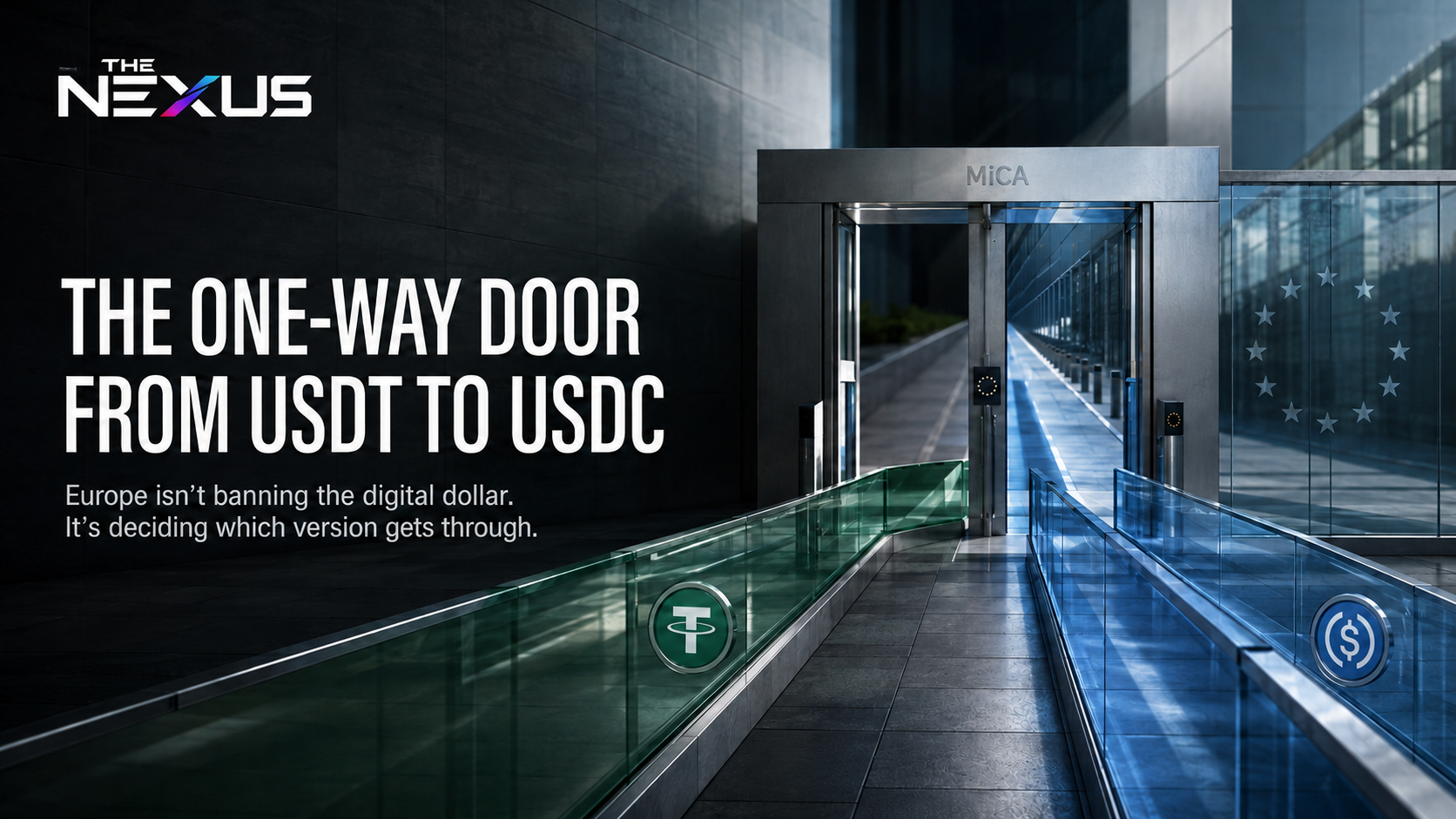
OKX is giving European customers a controlled exit from Tether. MiCA is doing more than regulating stablecoins. It is deciding which digital dollars are allowed through the door.
Europe’s stablecoin market is being reorganised one conversion button at a time.
OKX Europe has introduced a voluntary, one-way mechanism allowing eligible customers to convert existing USDT holdings into Circle’s USDC. It is not an automatic seizure and it is not a forced protocol migration. Customers choose whether to use it. But the direction of travel has already been decided: USDT can move into USDC, while USDC cannot move back into USDT through the regulated European platform.
What appears to be a minor account feature is really the visible edge of a much larger regulatory shift. MiCA has created a perimeter around Europe’s crypto market, and stablecoins whose issuers do not meet its requirements are being pushed outside it. OKX’s conversion tool is the off-ramp.
Anatomy
The legal position is slightly more complicated than the usual headline suggests.
MiCA did not suddenly come into force on 1 July 2026. Its rules for stablecoin issuers began applying on 30 June 2024, while the wider framework became fully applicable on 30 December 2024. The significance of 1 July 2026 is that it marked the final expiry of the grandfathering period that had allowed some existing crypto-asset service providers to continue operating under national regimes while applying for MiCA authorisation. From that point, unauthorised providers were expected to have completed their European wind-down plans. ESMA described the deadline explicitly as the end of MiCA’s transitional period.
USDT is also not excluded because Europe refuses to recognise it as an electronic money token. A dollar-pegged stablecoin such as USDT falls within MiCA’s EMT category by design. The problem is that its issuer is not authorised in the European Union as either a credit institution or an electronic money institution. Under MiCA, an issuer seeking to offer an EMT to the European public or have it admitted to trading must hold one of those authorisations, publish the required white paper and comply with rules covering reserves, governance, issuance and redemption.
Tether has not entered that regime. Circle has.
Circle’s French entity received an electronic money institution licence from the French banking regulator and began issuing USDC and EURC in compliance with MiCA on 1 July 2024. USDC therefore arrives at the door carrying the paperwork Europe requires. USDT does not. The tokens may both represent a digital dollar, but inside the European regulatory perimeter they now occupy entirely different legal positions.
OKX Europe, meanwhile, secured its own MiCA authorisation through the Malta Financial Services Authority in January 2025 and passported that licence across the European Economic Area. Once an exchange chooses the licensed route, the stablecoins it supports are no longer simply a commercial preference. They become part of its regulatory architecture.
What the conversion actually does
The mechanism provides a controlled way to dispose of USDT that remains inside eligible European customer accounts. The holder requests a conversion, reviews the quoted terms and receives USDC in return. The transaction moves in one direction because OKX cannot use its regulated European venue to rebuild a customer’s exposure to a stablecoin it is not permitted to offer.
This is important because nothing is being altered at the blockchain level. USDT continues to exist. Its smart contracts have not been disabled and European wallet addresses have not been erased. The conversion takes place inside a centralised exchange, where the customer’s balance is represented within OKX’s internal accounting system and every available action is determined by the platform.
That is the practical meaning of custody. The asset may run on a public blockchain, but when it sits inside an exchange account, the customer interacts with the exchange’s permissions rather than directly with the network. OKX can decide which assets may be deposited, traded, converted or withdrawn because the user does not control the keys governing the underlying balance.
The word “voluntary” is therefore accurate, but incomplete. Nobody is compelled to press the conversion button. The surrounding market, however, has been constructed so that one option remains commercially useful while the other becomes progressively harder to access.
Regulation chooses a winner
MiCA is presented as a neutral framework for transparency, consumer protection and financial stability. It does provide clearer obligations around reserves, redemption, governance and legal accountability. But neutral rules do not necessarily produce neutral markets.
Circle spent years building the regulatory relationships and corporate structure required to operate inside Europe. Tether took a different path and has criticised parts of MiCA, particularly its reserve requirements and the amount of money a large issuer could be required to place within European banks. Tether argues that forcing stablecoin reserves into the fractional-reserve banking system can introduce the very counterparty risk regulation is supposed to remove.
Whatever the merits of that argument, the commercial consequence is now clear. Circle gains access to licensed distribution. Tether loses it.
OKX and Circle had already announced a wider partnership in 2025 to deepen USDC liquidity and improve conversions between fiat dollars and USDC across OKX products. MiCA adds regulatory force to that strategic alignment. Every delisting, restricted trading pair and one-way conversion makes USDC more deeply embedded in Europe’s licensed crypto infrastructure.
This is how a market can be transformed without banning its dominant product outright. Regulators tighten the authorised perimeter. Exchanges remove the non-compliant asset from ordinary circulation. Liquidity follows the venues that remain accessible. Users then migrate towards the surviving alternative because it is the only one presented as frictionless.
The conversion button looks like convenience. Behind it sits industrial policy.
USDT has not been banned
MiCA does not make it illegal for a European individual to possess USDT in a self-custodied wallet. Nor does it switch off peer-to-peer transfers or erase liquidity from decentralised markets. A holder who controls their own keys may still be able to transfer USDT on supported networks, interact with on-chain protocols or exchange it through services operating outside the licensed European venue.
That distinction should not be mistaken for immunity. Regulators do not need to destroy a token to reduce its usefulness. They can restrict the exchanges, payment companies, brokers and custodians through which most people acquire and use it. Removing the convenient entrances and exits can be almost as effective as prohibiting the asset itself.
USDT may remain alive on-chain while becoming increasingly absent from the regulated interfaces through which European customers encounter crypto. The network continues. Access narrows.
This is one of the central realities of modern financial control. The state does not always need to stop the movement of an asset at protocol level. It can control the companies standing between the protocol and the public.
Compliance is not trustlessness
There is also a temptation to recast this as a fight between an unsafe stablecoin and a safe one. That is too simple.
USDC may offer stronger regulatory integration, formal redemption rights and a clearer legal route for European customers. Those are real advantages for anyone who values institutional accountability. They do not make USDC decentralised, permissionless or immune from intervention.
Both USDC and USDT are centrally issued stablecoins. Both depend upon corporate reserve management, banking relationships and access to traditional financial infrastructure. Both issuers can freeze addresses at the contract level. The argument is not between controlled money and uncontrollable money. It is between two corporate control systems, one of which has been admitted into Europe’s regulatory perimeter.
MiCA does not remove the need for trust. It formalises who must be trusted, what rules they must follow and which authorities stand above them.
That may produce a more orderly market. It also produces a market in which political and regulatory approval becomes a competitive moat. Stablecoin success is no longer determined solely by liquidity, reliability or user demand. It increasingly depends on whether the issuer has been accepted by the jurisdiction governing the customer’s access point.
The one-way market
For most OKX customers, the decision will appear straightforward. USDT has limited utility on the European platform. USDC can be traded, transferred and used across supported services. Converting is the practical choice.
But that is exactly why the mechanism deserves scrutiny. Regulation is most powerful when its preferred outcome feels less like coercion than common sense.
No official needs to confiscate the USDT. No dramatic ban needs to appear on a government website. The exchange simply offers a clean route from the disfavoured asset into the approved one, while the reverse route disappears. Over time, balances move, liquidity concentrates and the market conforms.
Europe has not eliminated the digital dollar. It has begun licensing which version of it may circulate through the front end of its financial system.
The USDT-to-USDC button on OKX is not merely a conversion tool. It is a border checkpoint, and it only points one way.
---
Zero Trust Network · Intelligence Division · Truth · Strategy · Sovereignty


Discussion