Circle Freezes DeFi Contract via Court Order, Locking 12.6M USDC
On 30 May, Circle, the issuer of the USDC stablecoin, executed a freeze on a smart contract address belonging to the privacy protocol Zama. The action, taken in compliance with a court-ordered restraining order, has immobilised approximately 12.6 million USDC. The target of the legal action is a sin

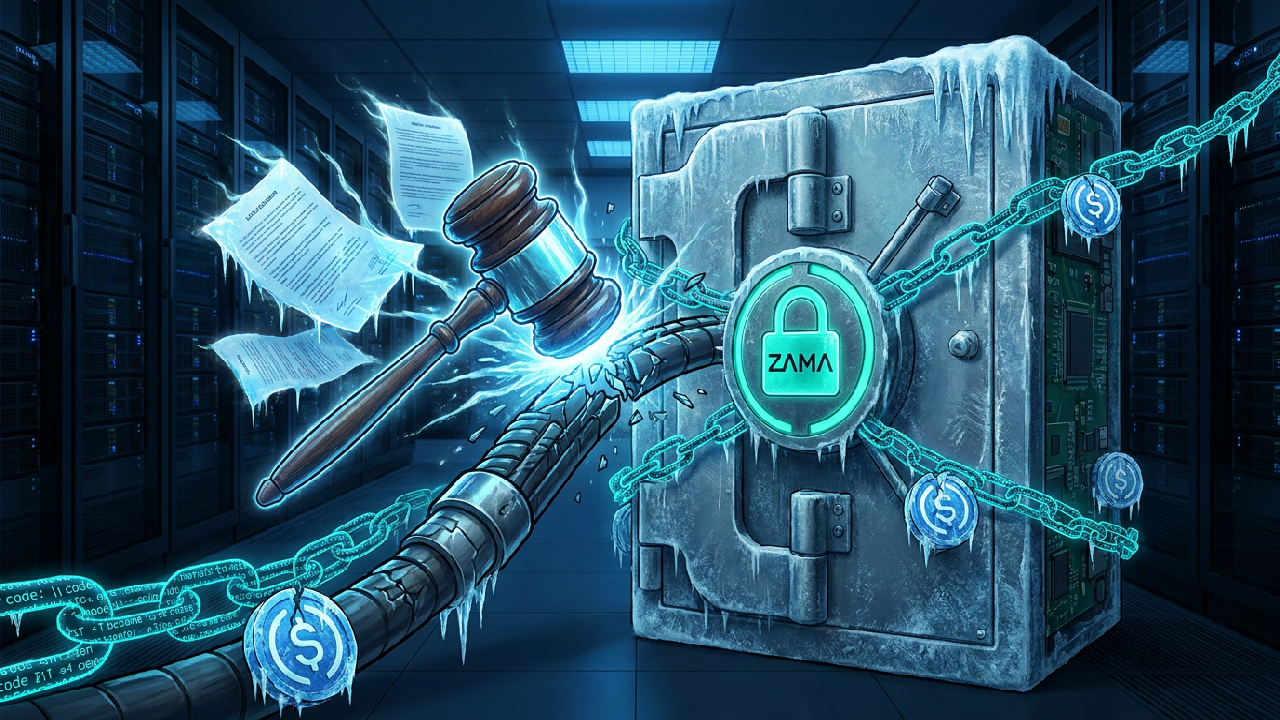
On 30 May, Circle, the issuer of the USDC stablecoin, executed a freeze on a smart contract address belonging to the privacy protocol Zama. The action, taken in compliance with a court-ordered restraining order, has immobilised approximately 12.6 million USDC. The target of the legal action is a single depositor allegedly linked to a dispute involving the DeFi protocol Overnight Finance. However, because the funds were held in a pooled contract, the freeze has trapped the assets of all users of Zama’s confidential USDC wrapper, known as cUSDC. Zama itself is not a party to the underlying litigation.
Anatomy
The failure cascade is a function of asset centralisation meeting protocol composability. The architecture consists of three primary components: the stablecoin, the wrapper contract, and the legal instrument.
First, the asset is Circle’s USDC, an ERC-20 token on Ethereum. The USDC contract contains a blacklist function, a feature common to centrally-issued stablecoins. This function allows an authorised address, controlled by Circle, to prevent a specified address from sending or receiving USDC. Any existing balance at the blacklisted address becomes non-transferable. This mechanism is the ultimate control point retained by the issuer.
Second, the protocol is Zama’s cUSDC wrapper. This is an ERC-1967 proxy contract that functions as a single, commingled pool of capital. Users deposit USDC into this contract address and, in return, receive cUSDC tokens which represent a claim on the underlying pool. Zama’s protocol uses fully homomorphic encryption (FHE) to enable private balance transfers among cUSDC holders. From the perspective of the Ethereum base layer and the USDC contract, all 12.6 million USDC resided at a single address: the Zama proxy contract.
Third, the trigger was a legal order, not a regulatory sanction. Plaintiffs in a civil dispute involving the treasury of Overnight Finance secured a temporary restraining order. The targeted party in that dispute had deposited approximately 12.4 million USDC into the Zama cUSDC pool on 11 May, constituting over 99 percent of the contract's balance. The court order, however, did not name the depositor’s wallet. Instead, it directed Circle to freeze the Zama contract address itself. Upon receiving the order, Circle’s compliance function executed the blacklist command on the cUSDC contract, instantly immobilising the entire USDC balance held within.
Unaffected depositors, who used the Zama protocol for its privacy features, are now collateral damage. Their funds are equally inaccessible, as the blacklist function operates on the container (the contract address), not on the specific units of value attributable to the targeted depositor within that container.
Pattern
This incident follows a known pattern of centralised stablecoin issuers exercising control over assets held in decentralised protocols, but it establishes a significant new precedent. The most prominent prior case was Circle's blacklisting of Tornado Cash addresses in August 2022. That action, which froze approximately 75,000 USDC, was compelled by the U.S. Treasury’s Office of Foreign Assets Control (OFAC) adding the protocol to its Specially Designated Nationals (SDN) list. The trigger was a state-level sanction based on national security concerns.
The Zama freeze lowers this threshold considerably. The catalyst was not a government agency sanctioning a protocol for illicit activity, but a court order obtained by a private plaintiff in a civil lawsuit. This demonstrates that the kill switch embedded in assets like USDC is not reserved for matters of state security or anti-money laundering enforcement. It can be activated as a remedy in commercial disputes.
This extends the chain of command from state actors to private litigants. Any entity with the resources to pursue civil litigation in a jurisdiction where Circle is compelled to operate can now potentially weaponise the stablecoin’s blacklist function against a DeFi protocol. The protocol does not need to be a defendant; it merely needs to be the custodian of assets belonging to a defendant. The indiscriminate nature of the freeze against a pooled contract makes it a powerful, if blunt, legal tool.
Forward Implication
The primary consequence is a re-evaluation of risk for any DeFi protocol that integrates centralised stablecoins into a pooled-capital architecture. This includes lending markets, liquidity pools, yield aggregators, and privacy wrappers. Their operational integrity is now demonstrably contingent on the legal standing of their largest depositors. A single user targeted by a civil lawsuit can trigger a protocol-wide asset freeze, creating systemic risk for all other users.
This incident exposes the fragility of composability. A protocol can have perfect code and robust security, but if it builds on top of a centrally-controlled asset, it inherits the trust assumptions and legal vulnerabilities of that asset. Zama’s advanced cryptographic privacy guarantees were rendered irrelevant because the underlying asset could be disabled at its source. The weakest link was not the protocol’s technology but the political and legal nature of the money it used.
Protocol developers and DAO treasuries must now consider this a known attack vector. The choice to integrate USDC or similar assets is an explicit trade-off: liquidity and market acceptance in exchange for exposure to the legal system of the issuer's jurisdiction. The question is no longer just whether a protocol could be sanctioned by a government, but whether it can withstand having its core liquidity frozen as part of a private legal quarrel it has no involvement in.
It remains to be seen whether Circle will, or even can, develop more granular tools to target funds within a smart contract without freezing the entire pool. Until such a mechanism exists, any DeFi protocol commingling user funds in a single contract is a potential target. The line between a financial primitive and an instrument of civil litigation has become materially blurred.
---
Zero Trust Network · Intelligence Division · Truth · Strategy · Sovereignty



Discussion