Humanity Protocol’s $36M Lesson: A Multisig Is Only as Strong as Its Key Management
Humanity Protocol has lost administrative control of its token bridges on the Ethereum and BNB Chain networks after an attacker acquired control of three of the six private keys governing its Gnosis Safe multisignature wallet.

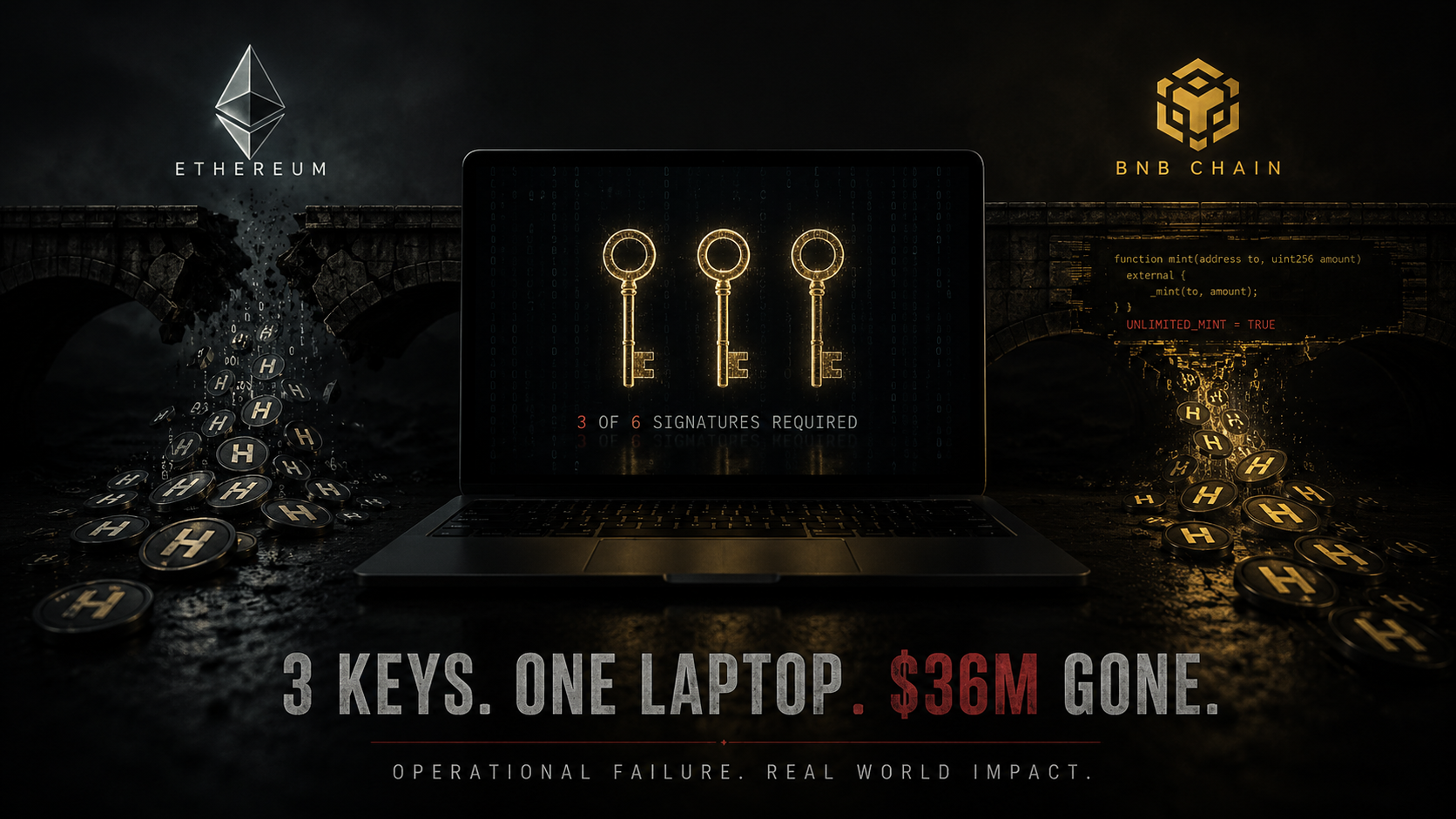
Humanity Protocol has lost administrative control of its token bridges on the Ethereum and BNB Chain networks after an attacker acquired control of three of the six private keys governing its Gnosis Safe multisignature wallet. The breach led to the theft and illicit minting of H tokens valued at over $36 million. With the 3-of-6 threshold met, the attacker drained approximately 141.2 million H tokens from the Ethereum bridge and modified the BNB Chain bridge contract to mint an additional 200 million tokens directly to their own address. Protocol representatives attribute the breach to a critical failure in operational security, stating that several of the multisignature keys were backed up to a single employee’s compromised laptop during the initial setup process.
Anatomy
The architecture of the failure was rooted in the operational management of the bridge’s administrative keys, not a flaw in the underlying smart contracts. Control over the cross-chain bridge, a high-value target, was vested in a Gnosis Safe contract configured to require three signatures from a set of six authorized keyholders. According to the protocol’s founder, Terence Kwok, these keys were distributed among four individuals.
The single point of failure was introduced during the key generation ceremony, when multiple keys were reportedly backed up on one device before being dispersed. This action effectively nullified the security assumptions of the multisignature scheme. Instead of requiring the compromise of three separate, isolated individuals or devices, the attacker only needed to gain access to this one central repository of keys. The 3-of-6 arrangement collapsed into a 1-of-1 security model, with the employee’s laptop representing the single key to the entire system.
Once the attacker possessed the requisite three keys, they held legitimate administrative authority over the bridge contracts. On Ethereum, this power was used to execute a transaction draining the bridge’s token reserves. On BNB Chain, the attacker took a different approach: they used their administrative privileges to upgrade the bridge contract, replacing it with a malicious version. This new contract contained a function that granted the attacker the ability to mint an unlimited supply of H tokens. They then invoked this function, creating 200 million new tokens and fundamentally compromising the token’s supply integrity.
This security setup contrasts with other treasury management systems reportedly used by Humanity Protocol, which include a licensed custodian for its main token treasury and multi-party computation (MPC) for its operational treasury. The bridge, one of the most critical and publicly exposed components of the protocol's infrastructure, was secured by a method whose theoretical strength was undermined by insecure real-world practices.
Pattern
This incident conforms to a well-documented pattern of exploits targeting cross-chain bridges through the compromise of their administrative keys. High-profile precedents include the Ronin Bridge and Harmony Horizon Bridge exploits, both of which involved attackers gaining control over a sufficient number of multisignature keys to authorize fraudulent withdrawals. These events consistently demonstrate that the primary vulnerability in such systems is not cryptographic weakness but human-led operational security failure.
The specific mode of failure, where supposedly distributed keys are centralized at a single point, is a recurring vulnerability. The Ronin exploit, for instance, was facilitated by the compromise of a small number of validator nodes whose keys were sufficient to approve transactions. In the Humanity Protocol case, the centralization was even more direct: co-locating distinct private keys on one machine during setup. This negates the entire purpose of a multisignature wallet, which is to eliminate single points of failure and enforce a policy of consensus. The on-chain logic of an m-of-n signature scheme is rendered irrelevant if the m keys can be accessed from a single n=1 source.
The post-exploit analysis and public debate follow a familiar script. The on-chain data, showing an address with legitimate administrative permissions executing transactions, is inherently ambiguous. It cannot, by itself, distinguish between an external attacker who has stolen keys and a malicious insider executing a planned event. Distinguishing factors often lie in the surrounding behavior. An external compromise may feature hurried, inefficient fund movements and rapid use of mixers. A staged event might involve suspicious timing relative to token unlocks, orderly fund consolidation, and movements that can eventually be traced to project-affiliated entities. In this case, on-chain researchers have pointed to evidence of methodical preparation, including the funding of attacker wallets weeks in advance and the simultaneous execution across two blockchains, suggesting a patient and coordinated operation rather than an opportunistic attack.
Forward Implication
The compromise of Humanity Protocol’s bridge immediately intensifies scrutiny on the operational security practices of all projects that use multisignature schemes for administrative functions. The incident demonstrates that the on-chain signature threshold is only one component of security. Sophisticated investors, auditors, and users will likely demand greater transparency regarding off-chain key management policies, including procedures for generation, backup, storage, and disaster recovery. The question is evolving from a simple “What is your m-of-n setup?” to a more rigorous “How do you guarantee the physical and digital segregation of your n keys at all times?”
The evidence of a long-term, planned operation, as suggested by on-chain analysis, indicates a maturation of attacker tactics. Adversaries are not merely scanning for immediate vulnerabilities but are capable of infiltrating systems, acquiring access, and remaining dormant until the most opportune moment to strike. This elevates the challenge for defensive security teams, who must protect against both immediate threats and persistent, low-and-slow intrusions.
For Humanity Protocol, the ambiguity surrounding the exploit’s origin, whether an external breach or an insider action, will inflict lasting reputational damage. This uncertainty complicates recovery efforts and suppresses asset value as the market struggles to price the risk of a simple security lapse versus a fundamental betrayal of trust. Other protocols that rely on similar administrative structures are now implicitly exposed, facing pressure to proactively re-evaluate and communicate their own key management practices before they become the subject of a similar post-mortem analysis.
---
Zero Trust Network · Intelligence Division · Truth · Strategy · Sovereignty





Discussion