The Nexus Report: Week of July 13–19, 2026
An oracle that lied with a valid signature. A one-way conversion at OKX. A federal deadline missed by six agencies. A blockchain that markets itself as permissionless while reserving the right to seize issued tokens. The asset looked free. It was tethered the whole time.

The Week in Brief
The asset looked free. It was tethered the whole time.
Every story this week traces the same shape from a different angle. A stablecoin freezes because an issuer decides it should, and the coin stays visible on the ledger while going permanently inert. A regulated exchange converts an entire user base from one dollar token to another because a trading bloc's compliance rules let the conversion run in only one direction. A government misses its own deadline to finish writing the rules that would let it govern the asset at all. A new blockchain launches in the language of permissionless finance while its own prospectus reserves the right to freeze, seize, and destroy the tokens built on top of it.
None of it required a broken chain or a stolen key. The ledger recorded everything correctly. The tether was never hidden. It was simply never load-bearing until someone decided to test it.
Security Intelligence
A trading desk that trusted its own oracle
Ostium, a perpetuals protocol on Arbitrum, lost between $11.86 million and $18 million in USDC this week after an authorized oracle signer submitted manipulated, future-dated price reports through a registered forwarder that relayed trusted price data to the protocol's contracts. The attacker opened and closed trades against these artificially favorable prices across roughly twenty trading loops, draining close to a third of the protocol's total value locked.
Nothing about the authentication failed. The signer was real, the signature was valid, and the contract accepted exactly what it was built to accept from an authorized source. The compromise sat one level back from anything a smart-contract audit examines: not whether the oracle's signature checked out, but whether the party holding that signing authority could be trusted not to lie. Ostium had raised roughly $27.8 million from institutional investors including General Catalyst, Jump Crypto, Coinbase Ventures, Wintermute, and GSR, and had cleared multiple audits. None of that reaches oracle signing authority, because it was never the layer those processes were built to examine.
The incident has already produced a live industry argument. Backpack CEO Armani Ferrante publicly called for eliminating instant settlement across the sector, arguing that mandatory withdrawal delays are worth their cost in convenience. Ferrante acknowledged that such delays would not have prevented the oracle manipulation itself, only slowed the attack's ability to extract funds before abnormal activity could be detected. Through July, crypto hacks have claimed roughly $57 million across incidents including Ostium, Bonzo Lend, and Lazy Summer Protocol, part of a 2026 running total near $992 million.
The safe that walked out with the key ring
A macOS information stealer analyzed by SlowMist this week, and covered in full on The Nexus, shows the same principle from a different direction. Nothing on the machine is broken. Every credential the victim had already trusted is simply gathered up and carried away at once.
The malware harvests the macOS Keychain, browser credentials, Apple Notes, local data from sixteen wallet applications, and identifiers from 223 browser wallet extensions. A fake system-update prompt checks the password a victim types against their real macOS account password, confirming it has captured the genuine credential before going any further. It can also clone an already-authenticated Telegram session onto another device. No phone number is entered, no SMS code requested, and the two-step verification password is never challenged, because the malware is not attempting a new login. It arrives carrying proof that an old one already succeeded.
A second path goes at the victim more directly and targets Ledger and Trezor users. The malware shuts down the real hardware-wallet apps and replaces them with lightweight fakes wearing the identical name and icon, then waits for the owner to type a recovery phrase into what looks exactly like the software they already trust. The hardware device can perform flawlessly throughout. It cannot stop its owner from handing the secret to a counterfeit sitting where the real interface used to be.
Composability moved faster than custody
Cascade, a Polychain-backed protocol, had its CLS vault drained of $1.34 million this week. Within hours, the stolen funds moved from Arbitrum to Solana and then to Ethereum through Relay Protocol, converting to DAI along the way. Every hop settled exactly as designed. Arbitrum recorded the exit. Relay bridged the funds. Ethereum recorded the arrival. None of that correctness was the point. Once control of the funds was lost, the same interoperability that makes modern crypto usable gave the attacker three chains and a bridge to disappear across before anyone could act. The vault was never the whole trust boundary. It extended across every bridge, protocol, and chain the assets could reach.
Sovereignty and the Regulatory Layer
One reserved right, four different governments
Four stories this week describe four relationships between a government or institution and the stablecoin or tokenized asset it governs. None required breaking anything. Each turned on authority that was already sitting in the design, whether used, nearly used, or left unfinished.
Start with the case that reached furthest. The United States immobilized roughly $131 million in USDT linked to the Central Bank of Iran this week, part of a cumulative $1 billion captured under Operation Economic Fury. Tether froze the wallets on Tron after an on-chain investigator flagged the blacklisting, and the Treasury Secretary confirmed the Iran connection publicly. The asset did not disappear. It stays visible on the ledger, permanently inert. Iran had adopted USDT specifically to route value around US financial reach. The reach came with the token.
Days later, OKX began converting European users from USDT to USDC, which the exchange described as routine compliance under MiCA. The conversion runs one way. Nothing converts back. Deposited USDT lands frozen the moment it arrives, unusable for spot trading, unavailable for yield products, unable to leave to an external wallet. The only exit is the conversion itself. Europe has not banned the digital dollar. It has built a one-way door between the version it rejects and the version it approves, and called the button on that door a compliance update.
The United States, meanwhile, reached its own statutory deadline this week without finishing the job. Six federal agencies, the OCC, FDIC, NCUA, Treasury, FinCEN, and OFAC, were required to finalize implementing rules for the GENIUS Act by July 18. None did. Comments on a joint customer identification rule remain open until August 21, and an FDIC anti-money-laundering proposal stays open until August 4. The statute carries no automatic extension and no fallback. Agencies missed roughly 40 percent of comparable deadlines under Dodd-Frank, and this one slipped into the same pattern inside the coverage window.
The sheriff built a blockchain
The week's closest look at the design itself came from Robinhood Chain, launched as a Layer 2 for tokenized shares and real-world assets and marketed as permissionless. Its own documentation describes something considerably narrower.
The chain screens transactions against sanctioned addresses at the sequencer, the component that orders transactions before they settle, so a flagged transaction is caught before it ever executes. Arbitrum's compliance architecture behind it goes further than the usual worry about a rollup censoring its users. A restricted transaction hash can be registered ahead of time with a guardian contract, which closes the standard escape hatch. Normally, if a sequencer refuses your transaction, you can force it in through Ethereum directly; here, a flagged transaction forced in that way still fails when it runs. It burns gas and produces nothing. The standard guarantee against sequencer censorship was specifically closed.
Validation is no more open. Two validators, run by Offchain Labs and Alchemy, are admitted through an allowlist and a bonded deposit. BoLD, the dispute protocol that secures the chain, was designed for permissionless validation and is deployed here with a permissioned validator set. Governance sits with an eight-member Security Council: Robinhood holds two seats, and the rest split among BitGo, Chainlink Labs, Fireblocks, Offchain Labs, Paxos, and Talos. Six of eight signatures plus a seven-day timelock govern routine changes; seven of eight bypass the delay entirely for emergencies.
The asset above the chain carries the clearest weakness. Robinhood's Stock Tokens are tokenized debt securities issued by a Jersey entity, not ownership of the underlying share. The issuer's own 167-page base prospectus reserves the right to block transfers, freeze products, pause all transfers, seize tokens, destroy tokens, and upgrade the contract code, explicitly including in response to sanctions or legal orders. Self-custody protects the key controlling the wallet. It does not touch the issuer's authority over what that wallet can do.
A provisional CipherIndex reading published alongside the analysis scores the chain 2.0 out of 10. Public verifiability and settlement security both read strong. Validator openness, censorship resistance, asset immutability, and asset sovereignty all read weak to near zero. The score is not an average. Trustlessness is a bottleneck property, and an issuer's power to seize an asset caps the whole reading regardless of how well everything else performs. Ethereum can finalize a censored transaction exactly as faithfully as an honest one. It can only finalize the state it was given.
Robinhood restricted customer trading during the 2021 GameStop volatility, citing clearinghouse collateral requirements it was obligated to meet. That restriction sat outside the system, an emergency override reached for under pressure. Robinhood Chain writes the same authority into the architecture, where it stops being an exception to the rules and becomes one of them.
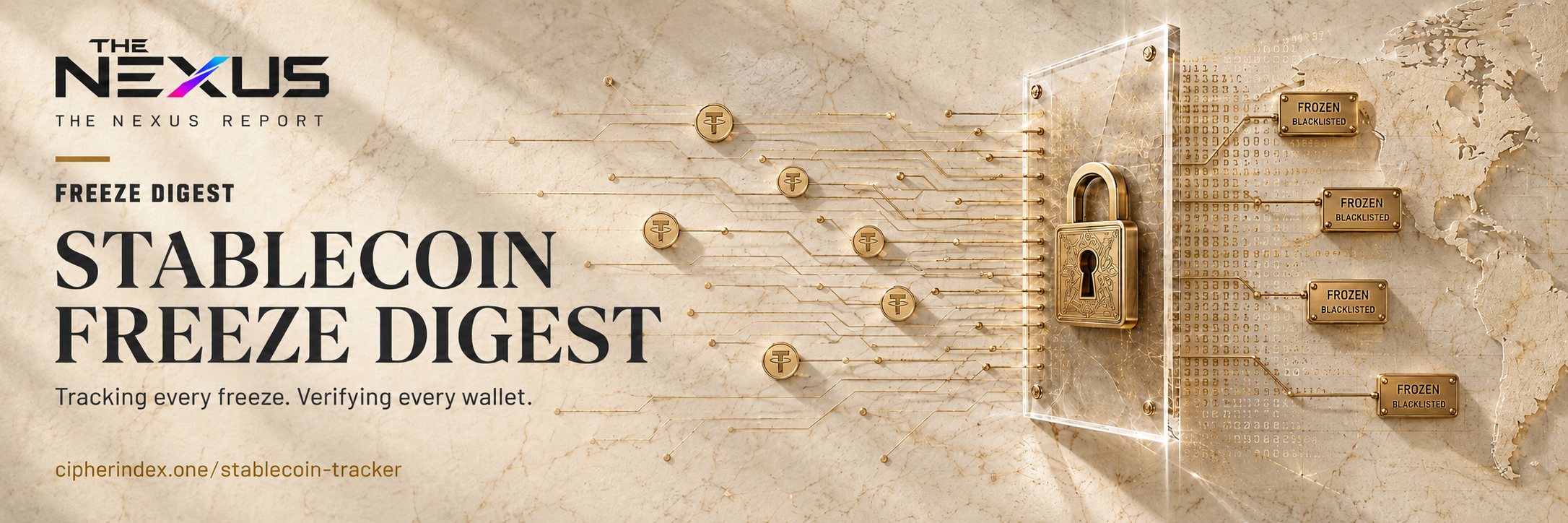
$143.79 million frozen across 22 confirmed events, entirely USDT, entirely on Tron. No freeze data was recorded for July 19, so the week's total is final as reported through July 18.
The week opened quietly, with a single freeze each on July 13 and July 14. Then July 15 alone produced $133.33 million across six freezes, roughly 93 percent of everything frozen this week, four of them executed in the same minute. The top four that day, at $85.53 million, $30.98 million, $12.31 million, and $2.23 million, sum to just over $131 million, matching the Operation Economic Fury Iran freeze reported the same week almost exactly. The timing and the aggregate value point to these wallets belonging to the same enforcement action, now visible down to the individual freeze: $85.53 million in one address alone, the largest single freeze this series has recorded.
July 16 brought a second coordinated action, six freezes totaling $3.81 million across two batches. July 17 followed the same pattern at smaller scale, seven freezes totaling $3.42 million, six of them within a five-minute window. July 18 closed with a single $1.24 million freeze.
All 22 freezes this week carried the same signature: batched, near-simultaneous execution rather than isolated intervention. Whatever produces a Tether freeze in July 2026 tends to produce several at once.
None of the reported freezes came with a public court order or appeals process.
Live tracker: cipherindex.one/stablecoin-tracker
The asset looked free. It was tethered the whole time.
Trust nothing. Verify everything. ∞ ZERØ




Discussion