The Nexus Report: Week of July 6–12, 2026
Nothing had to break this week. The contracts executed. Governance counted the votes. A hardware wallet enforced its own immutability. Three governments applied their own laws. Millions moved. Funds became inaccessible. One asset meant three different things depending on the border.

The Week in Brief
Nothing had to break this week.
The contracts executed exactly as written. Governance counted the votes it was given. Validators ordered transactions according to economic incentives. A hardware wallet enforced its own immutability. Three governments each applied their own laws.
No protocol bug was required. No cryptographic failure was necessary. No rule had to be ignored.
And yet millions of dollars moved, funds became permanently inaccessible, and the same asset was treated three different ways depending on which rulebook applied.
The systems worked.
The rules were enough.
Security Intelligence
The verifier that believed a lie
A lending protocol does not know what anything is worth. It knows balances, addresses, and rules. Whether a token is worth five dollars or five trillion has to come from somewhere outside the system, and that dependency is where Bonzo Lend, a lending protocol on Hedera, lost approximately $9 million this week.
The attacker deposited 250 SAUCE tokens, worth a few dollars, and submitted a fabricated price roughly twelve orders of magnitude above the token's real value to Supra, the oracle provider supplying Bonzo's collateral data. Supra's on-chain verifier had one job: confirm that any price update carried a valid cryptographic signature from an authorized source before passing it downstream. It accepted a price update carrying a null signature instead, the exact kind of message that check exists to reject.
From that point, nothing else needed to go wrong. Bonzo's contracts read the oracle, calculated collateral against the fabricated price, and approved loans against a borrower the system now believed was worth more than the entire lending pool. Every calculation downstream was sound. Only the premise beneath it was invented.
Hedera's consensus never faltered. Bonzo's core contracts were never rewritten. The failure sat in a single verifier contract that was supposed to distinguish authenticated data from arbitrary input, and didn't. Bonzo has publicly attributed the vulnerability to Supra; Supra has acknowledged it and shipped a fix. Neither fact helps the users whose deposits already left the pool, and neither fact changes the more uncomfortable point: Bonzo had marketed multi-oracle redundancy as protection against exactly this scenario, and a single compromised feed was still sufficient.
A four-year-old bug, still finding wallets
Not every failure this week involved a live attacker watching a mempool. Some had already happened years ago and were only discovered now.
Security firm Coinspect disclosed "Ill Bloom," a flaw in how a set of older mobile wallet apps generated recovery seed phrases. Weak random-number generation shrank what should have been an uncrackable space of possible phrases down to something a determined party could systematically reconstruct. On May 27, 2026, someone did exactly that: rebuilt every phrase the weak generator could produce, derived the corresponding addresses, and checked which ones still held funds. A single coordinated sweep drained roughly $3.1 million from 431 wallets in one pass; more than $5 million has moved from the exposed set since.
This is not a new category of bug. It is the fourth publicly documented instance of the same failure, following Milk Sad in 2023, a Trust Wallet browser extension flaw the same year, and Randstorm before that, wallets generated between 2011 and 2015 carrying the same weak-randomness defect. Every affected wallet was cryptographically valid. Every transaction it ever signed was correctly authenticated. The keys were simply never as random as the software claimed they were, and nothing about using the wallet correctly could have revealed that.
A key that can never be changed
Ledger's security research division, Donjon, disclosed a laser fault injection attack capable of resetting the password on any Tangem hardware wallet card ever produced, without the original password and without a backup card.
The attack requires physical possession of the card, invasive opening of the chip, roughly $250,000 in laser fault-injection equipment, and real expertise, precisely timed nanosecond laser pulses aimed at the exact silicon region enforcing a firmware check that verifies the card is in an authorized recovery state. Faulting that single check makes the firmware accept a password reset with no authorization at all.
Tangem cards do not support firmware updates. That is a deliberate design choice, marketed as a security feature: no remote update path means no remote compromise path. It also means this specific flaw cannot be patched on a single card already in circulation. Tangem has called the practical risk "virtually non-existent" given the cost and expertise required, and noted, accurately, that Ledger is a direct competitor disclosing a flaw in a rival's product. Both things can be true. The design choice that removed a remote update path is the same choice that makes every card permanently exposed to this specific physical attack.
The accounting that worked too well
Summer Finance lost approximately $6 million this week, and the mechanism was neither a stolen key nor a line of broken code.
The protocol's Lazy Summer architecture separates a central vault, Fleet Commander, from individual strategy contracts, Arks, that deploy capital and report value back to the vault. The attacker used a $65.4 million flash loan to temporarily distort the internal accounting Fleet Commander relied on, inflating its calculation of totalAssets() far beyond what the vault actually held, then redeemed against that inflated figure for a net profit of roughly $6 million before repaying the loan.
Every individual step was valid. The flash loan was repaid in full. No permission was bypassed. The vault trusted an accounting value that could be temporarily distorted by anyone with enough borrowed capital, and briefly, someone did.
A vote that did exactly what it was designed to do
BonkDAO's treasury lost approximately $20 million this week through its own governance process, and BonkDAO's own statement confirms the sequence precisely: an attacker purchased roughly $4 million in BONK through identified exchange wallets, submitted a proposal requesting a $20 million transfer to themselves, and waited. For seven days, the proposal sat on the governance forum with no opposition. Then the attacker voted yes with the tokens they had bought for exactly this purpose, and the proposal passed.
No backdoor. No stolen key. No broken contract. The governance system counted the votes it was given and executed the outcome those votes produced. BonkDAO has identified the exchange wallets used in the purchase, notified law enforcement, and is working with exchanges, bridges, and the Solana Foundation to recover what it can. None of that changes what actually happened: the theft occurred entirely within the rules, because sufficient influence over a voting mechanism is functionally indistinguishable from control over what it protects.
The route that fed a trader to the machine
A trader on Ethereum lost approximately $2 million this week in a single swap, and every actor involved operated within protocol rules the entire time.
A DEX aggregator routed roughly 1,117 of the trader's 1,126 ETH order through a nearly empty liquidity pool, causing a purchase at approximately 120 times the token's real market price. An arbitrage bot watching the public mempool spotted the resulting price dislocation before it settled, constructed a backrun transaction to extract the difference, and paid the block builder, Titan Builder, roughly $1.8 million to guarantee the backrun landed in the correct order within the same block. The trader was left with about $14,500 from a trade worth substantially more, a loss of over 99 percent.
Titan Builder has reportedly earned more than $112 million this year from block-building and MEV extraction broadly, including a separate $34 million incident with CoW Protocol. This is not an edge case in an otherwise well-behaved system. It is a standing, profitable, entirely legal business model built on the gap between what an aggregator promises to protect users from and what it actually prevents.
A pattern with a name and a number attached to it
None of this week's individual incidents happened in isolation. CertiK's H1 2026 Hack3D report puts a figure on the pattern underneath all of them: $1.31 billion lost across 344 incidents in the first half of the year, roughly 28 percent higher than the same period last year once last year's Bybit outlier is set aside. Wallet compromise, not code vulnerabilities, was the single most financially destructive category, driven overwhelmingly by two incidents from April: a $291 million drain from Kelp DAO and a $285 million drain from Drift Protocol, both attributed to North Korean state-sponsored actors, together representing the majority of North Korea's entire confirmed 2026 operating total.
Kelp DAO's attack targeted the off-chain infrastructure feeding a cross-chain verifier, not the verifier's code. Drift Protocol's attack was a six-month social engineering campaign that ended with two genuine, uncompromised governance signers unknowingly pre-authorizing a transaction they believed was routine. Neither incident involved a smart contract bug. Both are now cited by CertiK as the clearest evidence yet that in 2026, the contract layer is not where the money is actually being lost.
A smaller, related incident from earlier in the window fits the same shape: a double-spend against the privacy protocol Hinkal drained roughly $800,000 after a legacy note format failed to uniquely bind a nullifying key to its commitment, letting a single deposit generate multiple valid nullifiers. Every individual on-chain check passed. The flaw lived in what the circuit was allowed to prove, one layer above anything the contract itself could see.
Sovereignty and the Regulatory Layer
A dollar market, three rulebooks, no winner
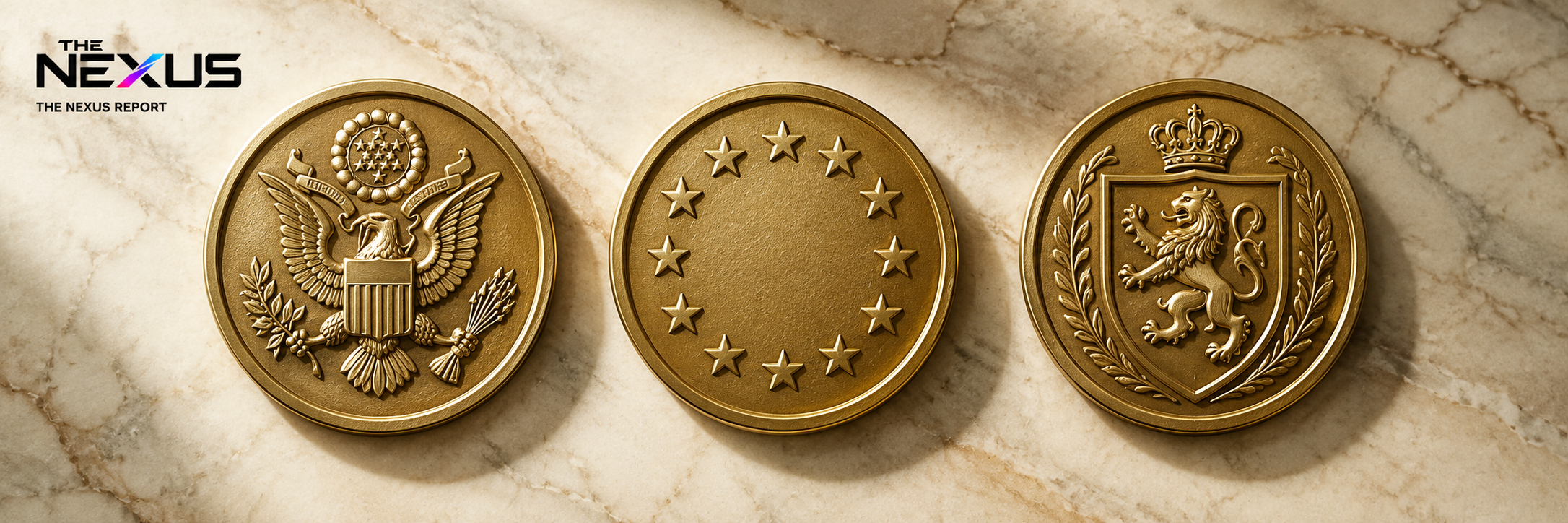
The GENIUS Act's July 18 deadline is now less than a week away, and three major jurisdictions have arrived at three incompatible answers to who gets to govern a global dollar-equivalent asset.
In the United States, six federal agencies, the OCC, FDIC, NCUA, Treasury, FinCEN, and OFAC, must finalize rules by July 18 with no statutory fallback if they miss it. Agencies have missed comparable deadlines under prior legislation roughly 40 percent of the time. In the European Union, MiCA's transitional grandfathering period expired July 1, forcing any unlicensed stablecoin providers out of the market immediately, and the European Commission has already opened a review to amend the framework it just finished enforcing, with officials explicitly measuring it against the GENIUS Act as the newer benchmark. In the United Kingdom, the Financial Conduct Authority published its final cryptoasset rulebook June 30, while the Bank of England has proposed a temporary £40 billion cap on any single systemic stablecoin.
The result is regulatory convergence in appearance, but fragmentation in practice. Speaking at Money20/20 Europe this week, one payments executive summarized the shift plainly: what began as a technical compliance question has become, in their words, a story about monetary sovereignty. Tether's own CEO has separately warned that MiCA's requirement to hold reserves specifically in EU banks could itself introduce systemic risk, given how those banks operate. A 37-bank European consortium, Qivalis, is pursuing a Dutch license for a MiCA-compliant euro stablecoin specifically to reduce dependence on dollar-denominated rails, out of a global stablecoin market where dollar-pegged assets still account for close to 99 percent of roughly $322 billion outstanding.
No single rulebook has won. The rulebook that has technically landed is already being rewritten one week into enforcement. The deadline that hasn't landed yet has a documented history of being missed. Every government involved is applying its own law correctly, and the result is an asset that means something different depending on which border it crosses.
Stablecoin Freeze Digest: Week of July 6–12, 2026
$69.96 million frozen across 31 events, confirmed daily through July 10. No daily report was issued for July 11 or 12 as of publication.
The week's pattern was uneven. For two of its seven days, it was extraordinary. July 6 through 8 tracked close to prior weeks, modest single or low-single-digit freezes on Tron. Then July 9 alone produced $53.34 million across 19 freezes in three distinct enforcement waves within the same day, the largest single-day total logged in this series outside Week 1's outlier. July 10 followed with $10.39 million across three freezes, including the first USDC freeze of the window, $4.59 million on Ethereum, a departure from a week that had otherwise been entirely USDT on Tron.
No freeze required a court order. None came with an appeals process.
Live tracker: cipherindex.one/stablecoin-tracker
Nothing had to break this week. The rules were enough.
Trust nothing. Verify everything. ∞ ZERØ




Discussion